
Rats in the Crawlspace
A crawlspace is the most attractive part of most Whatcom County homes to a rat: dark, undisturbed, insulated and connected to the outside by vents. Unlike a wall cavity it is habitat rather than a route, which changes both the work and the cleanup.
Call 360-410-2199 Request a free inspection
What to do, in order
- Listen for noise under the floor in the evening and toward morning, and note any musty ammonia smell or droppings in the garage or low cabinets
- If you go under yourself, ventilate first, wet material down with disinfectant, wear a fitted respirator and never sweep dry droppings
- Do not put bait under the house; a rat that dies in the floor structure has to be dealt with twice
- Clear what is feeding them: spilled bird seed, pet and chicken feed in bags, open compost, fallen fruit, bins without lids
- Call for the free visit, which goes the length of the crawlspace and around the exterior rather than peering in from the hatch
- Expect two to four weeks of trapping, with vents, the hatch and foundation penetrations sealed alongside as activity drops
- Leave insulation replacement until last, and only if contamination is widespread rather than a few droppings on sound batts
Why the crawlspace and not somewhere else
If you were a rat choosing accommodation in Whatcom County, you would pick the crawlspace.
It is dark all day. Nobody goes in it, sometimes for years at a stretch. It sits directly beneath a heated floor, so it is warmer than the ground outside. It is usually lined with fiberglass insulation, which is close to ideal nesting material. It has a vapor barrier to burrow beneath. It has water in the form of condensation or a damp corner. And it opens to the outside world through a row of vents that were installed for airflow rather than security.
That combination is why rats under the floor is the single most common substantial rodent job we do here, and why it is different in kind from finding one in a wall. A wall cavity is a corridor. A crawlspace is a home, and the population living in it is often established rather than passing through.
How you find out
Very few people discover this by going down and looking. It usually announces itself another way.
Sounds from below the floor, particularly in the evening and again toward morning, and particularly in a room over the lowest part of the crawl. Rats are heavy enough to be audible through a floor in a way mice generally are not.
A smell that develops slowly and is hard to place. Established rat activity produces a distinctive musty ammonia odor, and it often reaches the living space through the same gaps the animals use.
Droppings appearing in a garage, a utility room, or the back of a low cabinet — the places where the underfloor space connects upward.
A dog or cat that has become very interested in one particular part of the floor and will not let it go.
Or the honest version: a contractor, a plumber or a heat pump technician went under the house for something unrelated and came back up with news.
What they are doing down there
Understanding the pattern makes the response make sense.
Norway rats are the usual species in this situation. They are burrowers by preference and they operate at ground level, which is exactly what a crawlspace offers on the inside of a building.
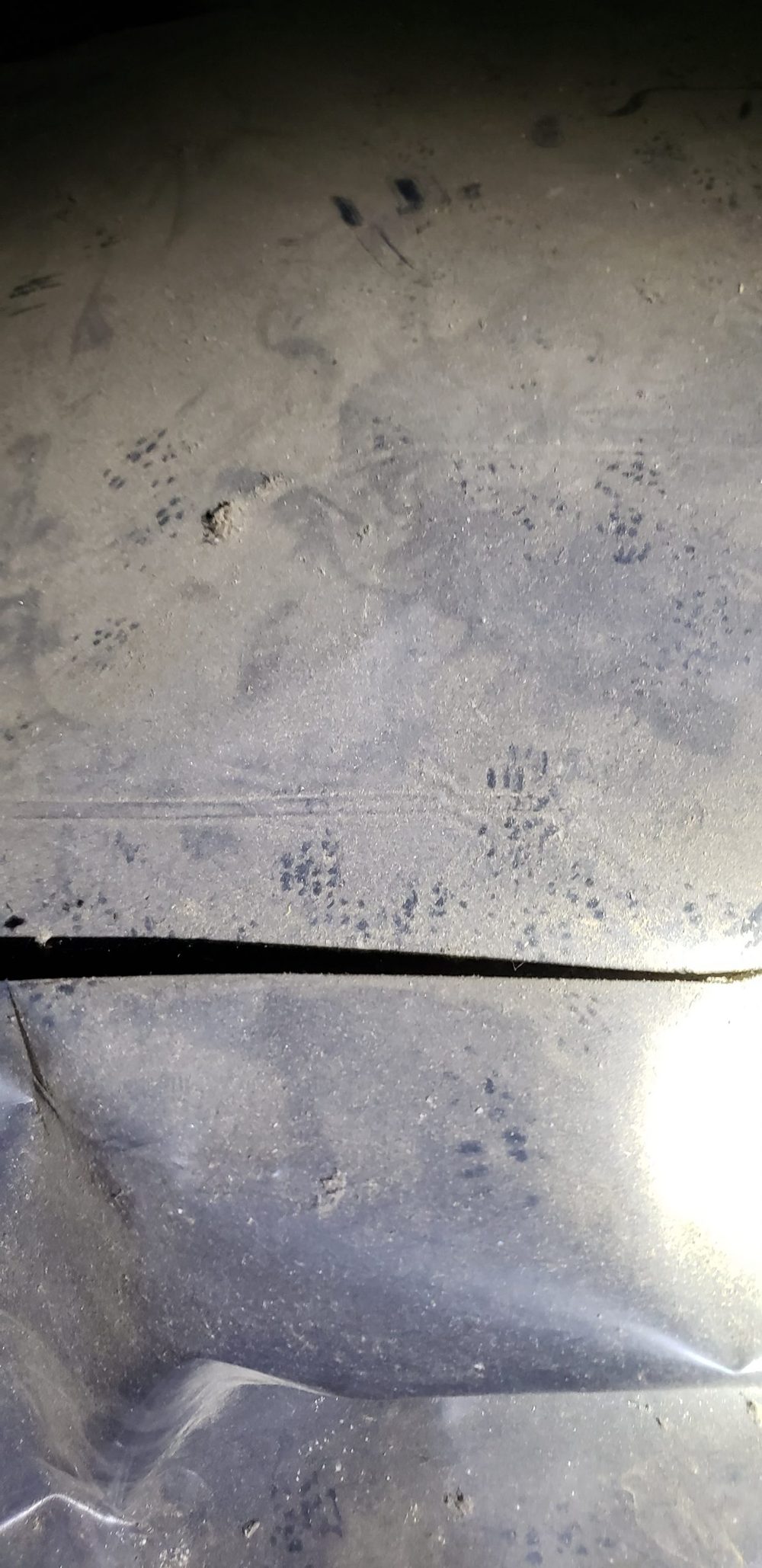
They establish runs — consistent routes worn along the same lines, typically following the edges of the space, the tops of foundation walls, the ducting and the perimeter rather than crossing open ground. Those runs are visible as smear marks on timber and concrete, as flattened tracks in the dust on a vapor barrier, and as concentrations of droppings.
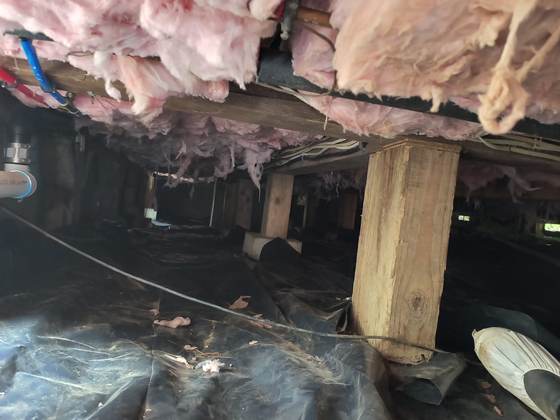
They nest in the insulation, pulling it down out of the joist bays to build with and leaving the bays bare. A crawlspace with insulation hanging in swathes and piled in corners is not a fitting failure, whatever anyone has told you.
They gnaw, because they must. Timber, plastic pipe, cable sheathing, the vapor barrier itself, and occasionally ducting all get worked on. The wiring is the one that matters most and it is the one nobody sees.
And they move upward wherever the floor structure allows. Every pipe and cable that passes through a bottom plate is a potential route into a wall, which is why a crawlspace problem so often becomes a kitchen problem a few weeks later.
How they got in
There is nearly always a specific answer, and in this county it is usually one of five.
Vent screens. The most common by a distance. Older crawl vents were screened in materials that corrode, and yard equipment, pressure washing and general age finish the job. A rusted-through vent is not a small defect — it is an opening sized for the animal.
The crawl access hatch. Frequently a sheet of plywood or a light door that has been removed and replaced repeatedly for utility work and no longer sits tight. Sometimes it is simply missing.
Foundation penetrations. Water supply, waste, gas, electrical, cable and heat pump lines all pass through the wall somewhere, and the great majority were sealed to keep weather out rather than animals.
Burrowing under the foundation line. Where a foundation is shallow, where a slab-on-grade addition meets an older wall, or where landscaping has built the grade up against a building, a Norway rat is entirely capable of digging its own entrance.
Deck and porch skirting. Structures built against a house create a protected void that connects to the crawl area, and skirting is very often decorative rather than sealed.
We look at all five on every visit, because a building usually has more than one and closing four of them is not a resolution.
What is outside feeding it
A crawlspace population is supported by something above ground, and it is worth being blunt about the usual suspects.
Bird feeders, which spill seed continuously. Pet food left out or stored in permeable packaging in a garage. Compost that is open rather than contained. Fallen fruit under an unpicked tree. Bins with hardened or missing lids. Chicken feed, which in this county is a very frequent contributor. Stored material — timber, pallets, tarps, unused equipment — sitting directly on the ground within a short run of the building.
None of these cause a rat problem on their own. All of them make a marginal property attractive, and dealing with them is the cheapest part of the whole exercise.
Telling rats from mice under a floor
The two need different responses, and the crawlspace usually makes the answer obvious once you know what to look at.
Droppings. Mouse droppings are small, roughly the size of a grain of rice, pointed at the ends and produced in very large numbers. Rat droppings are substantially bigger — around half an inch or more — with blunter ends, and appear in smaller numbers because there are fewer animals producing them.
Runs. Rats leave heavy, obvious sign: greasy smear marks where they pass repeatedly against timber and concrete, worn tracks in dust, and clear consistent routes. Mice are light enough that their traces are subtle and often only visible in a dusty vapor barrier.
Gnaw damage. Rat gnawing is coarse, with visible individual tooth marks and real material removal. Mouse gnawing is fine and shallow.
Openings used. A mouse gets through a quarter-inch gap. UC IPM puts a rat at slightly more than half an inch to pass through, though state wildlife guidance is clear that a quarter inch is enough for one to gnaw an opening up to size, and a rat is far more capable of enlarging what it finds. So the size of the holes narrows the diagnosis without settling it: if quarter- inch gaps are the only defect on an otherwise tight building, mice are the more likely answer, but the sealing standard stays the same either way.
Nesting. Mice make discrete nests, roughly fist-sized, tucked into a protected spot. Rats work at a different scale, pulling insulation down across several joist bays.
It matters because the trap types differ, the number of traps differs enormously, and the exclusion specification differs. Treating a mouse problem like a rat problem leaves gaps open. Treating a rat problem like a mouse problem leaves you badly under-trapped.
What it does to the rest of the house
People are usually more concerned about the crawlspace than about the building above it, and it is worth reversing that emphasis for a moment.
Wiring. Cable sheathing is a material rodents work on, and a crawlspace is full of it — power runs, low-voltage cable, thermostat wiring, sometimes communications. This is the damage that carries real consequence and it is entirely invisible from inside the house.
Ducting. Flexible duct is easily breached. A hole in a supply run means you are heating the crawlspace, and it also means air that has passed through a contaminated space can reach living areas.
Plumbing. PEX and other plastic supply lines are chewable. A pinhole in a supply line under a floor can run for a long time before anybody notices, producing a wet crawl area and a substantial bill.
Insulation performance. Batts pulled down from joist bays are not insulating anything. A crawlspace that has been worked over for a couple of winters is measurably more expensive to heat above.
The upward routes. Every penetration through the bottom plate connects the crawl area to a wall cavity, and every wall cavity connects to somewhere you live. A crawlspace population that has been there a while very often produces a kitchen sighting eventually, and by then two problems need solving.
Coops, feed and the neighboring-property problem
Two things come up so often on properties in this county that they deserve their own note.
Backyard poultry is common here and it is one of the most reliable rat attractants there is — not the birds themselves but the feed, which is high value, often available continuously, and frequently stored in bags rather than metal. Almost every rural and semi-rural rat job we do has a feed component. The fixes are practical: feed in metal containers with fitted lids, feeders lifted and emptied at night rather than left full, spillage cleaned rather than allowed to accumulate, and coop floors and skirting closed properly. You do not have to give up the chickens. You do have to stop feeding everything else.
The second is that rats do not respect property lines. On smaller lots, particularly in older parts of Bellingham and Ferndale, a population is often supported by something two doors down — a neglected outbuilding, an unmanaged compost heap, a vacant property, a feed source nobody has connected to the problem. We can close your building completely, and we will, but where the pressure is coming from next door the honest framing is that we are keeping animals out rather than removing them from the area. Where a neighbor is willing to have a conversation, that conversation is worth more than another visit from us.
The cleanup question, answered honestly
This is where the industry has a reputation problem, so we will be direct about where the line sits.
Full crawlspace restoration — removing all insulation, replacing the vapor barrier, sanitizing the space and reinsulating — is a genuinely large piece of work. It is sometimes exactly right. It is also the single easiest thing to oversell to somebody who has just been told there are rats under their bedroom.
Our position is that restoration is warranted when the contamination is widespread rather than localized: insulation pulled down across a large proportion of the joist bays, nesting material distributed through the space, saturation rather than scattered droppings, a vapor barrier that has been extensively burrowed under and torn, and an odor that persists after the animals are gone.
It is not warranted for a modest number of droppings on otherwise sound material in a space that is dry, and we will tell you that even standing in a crawlspace that has just given somebody a fright.
Where the honest answer sits in between, we say so and let you decide. Sometimes the right call is to remove and replace the worst two or three bays, clean up the rest, and reassess in a year.
Doing it in the right order
The sequence is not arbitrary and getting it wrong costs money.
Trapping first, or at least alongside. Snap traps set on the actual runs and at the actual entry points, in numbers, checked and repositioned. Rats are neophobic: they notice new objects in a familiar space and avoid them, sometimes for several days. Placement, patience and enough traps are what make this work. We do not use bait inside a building envelope, because a rat that dies in a floor structure is a problem we then have to solve twice.
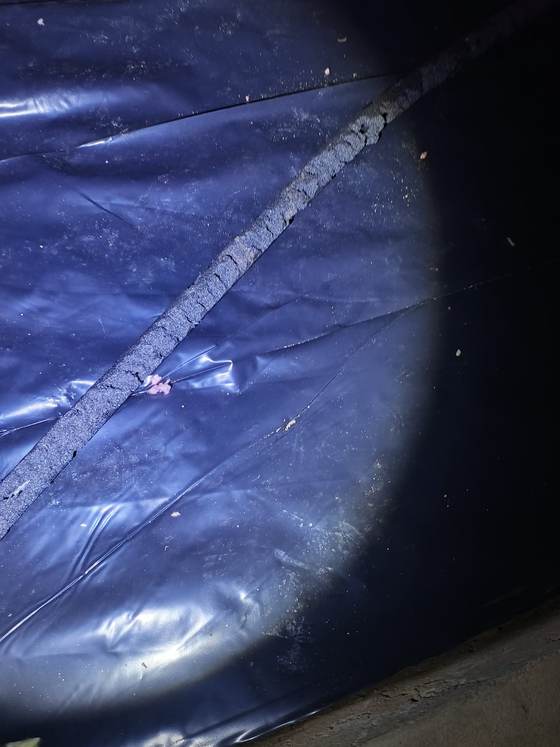
One practical wrinkle that catches people out: where a vapor barrier is in place, rats frequently travel underneath it rather than on top, and a trap set on the plastic sits above a runway it never touches. The tell is a raised, meandering ridge in the sheeting. We cut in, set below, and patch the barrier afterward.
Sealing second, once we know activity is down. Metal mesh and sheet material, mortar where appropriate, new vent covers in a specification that lasts, a properly fitted crawl hatch, penetrations closed with something a rodent cannot chew. Expanding foam alone is not a seal and anybody using it as one is buying themselves a return visit.
Restoration last, if it is needed at all. There is no sense in installing new insulation while an unresolved population is living under the floor, and no sense in doing it before the building is closed. Where the work is needed, doing it last means doing it once.
Moisture, which is usually part of the story
A crawlspace with a rat problem very often has a water problem too, and the two reinforce each other.
Damp ground supports the insects that other things eat. Damp insulation loses its function and becomes more attractive as nesting material rather than less. A wet space corrodes vent screens faster. And moisture in a crawlspace produces its own separate list of problems — moisture ants, springtails, sowbugs and decay in the framing, which in this climate takes structural capacity faster than rodents do.
So a fair proportion of what we recommend under a house is not pest work at all. Getting roof water discharged well away from the building. Correcting grade that falls toward the foundation. Clearing vents that landscaping has buried. Repairing a vapor barrier that is in pieces. Fixing the slow supply leak that has kept one corner wet for three years.
We say it knowing it is not work we bill for, because a dry crawlspace is harder to live in for everything we have just been discussing.
Safety if you are going down yourself
Plenty of people want to look before they call, which is reasonable. A few points worth having first.
The main concern with rodent droppings and nesting material is airborne particulate from dry material, and the local species that matters for that is the deer mouse rather than the rat. Either way the handling is the same: ventilate the space before you go in, do not sweep or dry-vacuum, wet material down with a disinfectant solution before disturbing it, use a fitted respirator rather than a paper mask, wear gloves, and bag material rather than piling it.
Beyond that, crawlspaces have their own hazards that have nothing to do with animals — protruding fasteners, exposed wiring, standing water near electrical work, low headroom and no easy exit. If any of that describes yours, it is a reasonable moment to let somebody else do it.
What it takes and how long
For a typical single-family house here with an established but not extreme crawlspace population, the shape of it is a few weeks: trapping running while the exterior gets closed, activity dropping through the second and third week, then a check to confirm.
Buildings that take longer are the ones with structural complications — a crawl that cannot be fully accessed, a foundation that a rat is genuinely burrowing under, several connected structures, or a neighboring property that is supplying animals faster than we can exclude them.
We would rather set that expectation at the beginning than let you believe a single visit ends it. It occasionally does. More often it does not, and a company that pretends otherwise is one you will be calling again.
Where to start
Tell us what you have noticed and roughly where, and we will come and look properly — the length of the crawlspace with a light, not a glance through the hatch, plus the full exterior at ground level.
You get a straight account of what is down there, how it got in, what needs closing, whether the insulation genuinely needs to come out or does not, and what each part costs. Rodent assessment is free, there is no term agreement, and if the answer is that your crawlspace needs a drainage contractor more than it needs us, that is what we will say.
Frequently asked questions
How do rats get into a crawlspace in the first place?
Most often through a failed vent screen, a crawl hatch that does not close properly, or a gap where a pipe or cable passes through the foundation. Norway rats will also burrow along a foundation and come up where the concrete ends.
Do I have to replace the insulation?
Not always, and we will not pretend otherwise to sell the work. Scattered droppings on an otherwise sound batt do not justify a full replacement. Widespread nesting, saturation with urine or material pulled down across the floor does.
Is it dangerous to go under there myself?
There is some real risk and it is manageable. Do not disturb dry droppings or nesting material, ventilate the space first, wet material down rather than sweeping it, and wear a proper respirator rather than a dust mask. Otherwise leave it.
Why not just put bait under the house?
Because you lose control of where the animal dies and you learn nothing about the size of the problem. We trap under buildings so that the rats come out, get counted and get removed rather than decomposing in your floor structure.
How long before it is actually over?
Usually two to four weeks for the trapping, because rats are cautious about anything new in their space. The sealing happens alongside it. Restoration, where it is needed, comes last so the work is not done twice.
Will they come back next winter?
Only if the way in is still open. That is why we treat the sealing as the job and the trapping as the part that makes the sealing safe to do. A crawlspace closed properly stays closed.
What do you charge to come and look?
Nothing. Rodent assessment is free and it includes going the length of the crawlspace rather than shining a light through the hatch, which is the only way to know what is actually happening down there.
Guides
Rodent & Mouse Control in Whatcom County?
Family-owned, no long-term contracts, and every treatment is backed by our 100% Service Guarantee.
Most calls in Whatcom County are out within 1–2 days, about 3 during the late-summer peak.
Last updated