
Rodents in the Attic Insulation
Insulation is the best nesting material most buildings contain, which is why attic rodent activity concentrates in it. The damage is to thermal performance as much as to hygiene, and the decision that matters is whether the material can be cleaned or has to come out.
Call 360-410-2199 Request a free inspection
What to do, in order
- Note when the noise happens: overhead after dark points to rodents, while daytime activity suggests a squirrel, bat or bird, which we do not handle
- From outside, look along the roofline for soffit and fascia gaps, open rafter tails, damaged gable vent screens and branches touching the roof
- Before going up, ventilate the attic, wet droppings and nesting down with disinfectant, and wear a fitted respirator and gloves
- Do not blow new insulation over the old; covering contaminated material keeps the odor and sets up a second job
- Book the free attic assessment, which covers the roofline and the connected voids, including the crawlspace below
- Work in order: trap the animals out, close the roofline and cut back branches, then decide whether the insulation stays or goes
- Once it is resolved, move anything you care about out of cardboard and into rigid sealed containers
Why the insulation is the target
An attic is not inherently attractive to a rodent. It is hot in summer, cold in winter, exposed, and a long way from food.
What makes it worth the climb is the insulation. Fiberglass batts and blown-in material are, from an animal’s point of view, an unusually good building resource: soft, dry, endlessly available, easy to shape, and warm once it is packed around a nest. A roof space with a foot of loose-fill in it is a warehouse full of bedding.
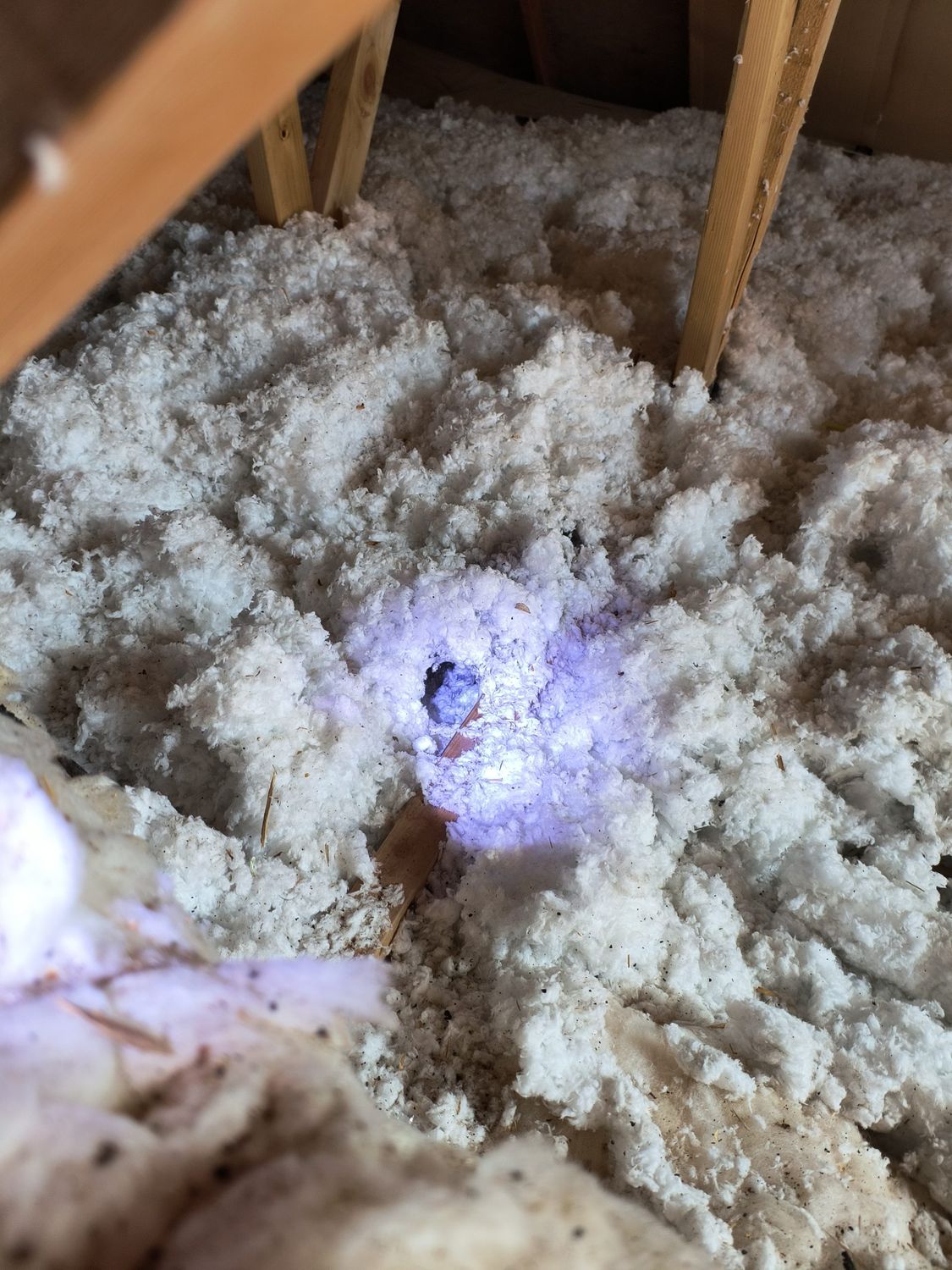
So attic rodent activity is nearly always insulation activity. The animals are not simply passing over the material — they are living in it, tunnelling through it, dragging it into heaps and compressing it flat along the routes they use most.
That is why an attic job is different from a crawlspace job or a kitchen job. The question is not only how to remove the animals and close the building. It is what condition the insulation is in afterwards, and whether it can stay.
What it costs you in heat
This is the part that rarely gets explained properly, and it is usually the larger number.
Insulation does not work because of what it is made of. It works because it traps still air in a large volume of low-density material. Anything that reduces that volume reduces the performance almost proportionally.
Rodents reduce it three ways. They compress it, flattening runs through loose-fill and matting batts down along the routes they travel. They remove it, pulling material out of place to build nests, which leaves bays partly or entirely bare. And they wet it, because urine saturates and the material then settles and stays settled.
The visual from a hatch is misleading here. An attic can look more or less insulated while a substantial share of its effective value has gone, because compression is not obvious from a distance and bare joist bays are hidden behind the ones nearer the opening.
For a house in this climate, where the heating season is long and mild rather than short and severe, degraded attic insulation is a steady cost that runs for as long as it goes unaddressed. That is worth weighing against the price of putting it right, and it frequently changes the answer.
What is up there
The realistic list for a Whatcom County attic is shorter than people fear, and it includes one thing we do not handle.
Roof rats. Confident climbers and the species most associated with upper structures. They will use branches, downspouts, cable runs, rough siding and trellis to reach a roof, and they enter at the line where the roof meets the wall. In an attic they are active mainly after dark.
Norway rats. Less common overhead but entirely capable of it, particularly in buildings where an interior wall cavity gives them a route up from the crawlspace without ever going outside.
House mice. Common, and easily overlooked because they are quiet. Mouse activity in an attic often shows as scattered droppings and fist-sized nests tucked into corners and along the top plates rather than as obvious damage.
Deer mice. More likely where a property adjoins woodland or open ground, and more seasonal. They are the species that makes careful handling of dry nesting material worthwhile, and we treat all attic material to that standard rather than trying to tell them apart by eye. The reason is hantavirus, which the Washington State Department of Health links to the deer mouse here and to breathing dust stirred up out of an enclosed space.
Something else entirely. Attics are also where squirrels, bats and birds end up, and all three are outside what we do. If that is what you have, we will say so, at no charge, and point you toward somebody properly equipped rather than taking a job we should not take. Daytime activity overhead is the usual tell, and it is worth mentioning on the phone before anybody drives out.
How they get to the roof
Attic entry is a roofline problem, and it comes down to a familiar set of defects.
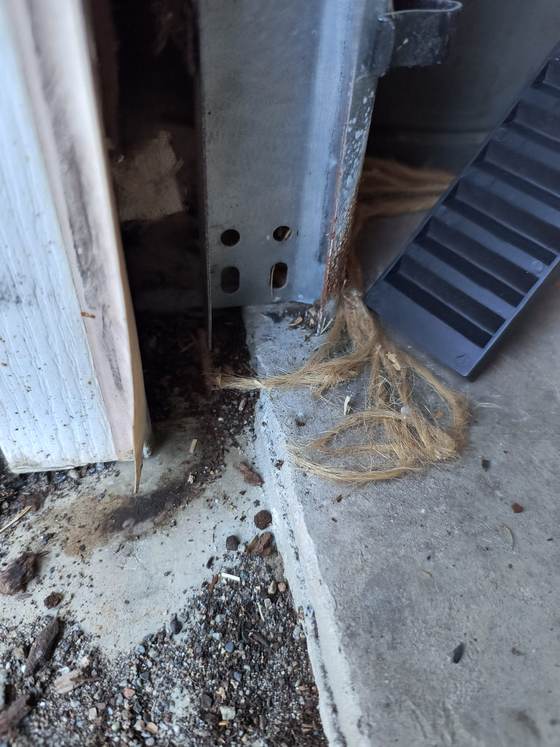
Soffit and fascia junctions. The single most common. Where the soffit meets the fascia board, or where it returns at a corner, there is very often a gap that has been there since construction and that nobody has ever been in a position to see.
Open rafter tails. On older construction the space between rafters at the wall top is sometimes simply open, or blocked with material that has since failed.
Gable and roof vents. Louvred gable vents with damaged or missing screens are effectively doors. So are turbine and box vents where the flashing has lifted.
Roof-to-wall junctions. Where a lower roof — a porch, a garage, an addition — runs into an upper wall, the detail is complicated and frequently imperfect. An animal on the lower roof is already halfway there.
Vegetation. Branches touching or overhanging a roof are a bridge, and so is ivy or dense climbing growth on a wall. Cutting back to a clear gap is often the cheapest single measure available.
Utility penetrations at height. Service entries, satellite and cable brackets, plumbing vents and heat pump line sets all pass through the envelope somewhere, and sealing at height is done to a poorer standard than sealing at ground level in most buildings.
When the insulation has to come out
We want to be plain about this, because attic insulation replacement is one of the easiest things in this trade to oversell.
It should come out when the material is matted or compressed across a meaningful area rather than in one spot; when nesting material and waste are distributed through it rather than confined; when there is urine saturation, which you can generally smell before you can see it; when the material has been extensively tunnelled so its structure is gone; or when odor persists in the living space below and the attic is the source.
It generally does not need to come out when the activity was brief and recent; when droppings are scattered on material that is otherwise intact, lofted and dry; when the affected area is small enough to deal with in isolation; or when what you have is old, historic sign from a problem that has already ended.
The in-between case is real and common. Frequently the right answer is to remove and replace the worst areas, clean and treat the remainder, close the building properly, and look again in a year. That is a smaller job than a full cleanout and in a lot of houses it is the honest recommendation.
Where removal is warranted, it is worth doing properly: material out, waste and nesting removed, surfaces treated, the space allowed to dry, and only then reinsulated to a specified depth. Blowing new material on top of contaminated insulation is a shortcut that buys you the same job again later with the odor still in it, and we will not do it that way.
The order the work goes in
Animals out first. Trapping in the attic and in the connected voids, on the runs and at the entry points, in numbers, checked and adjusted. We do not use bait inside the envelope: an animal that dies in a soffit or a wall top is a second problem, and one that is genuinely difficult to reach in a roof.
Building closed second. Roofline sealing in materials that hold — metal mesh behind vents, sheet metal at soffit and fascia gaps, proper vent covers, blocking at rafter tails — plus the vegetation cut back. Working at height is most of what makes attic exclusion a different job from crawlspace exclusion, and it is not a place for expanding foam.
Insulation last. Removal, cleaning and replacement once nothing is living up there and nothing can get back in. Doing it in any other order means doing it twice.
The ceiling plane, which almost nobody seals
There is a second boundary in this job that gets far less attention than the roofline, and in an occupied house it matters just as much.
The ceiling below an attic is full of holes. Recessed light housings. Bathroom and kitchen extract fans. The attic hatch itself, which in most houses is a sheet of board resting in a rebate. Plumbing vent stacks passing through. Electrical boxes. The gap at the top of an interior wall where the drywall stops short of the top plate. Chimney and flue chases, which are frequently open the full height of the building.
Individually these are small. Collectively they are why an attic problem becomes a living-space problem: odor comes down through them, insects that have been breeding in nesting material come down through them, and in some houses the animals themselves come down through them into a wall or a ceiling void over a bedroom.
Sealing the ceiling plane is not glamorous and it is not usually what somebody calls about, but it is worth doing at the same time as the insulation work because the attic is already open and the material is already out. It also pays for itself independently of the pest question — air leakage through those same penetrations is one of the larger heat losses in a typical house here, and warm moist air pushed into a cold roof space is where a good deal of attic condensation comes from in the first place.
Damp attics make everything worse
A wet roof space is a worse pest problem than a dry one, and in this climate wet roof spaces are not rare.
Insulation that has taken on moisture settles, loses loft and stops performing. It also becomes more attractive as nesting material rather than less, because damp fiberglass packs and holds shape. Timber that stays damp supports mold and eventually decay, which in a roof structure is a considerably more expensive problem than any animal.
The usual causes are mundane. Bathroom and kitchen fans that discharge into the attic rather than through the roof or the wall — genuinely common, and something we find on a meaningful share of the buildings we look at. Blocked or insufficient soffit and ridge ventilation, sometimes blocked by insulation installed carelessly against the eaves. Air leakage from below, as above. A minor roof or flashing defect that has never been traced.
So part of an honest attic assessment is not about pests at all. If your fan discharges into the roof space we will tell you, because putting new insulation into a wet attic is money spent on something that will fail again.
What we will not sell you
A full insulation replacement for scattered droppings. If the material is dry, lofted and structurally intact, cleaning the affected area is the proportionate response. We would rather do the smaller job and keep the relationship.
New insulation blown over contaminated material. It hides the problem, keeps the odor and guarantees a bigger job later.
A wildlife job. If what is in your roof has fur beyond a rodent’s, or wings, we are not the right company. That answer costs you nothing and it is the one you will get.
A quarterly plan instead of closing the roofline. Recurring service does not address an open soffit. Anybody proposing it as though it did is selling subscription rather than resolution.
Insulation work before the building is closed. New material installed while the entry is still open is a donation to next winter’s population.
Timing, and the case for doing it in summer
Attic rodent activity in this county follows the same seasonal curve as everything else — pressure rises from late September, peaks through the autumn and stays elevated into the new year. Most calls come when the noise starts, which is to say once the animals are already in.
There is a reasonable argument for doing the roofline work in July or August instead. The weather is workable, the attic is accessible, the population is not yet pushing in, and the sealing is being done to an empty space rather than around a live problem. Insulation work in particular is far easier in a dry season.
Almost nobody does this, because in August nothing is wrong. It is still the cheaper version of the same project, and if you have had an attic problem once, the summer after is the time to make sure it does not happen twice.
There is also a practical scheduling point. Attic and roofline work is weather-dependent in a way that crawlspace work is not, and in a Whatcom County November the number of days suitable for working at height is limited. A job booked in the autumn frequently waits on the weather.
Signs from below
Most people never go into their attic, so the evidence usually arrives indirectly.
Noise overhead in the evening and before dawn, particularly directly above a bedroom ceiling. Sound that moves along the ceiling line is an animal on a run.
A stain appearing on a ceiling with no plumbing above it and no roof leak, which is occasionally urine saturation working through.
An odor that develops slowly in an upstairs room, strongest near a ceiling light, an attic hatch or a bathroom fan — all of which are unsealed penetrations into the roof space.
Droppings appearing on top of stored boxes in a loft, or around the hatch when it is opened.
Heating bills that have drifted upward without an obvious explanation, in a house where nothing else changed.
And insects: an established rodent presence supports flies and beetles that feed on waste and nesting material, and a sudden appearance of either in an upstairs room sometimes points upward.
What stored belongings tell you
Most attics double as storage, and the boxes are often better evidence than the insulation.
Cardboard is nesting material as much as insulation is, and a rodent will work into a box far enough to shred the contents without doing much to the outside. Clothing, linen, camping gear, upholstered items and anything with padding are all targets. Paper records, photographs and books get chewed for material rather than eaten.
Look for shredded edges, small heaps of fibrous debris beside a box, gnawed corners at the base where a box meets the deck, and droppings sitting on the tops of boxes along a route. Plastic tote lids get gnawed at the rim, which is a useful sign because it tells you the animal is a rat rather than a mouse.
The lesson people usually take from this is worth stating: after an attic problem is resolved, move anything you care about out of cardboard and into rigid sealed containers. It removes a resource, it makes future evidence easier to read, and it saves the contents.
Safety, briefly
If you are going up to look, the standard precautions matter more in an attic than almost anywhere else, because the material is dry and the space is unventilated.
Ventilate before you go in. Do not sweep, brush or dry-vacuum nesting material or droppings. Wet material down with a disinfectant solution and let it sit before disturbing it. Use a fitted respirator rather than a dust mask. Wear gloves, bag material rather than piling it, and wash afterwards.
Beyond the animals, attics have their own hazards — walking surfaces that are not walking surfaces, exposed wiring, low clearances, and nails through the roof deck at head height. Plenty of people are entirely capable of doing this themselves. Plenty of others should not.
What you get from us
We will look at the attic properly rather than from the hatch where it is safe to do so, walk the roofline from outside, and check the connected voids and the crawlspace, because a surprising proportion of attic activity arrives from below through an interior wall rather than over the roof.
You get a direct account: what is up there, whether it is even ours to handle, where it is getting in, what the roofline needs, and an honest answer on the insulation — including the answer that it can stay, when that is the truth.
Assessment is free, there is no term agreement, and where the right recommendation is a roofer, an arborist or an insulation contractor rather than a pest control company, we will tell you that too.
Frequently asked questions
How do rodents get into an attic at all?
Usually at the roofline rather than the ground. Gaps where the soffit meets the fascia, open rafter tails, unscreened gable and roof vents, the junction where an addition's roof meets a wall, and branches that let a climber reach the roof directly.
Does the insulation really need replacing?
Sometimes. Compressed, matted, tunnelled or urine-saturated material has lost most of its function and should come out. Scattered droppings on batts that are otherwise intact and lofted usually do not justify a full replacement, and we will say so.
How much heat am I actually losing?
More than people expect. Insulation works by trapping air, so material that has been compressed into runs and pulled into nests can lose a large share of its rated value in the affected areas even though it still looks like insulation from the hatch.
What if it turns out to be a squirrel or a bat?
Then it is not our job and we will tell you plainly rather than sell you a rodent program. We handle insects and rodents. For anything else we will say what we think you have and point you to somebody equipped for it.
Can you just blow new insulation over the top?
Not over contaminated material, no. Covering nesting material and waste traps the problem under a new layer and leaves the odor, which is a route into a second job later. If it needs removing, it needs removing first.
Is the smell going to go away?
Once the animals, the nesting material and the saturated insulation are out, and the surfaces have been treated, yes. Odor that persists after a proper cleanout usually means something was left behind, most often inside a soffit or a wall top.
What does it cost to have it assessed?
Nothing. We will look at the attic, the roofline and the connected voids at no charge, and give you a plain account of what needs doing including whether the insulation can honestly be left alone.
Rodent & Mouse Control in Whatcom County?
Family-owned, no long-term contracts, and every treatment is backed by our 100% Service Guarantee.
Most calls in Whatcom County are out within 1–2 days, about 3 during the late-summer peak.
Last updated