
Droppings in the Kitchen
Droppings in a kitchen mean an animal is feeding there, not merely passing through. Their size, freshness and distribution tell you what it is and how long it has been going on, and the response is cleanup, trapping and closing the route it used.
Call 360-410-2199 Request a free inspection
What to do, in order
- Leave a representative patch of droppings undisturbed if you can, and note their size, freshness and where in the kitchen they sit
- Do not sweep or vacuum dry droppings: ventilate the room, spray them with disinfectant, let it soak, then pick up with disposable towels
- Throw out food in cardboard, paper or thin film from the affected cupboard and anything gnawed; wash the outside of glass, metal and rigid containers
- Move dry goods into rigid containers with proper lids so the kitchen stops feeding anything
- Pull out a bottom drawer and shine a light at the back of the cabinet for gaps around the pipes and lines
- If you trap yourself, set several snap traps tight to the walls on the runs the droppings show; skip glue boards and bait stations in a kitchen
- Then have the building looked at rather than the room: our free rodent visit covers the connected voids, the crawlspace and the exterior
What you have actually found
Opening a drawer or pulling out a toe-kick panel and finding a scatter of small dark pellets is a specific kind of unpleasant, and the first reaction is usually to clean it up immediately and think about it afterwards.
That is understandable, and it is worth taking two minutes first, because what is in front of you is the most useful evidence you are going to get. Once it is wiped away, the questions we would ask — how much, how fresh, where exactly — become guesswork.
The important thing to understand is what droppings in a kitchen mean as distinct from droppings anywhere else. A rodent leaves droppings continuously as it moves, so finding them in a garage or a crawlspace tells you an animal passed through. Finding a concentration of them in a food storage area tells you something is spending time there, and something spends time where it is being fed.
Reading the size
The species question is answered almost entirely by size, and it matters because the response differs.
House mouse. Around a quarter of an inch, roughly the shape of a grain of rice, tapered at both ends. Produced in genuinely large numbers — a single mouse leaves dozens in a day — and scattered rather than deposited in one place. This is by a wide margin the most common finding in a kitchen.
Deer mouse. Similar in size to a house mouse and difficult to separate on the droppings alone. Context helps: deer mice are more likely where a property adjoins woodland, open ground or a greenbelt, and they are more strongly seasonal. Their droppings and nesting material warrant more careful handling, which we come to below.
Rat. Half an inch to three quarters, distinctly thicker, with blunter or rounded ends rather than sharp points. Fewer of them, because rats are larger animals in smaller numbers. Norway rat droppings tend to be more capsule-shaped; roof rat droppings are somewhat more slender and curved. Either way, if what you are looking at is obviously larger than a grain of rice, the job changes.
Not a rodent at all. Cockroach droppings are much smaller, closer to coarse ground pepper or coffee, and often accompanied by dark smearing. Bat guano crumbles to a glittery dust because it is largely insect fragments, but that is an attic finding rather than a kitchen one and it is outside what we handle. The size test resolves nearly every case.
Reading the age
Freshness tells you whether this is happening now or happened once.
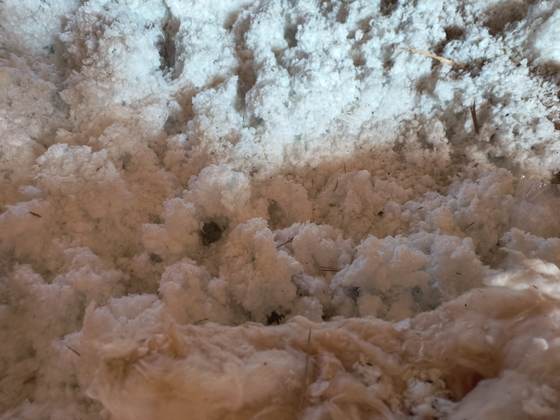
Fresh droppings are dark — near black in most species — soft, and have a faint sheen. Within roughly two to three days they lose the shine, lighten toward gray or brown, and harden.
Old droppings are dull, dry, and crumble to dust under light pressure. Use a disposable implement rather than a finger.
What you usually find is a mixture, and a mixture is the most common and least welcome answer: it means activity has been going on for a while and is still going on now.
If everything is uniformly old and dry, there is a reasonable chance you are looking at a historic problem — a previous occupant’s, or one that resolved when something else changed. That still deserves a look at the building, because the opening that let them in is almost certainly still there.
Reading the pattern
Where they are is as informative as what they are.
Concentrated in one place. A resting or feeding spot rather than a route. Look for what is being eaten within a couple of feet of it.
A line along the back of a cupboard or a run of countertop. A route. Rodents travel with a body part in contact with a vertical surface where they can — it is a security behavior — so droppings along the back edge of a shelf or the base of a wall map their movement rather than their destination.
Inside a drawer or a sealed-looking cupboard. More significant than it sounds, because it means the cabinet interiors are connected to somewhere else. Cabinet runs are almost never sealed at the back or underneath, and the void beneath a toe-kick frequently opens into the floor structure.
Under or behind appliances. The most productive place to look and the one people check last. The warmth behind a refrigerator, the void under a dishwasher, the gap beside a range and the space beneath a built-in oven are all sheltered, warm, and near food.
On the countertop. Worth acting on quickly, for obvious reasons around food preparation surfaces.
Cleaning up without making it worse
This part has a right and a wrong method, and the wrong method is the intuitive one.
Do not sweep and do not vacuum dry droppings or nesting material. Both actions put fine particulate into the air in a small enclosed room, and that is the route by which the small health risks associated with rodent waste actually reach people. Washington’s Department of Health makes that point directly in its hantavirus guidance: the hazard is in the dust raised from droppings, urine and nesting material rather than in the droppings themselves. In this region the species of note for that is the deer mouse, and because you cannot reliably tell a deer mouse dropping from a house mouse dropping by eye, the sensible course is to handle all of it the same way.
The method that is actually recommended is simple. Open a window and ventilate the space for a while before starting. Put on disposable gloves. Spray the droppings and the surrounding area thoroughly with a disinfectant or a dilute bleach solution and leave it to soak for several minutes rather than wiping immediately. Pick everything up with disposable paper towels. Bag the towels and the gloves, seal the bag, and put it in an outside bin. Disinfect the surface again afterwards, and wash your hands properly even though you wore gloves.
For a larger accumulation, or for nesting material in an enclosed space, a fitted respirator is a reasonable precaution rather than an overreaction. A paper dust mask is not the same thing.
The food question
The instinct to throw everything out is understandable and usually excessive.
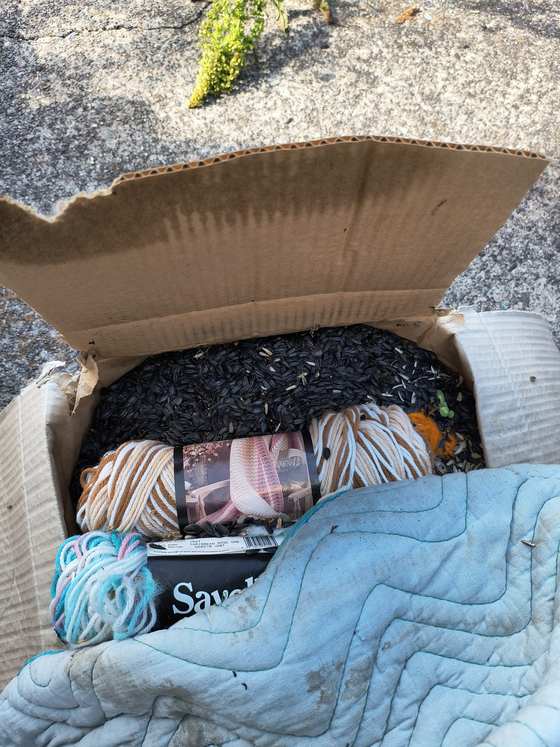
Discard anything in cardboard, paper, a paper sack or thin film packaging that is stored in the affected area, and anything showing gnawing or gnawed packaging, regardless of where it is. Rodents chew into boxes and bags routinely and the damage is often small enough to miss.
Keep anything in glass, metal, or rigid sealed plastic, once the outside of the container has been washed. Tinned goods are fine. Sealed jars are fine.
Wash any dishes, utensils or cookware that were stored in an affected cupboard.
And afterwards, move dry goods into rigid containers with proper lids. This is the single most effective thing a household can do to make a kitchen uninteresting, and it is worth doing whether or not you ever see another dropping.
Where they are coming from
Here is the part that decides whether this recurs.
Rodents do not begin in a kitchen. They arrive there from somewhere else in the building, and they got into the building through an opening in its shell.
The chain usually runs from an exterior defect into an unfinished space — the crawlspace, the garage, a wall cavity, an attic — and then into the kitchen through a service penetration. Kitchens are riddled with those: the hole cut for a water supply under the sink, the waste line, the gas line behind a range, the electrical feed for a dishwasher or disposal, the refrigerator water line, and the gaps around all of them where a cabinet meets the floor and the wall.
Pull out a bottom drawer and look at the back of the cabinet with a flashlight and you will very often find the answer sitting in plain sight — a half-inch gap around a copper pipe that has been there since the house was built.
That is why we spend most of a rodent visit somewhere other than the room where the droppings are. Cleaning the kitchen and setting traps in the kitchen deals with what you can see. Closing the exterior opening and the interior penetration is what stops it happening again next October.
What we do about it
The work has a fixed shape.
We find the interior connection points first, which means looking under and behind the cabinet run, at the toe-kick voids, at every service penetration, and at how the kitchen connects to whatever unfinished space lies beneath or beside it.
We work the exterior systematically for the way into the building: crawl vents and their screens, the crawl access, foundation penetrations, grade and where soil meets siding, the garage door seal, the junction where an addition meets the original structure, and the roofline where a climber would work.
We trap rather than bait inside the building envelope. Traps go on the runs and in the voids, correctly oriented, in sufficient numbers, and get checked and adjusted rather than left. Placement is most of the skill in this. A trap in the middle of a floor catches nothing; a trap set tight to a wall on an active run catches on the first night.
We seal in materials that hold. Metal mesh, sheet metal, mortar and proper vent covers, cut and fitted rather than stuffed. Expanding foam by itself is not exclusion and a rodent will be through it before the month is out.
And we tell you what we found, in plain terms, including the parts that are not our work — the drainage issue, the failed door seal, the neighbor’s feed store.
Things people try first, and how they go
Almost everybody does something before they call, and it is worth saying which of those things help.
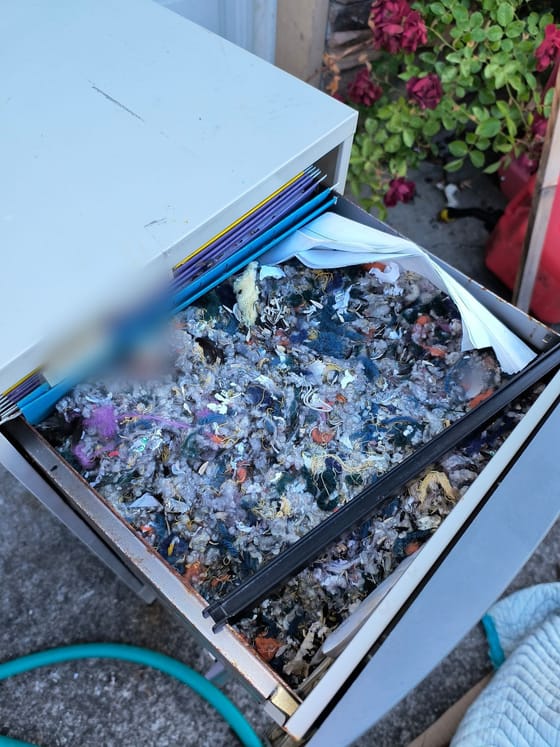
Snap traps from the hardware store. These work, and they are what we use. What people get wrong is the number and the position. One trap in the middle of a cupboard floor will sit untouched for a fortnight. Six traps set tight against walls, on the runs the droppings have already mapped for you, with the trigger end toward the wall, will produce results in a night or two. If you are going to try this yourself, buy more than you think you need and put them where the evidence is rather than where it is convenient.
Glue boards. We do not use them and we would suggest you do not either. They catch non-target animals, they are slow, and they leave you dealing with a live and distressed animal in a way most people find genuinely upsetting.
Bait stations indoors. Please avoid this in a kitchen. An animal that takes bait will die somewhere it feels safe, which will be inside a floor, a wall or a cabinet base, and the resulting smell runs for weeks and draws flies on top of it. Trapping keeps you in control of where the animal ends up.
Peppermint oil, ultrasonic plug-ins and similar. There is no reliable evidence that either deters an established rodent. Animals with a food source habituate quickly. They are harmless to try and they are not a plan.
Steel wool pushed into a gap. Better than nothing and better than foam, but it is a temporary measure rather than a repair. It compresses, it rusts, and it can be worked loose. Where it is holding, it is worth having the same opening closed properly at some point.
A cat. Occasionally effective as a deterrent, frequently not, and never a substitute for closing the building. Cat food left out overnight is also one of the more common things sustaining the population in the first place.
What a small number of droppings really means
We get asked this a great deal, usually hopefully, so here is the arithmetic.
A single house mouse produces something in the region of fifty to seventy droppings in a day. That number surprises most people, and it has a useful implication: a light scatter of fresh droppings in one cupboard is far more likely to mean a recent arrival than a small, contained, tolerable problem.
The same arithmetic works in reverse over time. A heavy accumulation across several locations does not necessarily mean a large population — it can be one animal that has been resident for a couple of months. Volume tells you about duration at least as much as about numbers.
Either way, the practical conclusion is the same and it is the more reassuring one: finding droppings early, in one place, is the cheapest and fastest version of this problem. Mice reach breeding age in a matter of weeks and litters follow quickly, so the difference between acting in the first week and acting in the second month is substantial.
Why it always seems to be autumn
Kitchen droppings are a strongly seasonal complaint in Whatcom County, and the curve is consistent year on year.
Calls begin climbing as nights cool in late September, run hard through October and November, and stay elevated through the winter. What has changed is not the rodent population outside but its motivation. Vegetation dies back and removes cover. Natural food declines. A heated building becomes a genuinely better proposition than it was in August.
Which is why the mouse that appears in a kitchen in the second week of October, in a house that has been trouble-free all summer, is not a sign that anything about the house got worse. It is the same quarter-inch gap that was always there, meeting a change in the weather.
The corollary is that the best time to do exclusion work is the late summer, before the push starts. Almost nobody does it then, because nothing is wrong in August. It is still the right answer.
Commercial kitchens are a different matter
If the room in question is a restaurant, a café, a bakery, a taproom kitchen or any food premises, the calculation changes and it changes quickly.
The consequences are regulatory as well as practical. Evidence of rodent activity in a food establishment is a health inspector’s finding, and it can carry consequences up to and including closure. The reputational side is worse: one photograph on a review site does more damage than the animal ever could.
The building side is also harder. Commercial premises tend to have more penetrations, more delivery traffic, more waste stored outside, longer hours, shared walls with neighboring units, and back-of-house areas that were built for throughput rather than for sealing. In a shared building the problem is frequently not yours at all — it belongs to the unit next door, and it reaches you through a party wall.
Our approach in those settings is documentation and discretion alongside the work: records that show a controlled program rather than a reaction, service timed around operating hours, and a written account of the structural defects that need a landlord’s attention rather than a technician’s. If that is your situation, say so when you call and we will treat it accordingly.
What to do next
If you have found droppings, leave a representative patch undisturbed if you reasonably can, clean the rest by the method above, and get the dry goods into sealed containers.
Then have somebody look at the building rather than the room. We will go through the kitchen, the connected voids, the crawlspace properly with a light, and the full exterior at ground level and up. You get a direct account of what is happening, where it is getting in, what needs closing and what it costs, and you decide from there.
Rodent assessment is free, nothing here requires a term agreement, and we would much rather seal a building once than visit it quarterly forever.
Frequently asked questions
How do I tell a mouse from a rat by the droppings?
Size mostly. Mouse droppings are around a quarter inch, pointed at both ends and left in large numbers. Rat droppings are half an inch or more with blunter ends and appear in smaller quantities because there are fewer animals producing them.
How old are they?
Fresh droppings are dark, soft and slightly shiny. Within a few days they dull and harden, and older ones crumble when pressed with something disposable. A mix of both usually means activity has been going on for a while.
What is the safe way to clean them up?
Ventilate the room, put on gloves, spray the droppings with disinfectant and let them sit rather than sweeping or vacuuming dry material. Wipe up with disposable towels, bag everything, and disinfect the surface afterwards. Never dry-brush them.
Do I have to throw all the food out?
Anything in cardboard, paper or thin plastic that shows gnawing or is stored where droppings are should go. Sealed glass, metal and rigid containers are fine once the outsides are washed. When in doubt, discard it.
There were only a few. Is that still a problem?
It is worth acting on. A mouse produces dozens of droppings a day, so a small number usually means recent arrival rather than a small problem, and recent arrival is the easiest and cheapest stage to deal with.
Why does it keep happening every autumn?
Because the opening that let them in is still open. Rodent pressure in this county rises sharply from late September, and a building with an unresolved gap gets a new population every year regardless of what was done inside.
Do you charge to come out and look?
No. Rodent assessment is free, and it covers the kitchen, the connected voids and the exterior, because the answer to a kitchen problem is nearly always somewhere other than the kitchen.
Rodent & Mouse Control in Whatcom County?
Family-owned, no long-term contracts, and every treatment is backed by our 100% Service Guarantee.
Most calls in Whatcom County are out within 1–2 days, about 3 during the late-summer peak.
Last updated