
Anobiid Powderpost Beetle — Hemicoelus gibbicollis
Hemicoelus gibbicollis · Structural pests
Small round exit holes and gritty powder in crawlspace framing here are anobiid beetles, not the true powderpost beetles most articles describe. Those need hardwood pores our Douglas fir does not have. Anobiids need damp wood instead, so drying the space is what actually ends the cycle.
Call 360-410-2199 Request a free inspection
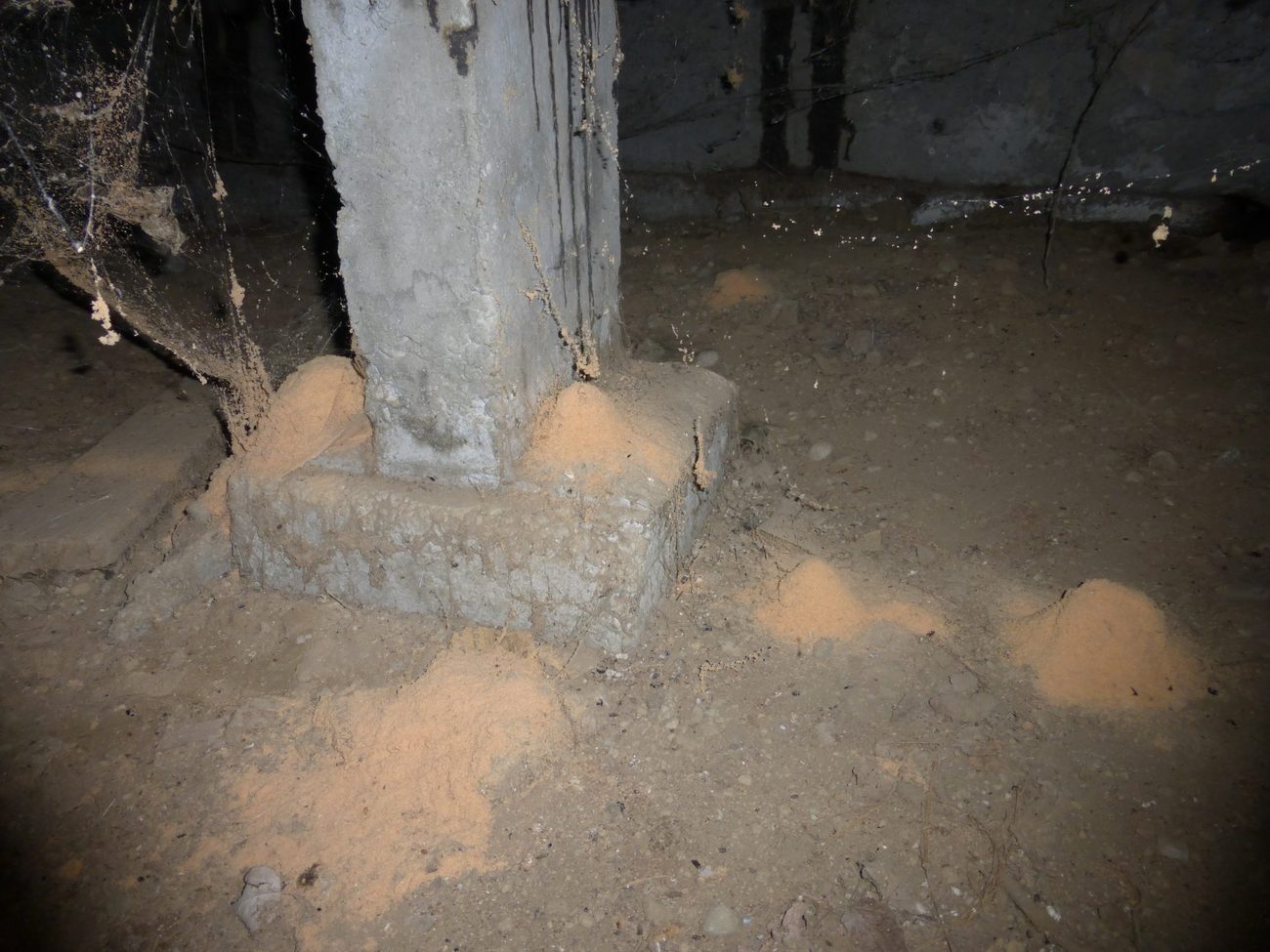
Sometimes worth treating, sometimes not — it depends on what is below.
Anobiid powderpost beetle at a glance
| Size | Two to five millimeters — an eighth to a quarter of an inch |
|---|---|
| Color and shape | Reddish to chocolate brown, cylindrical, head tucked under a hood-like thorax |
| How to tell it from a wood-boring weevil | No snout, clean round exit holes, and wood that is damp but still firm to a probe |
| Frass | Gritty between finger and thumb, not talc-fine like a true powderpost beetle's |
| Wood it attacks | Softwood framing and plywood subfloor above roughly fourteen percent moisture |
| When you see it | Adults emerge June through August; larvae spend four to six years in the wood |
| Do we treat it | Depends — only if frass is still moving and the wood is still damp enough |
Signs you have them
- Small round exit holes in joists, sill plates or subfloor, varying slightly in size
- Gritty pale powder collecting on the vapor barrier, a duct top or a beam flange
- Fresh frass reappearing a few weeks after the timber below was brushed clean
- Pale, sharp-edged new holes appearing in summer
- A small brown cylindrical beetle on a light or windowsill near the crawl hatch in July
The name on the page is the wrong name
Almost everything written about this insect online is written about a different family, and the mix-up is not trivial — it points people at the wrong wood, the wrong buildings and the wrong remedy.
The true powderpost beetles are the Lyctidae. Their whole biology is built around a feature of hardwood: pores wide enough for a female to insert eggs into, in sapwood with enough starch to raise larvae on. UC IPM states the constraint directly, that these beetles go after hardwoods because those woods have pores they can lay eggs into and softwoods do not. The list of hosts that follows is always the same — oak, ash, hickory, mahogany, walnut, bamboo. Those are flooring, cabinetry, furniture, tool handles and imported items.
Look at what your house is made of. In Whatcom County the framing, the joists, the subfloor, the sill plates and the posts are Douglas fir and hemlock, with some cedar. None of that is a lyctid host. A true powderpost beetle could sit on your rim joist for a season and get nowhere.
What does work that timber is the Anobiidae, and the regional handbooks name the species: Hemicoelus gibbicollis, the western deathwatch beetle. Oregon State’s PNW 326 describes it as most abundant along the Pacific Northwest coast and records it in unpainted Douglas fir in barns and bridges. WSU’s own bulletin on anobiids in structures makes it the primary damaging species in this state and says the other anobiids present do not cause serious problems.
So the identification worth making is not beetle versus something else. It is which beetle, because the answer decides whether you are looking at an imported furniture problem or at your own crawlspace.
We have kept the common name in the heading because that is what people type and what gets written on quotes. Everything below is about the anobiid.
The lyctid case that does occasionally happen here
Correcting a misconception is not the same as saying the other insect never appears, so here is the narrow situation in which a true powderpost beetle is the right answer in this county.
It arrives in the wood rather than starting in your building. A hardwood floor, a run of oak trim, a piece of imported furniture, a bamboo item, a stack of ash stock in a workshop — material that was already carrying eggs or larvae when it came through the door. The holes are tiny, uniform in size, and the powder streaming out of them rubs like talc rather than sand.
That situation has nothing to do with your crawlspace and is not solved by drying anything. UC IPM notes lyctids will work material down to around eight percent moisture content, which is drier than the inside of a heated house, so the moisture argument that governs the rest of this page simply does not apply. The answer there is about the affected item and where it came from.
If what you have is pinholes and flour-fine powder in finished hardwood indoors, you are on the wrong page and the difference is worth knowing before anyone quotes a crawlspace job.
What the insect looks like, and why you will probably never see one
WSU describes the adults as reddish to chocolate brown and two to five millimeters long — an eighth to a quarter of an inch on the PestSense sheet. Cylindrical rather than flat, with the head tucked down under a hood-like thorax, which is the giveaway when one turns up on a windowsill in July.
The eggs are half a millimeter, white and shaped like a teardrop, laid into checks, cracks, old exit holes and the end grain of unfinished lumber. The larva is the stage that matters: white, C-shaped, five or six millimeters long when mature, and permanently out of sight.
Most households never see any of it. What they see is powder, a hole, or a beetle on a light fixture in early summer, and by then the animal has already finished a job that took years.
The moisture number, and why it is not the one on our termite page
This is the fact that makes the beetle a Whatcom County problem rather than a national one, and it is worth being precise because the figures published for different organisms get blended together into a single vague warning about damp.
Three independent sources put the anobiid requirement in the same band. The Pacific Northwest handbooks say any wooden timber at thirteen to eighteen percent moisture content is subject to attack. WSU’s bulletin gives an optimum of fourteen to twenty percent. UC IPM says these beetles prefer wood above fourteen percent and recommends holding material below fourteen to fifteen percent as prevention. WSU’s PestSense sheet lands in the middle at fourteen to seventeen.
Take the working threshold as above roughly fourteen percent, and the prevention target as below fourteen to fifteen.
Notice what that is not. It is not the decay threshold, and the two get conflated constantly. Fungal decay runs at much wetter conditions than this, and the safe line for decay sits higher than the safe line for beetles. A crawlspace can be nowhere near rotting and still be comfortably inside the range that sustains an anobiid population indefinitely. That is exactly the situation in a great many houses here: framing that is not wet, not soft, not failing, and never quite dry either.
Which is why the beetle is often the first organism to arrive in a marginal crawlspace and the decay organisms come later. It is an early indicator, not a late one.
Why this county in particular
Thirteen to eighteen percent is not an unusual condition here. It is the default condition under a lot of the housing stock.
We get about thirty-five inches of rain across a long gray season, no hard freeze to dry anything out, and a building stock full of vented crawlspaces sitting over soil that gives up water all winter. WSU’s guidance puts western Washington, and coastal areas particularly, among the most susceptible regions, and the handbooks note that anobiids do best in buildings that are unheated or heated only occasionally — which describes the space under your floor precisely.
The locations we find them in are consistent:
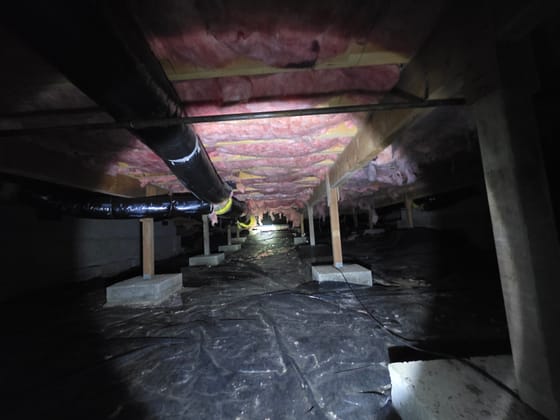
Floor joists and the subfloor above them, especially in bays with poor air movement — behind ductwork, over a low spot, in a corner where the vents do not reach.
Sill plates and mudsills, the timber closest to the ground and to splash-back.
Pier posts and their blocking, which sit on concrete that wicks.
Plywood subfloor, which WSU lists explicitly among the materials attacked. The glue lines do not stop them.
Unheated outbuildings and barns, where the timber is unfinished, the space is unconditioned and nobody looks for years.
Older Bellingham housing — the Lettered Streets, Columbia, Sunnyland, York, South Hill — because post-and-pier construction puts framing close to grade and a lot of those spaces have never had an intact ground cover.
Around Lake Whatcom and out toward the forest edge, shading is the extra variable: a lot that never gets sun keeps the whole underfloor space a couple of points wetter than the same house on an open lot in Ferndale. In the farm country — Lynden, Everson, Nooksack, Sumas — the volume is in outbuildings and low-set structures rather than in living space.
Frass, holes, and reading them properly
Anobiid frass is the diagnostic feature, and the texture is the part people get wrong.
Rub a pinch between finger and thumb. Anobiid material is gritty, because it is made of tiny compressed fecal pellets rather than loose dust. UC IPM ranks the three families by exactly this feel: lyctid frass rubs like baking flour or talcum powder, anobiid frass has a distinct grain to it, and bostrichid frass is coarser still. WSU describes the accumulation as powdery frass beneath a thin layer of wood, which is what you get when the larva works just under the surface and the shell finally breaks.
The exit holes are round and small. UC IPM adds a detail worth knowing: anobiid holes vary in size across one infestation, while lyctid holes tend to be uniform. A joist showing a scatter of holes at slightly different diameters is telling you something.
Where it lands matters too. Frass falls, so it collects on the vapor barrier, on the top of a duct, on stored boxes, along the flange of a beam, or streaked down the face of a joist. Map where it is heaviest and you have usually mapped the wettest part of the crawlspace, because that is the same place.
Active or long finished — the only test that decides anything
More money is wasted on this species than on any other in the library, and it is wasted for one reason: holes are permanent and people read them as current.
A hole made in 1968 looks essentially the same today. Exit holes are a record of history. WSU is direct that holes alone do not establish activity, and that frass being pushed out is the best indicator that larvae are working.
The test. Clear everything away beneath the suspect timber — brush the joist face, wipe the vapor barrier, take the dust off the top of the duct. Photograph it clean and write down the date. Then leave it alone for a few weeks and come back. New material means an active population. Nothing means you are looking at a scar.
Supporting signals. A fresh hole is pale and sharp at the edge; an old one is darkened and dusty. Fresh frass is loose and light. Old frass compacts and grays with time. And the moisture readings around the timber tell you whether the wood could support a generation now regardless of what it supported forty years ago.
Timing helps. Adults emerge June through August, so summer is when new holes and fresh piles appear. Set the test up in spring and the answer arrives on its own.
Four to six years, and what that does to your expectations
The larval stage is long. WSU puts it at four to five years feeding inside the timber. The regional handbooks extend that to five or six years or longer in cool damp wood, and cool damp wood is what we have.
Three consequences follow, and they are all counterintuitive.
What emerges this summer reflects conditions from years ago. A crawlspace dried out last autumn can still produce beetles for several seasons afterward, because the generation already in the wood finishes on its own schedule. That is not failure. It is arithmetic.
Judging a result takes seasons, not weeks. Anybody promising you a clean answer by the following month is describing a faster insect than this one.
And the population builds slowly enough that panic is misplaced. Damage accumulates over decades, not over a winter. What justifies acting now is that the same decades are available to the moisture problem underneath.
The year, as it runs here
The calendar for this species is short and it is worth knowing, because two of the three useful things you can do are seasonal.
June to August is emergence. Adults chew out, mate and lay, and this is when new holes appear and fresh piles collect. It is also the only window in which most people ever see the beetle itself, usually on a light or a window in a utility room over the crawl hatch.
Autumn through spring is when the crawlspace tells the truth. A space that looks tolerable in August can be running water in February, and the moisture reading that matters is the winter one. Anybody assessing an underfloor space in high summer is reading it at its most flattering.
Late spring is when to set the frass test. Clear the timber in April or May and check it in July and you have caught the emergence window rather than waiting another year for an answer.
That sequence is worth planning around. A call in September about beetles seen in July can still be usefully answered, but the cleanest evidence has already fallen and been swept up by somebody tidying the crawlspace.
What to do before anybody comes out
Four things, none of which cost anything.
Leave the frass where it is. The single most common thing that happens to this evidence is that somebody vacuums it, and with it goes the only proof of current activity anyone had. Photograph it in place instead.
Catch a beetle if one appears. A specimen in a sealed bag settles anobiid against weevil against something that flew in the window, and it settles it in seconds rather than by argument.
Look up from the pile, not around it. Frass falls, so the hole is above the heap. Follow the vertical line and check the underside of the joist and the subfloor above it.
Note whether the crawlspace has a ground cover, and what state it is in. Torn, shoved aside, in pieces, or absent entirely — that observation predicts the moisture reading before anybody takes one, and it is the thing most likely to decide whether treatment holds.
Telling it from the wood-boring weevil
These two are confused constantly, in both directions, and they are the two most likely insects in a Whatcom County crawlspace to leave round holes and pale powder.
Look at the head. A weevil carries a long forward-projecting snout with the antennae elbowed off it partway along. An anobiid has no snout at all — the head is small, blunt and pulled down under the thorax. Under a phone camera on macro this is not a subtle difference.
Look at the wood. The anobiid works timber that is damp but still sound enough to resist a probe. The weevil works wood that fungi have already broken down, and a blunt tool sinks into it.
Look at the hole shape. Anobiid exits are clean circles. Weevil exits are irregular, oval or slit-like, with ragged margins.
The distinction is worth twenty minutes because the two findings mean different things. An anobiid says the space is damp. A weevil says the timber has already been through decay. Their own profile goes through the rest of it.
What treatment involves, and what it depends on
The verdict on this page is depends, and here is the honest account of what it depends on.
Whether it is active. Established first, by the frass test, before anybody quotes anything. Inactive damage in dry timber does not warrant an application, and we would rather run the test and lose the job than treat a museum piece.
Whether the wood is still in range. Meter readings across the framing. Timber sitting at eleven percent is not going to sustain the next generation whatever is in it now. Timber at seventeen will.
Whether the member has lost capacity. Where section is genuinely gone, that is a carpenter’s job. Applying product to a joist that needs replacing is spending on the wrong trade.
Where treatment is warranted, the shape of it is fairly settled. Borate materials are the standard for structural anobiids — the Pacific Northwest handbooks call sodium borates highly effective against structure-infesting anobiids while noting it can take years to bring a population down, which fits a five-year larval stage exactly. Borates want bare, accessible wood, which is what crawlspace framing is, and they do not pass through paint or a sealer, which is a real limitation and worth stating rather than glossing.
Then the part that actually decides the outcome:
Get the moisture down. A complete lapped ground cover over the soil. Ventilation that is open, screened and not buried by a flower bed. Downspouts discharging away from the building. Grade falling away from the foundation. Standing water dealt with at the source rather than pumped. Some of that is crawlspace restoration or exclusion and repair work; some belongs to a drainage contractor or a plumber, and we say which is which. The crawlspace guide sets out how the system is supposed to work.
Clear the reservoir. WSU lists removing lumber scraps from the crawlspace as a control measure in its own right. Form boards, offcuts, an old door, a stack of siding left after a remodel — every one of those is a breeding site sitting inside the foundation.
Borate-treat new material. Any framing going into a location with a history is cheap to treat while the bay is open and awkward to treat afterward.
What we will not do
Fumigate. That is a response built for other species in other climates, and proposing it for an anobiid in a Bellingham crawlspace is a sign the diagnosis came from a national script.
Sell a standing annual plan for this insect. If the framing is dry the population has nothing to work with; if it is damp, the answer is drying it rather than visiting every year and billing for the visit.
Treat holes with nothing living behind them. Covered above at length because it is where most of the wasted money in this category goes.
Quote from a photograph of holes. A photograph shows history. It does not show a moisture reading and it does not show whether frass is still moving.
What you get in writing
Worth stating plainly, because this is the point where the industry gets vague.
Our paperwork is a record of the treatment performed: the product applied, the members and areas it went on, and the date the work happened. That is a useful thing to keep with the house file.
We are not structural pest inspectors and we do not issue a document setting out findings of wood-destroying organism damage. That is a regulated document under Washington’s rules, it belongs to a separately licensed credential, and we hold treatment licensing instead. Nobody at this company will blur that line to keep a booking, and if somebody tells you a treatment record covers the same ground, that is worth a second question.
How worried to be
Less than the marketing suggests and more than the silence suggests.
Anobiids can hollow out joists, posts, studs and sill plates given long enough, and WSU does not soften that. But long enough means decades, in wood that stayed in range the whole time. Nothing is failing this winter because of a beetle.
What raises the stakes is company. Timber damp enough for anobiids year after year tends to get wetter rather than drier, and the organisms that follow — dampwood termites, moisture ants, decay fungi — take capacity out of the same members. The beetle is frequently the cheapest warning you will get, arriving before any of the expensive things do.
Treat it that way and the finding is genuinely useful. Treat it as an emergency and you will overspend on product and underspend on drainage, which is the exact inversion this page exists to prevent.
Related work
The service page covering this insect alongside the others that leave holes in timber is wood-boring bee and beetle control, and the broader structural picture sits on termite and wood-destroying pest control. Because the finding is nearly always a crawlspace finding, crawlspace cleanout and restoration is where most of these jobs actually end up. If what you have is powder in a cupboard or a rug rather than in framing, that is a different group entirely and carpet and pantry beetles covers it. And where the softness is at a window rather than under the floor, soft wood around a window sill walks through the probe test.
Frequently asked questions
Is this the same thing as a powderpost beetle?
Not the one nearly every article means. True powderpost beetles are lyctids, and they need the wide pores of hardwood sapwood to lay eggs in. The insect working softwood framing on this side of the Cascades is an anobiid, and the two behave differently enough that the distinction changes the whole answer.
How damp does the framing have to be for this beetle?
Damper than furniture, drier than rot. The Pacific Northwest handbooks put timber at thirteen to eighteen percent moisture content within reach of attack, and UC IPM sets the threshold at greater than fourteen percent. Holding framing below roughly fourteen to fifteen percent is the preventive number worth chasing.
The holes have been there for years. Does that mean I still have beetles?
No. A hole is a permanent scar in the wood and outlasts the insect that made it by decades. Fresh material being pushed out of a hole is the evidence that matters, and WSU calls expelled frass the best indicator that larvae are still working in there.
Why does the same crawlspace get reinfested after treatment?
Because emerging females lay back into wood they can already use, and damp framing stays usable indefinitely. Nothing about the timber changed when the last application was made, so the following generation goes into the same joists and the cycle simply restarts.
How long does one of these beetles live inside the wood?
Longer than most people would guess. WSU puts the larval stage at four to five years inside the timber, and the regional handbooks stretch that to five or six years or more in cool damp conditions. What emerges this June was laid before the last presidential election.
Could this be structural?
It can become structural where a population has run for many years in a member that is also wet enough to be decaying. The insects and the decay fungi take capacity out of the same timber at the same time, and by then the two losses cannot be separated by looking.
Will painting the wood stop them?
It helps on bare timber that is not yet infested, because a sealed surface gives a female nowhere to lay. It does nothing for larvae already inside, and it is largely irrelevant in a crawlspace, where the framing is unfinished and the real variable is how wet the space is.
Sources
- WSU Extension EB1577E — Anobiid Beetles in Structures — read September 2, 2026
- Pacific Northwest Pest Management Handbooks — Wood-infesting pests: Beetle — read September 2, 2026
- WSU PestSense — Deathwatch beetles (Anobiids) — read September 2, 2026
- UC IPM Pest Notes — Wood-Boring Beetles in Homes — read September 2, 2026
- OSU Extension PNW 326 — Preventing and Controlling Powderpost Beetles — read September 2, 2026
Rules change. This page is scheduled for review against its sources by September 1, 2027. If you are reading it after that date and something looks out of step with the current rule, the rule is right and we are wrong — please tell us.
Pest problem in Whatcom County?
Family-owned, no long-term contracts, and every treatment is backed by our 100% Service Guarantee.
Most calls in Whatcom County are out within 1–2 days, about 3 during the late-summer peak.
Last updated