
Wood-Boring Weevil — Euophryum confine
Euophryum confine · Structural pests
The wood-boring weevil is a small snouted beetle introduced from New Zealand that can only develop in timber fungi have already broken down. It is routinely mistaken for a powderpost beetle because the holes and powder look similar. Finding one tells you decay is present and has been for some time.
Call 360-410-2199 Request a free inspection
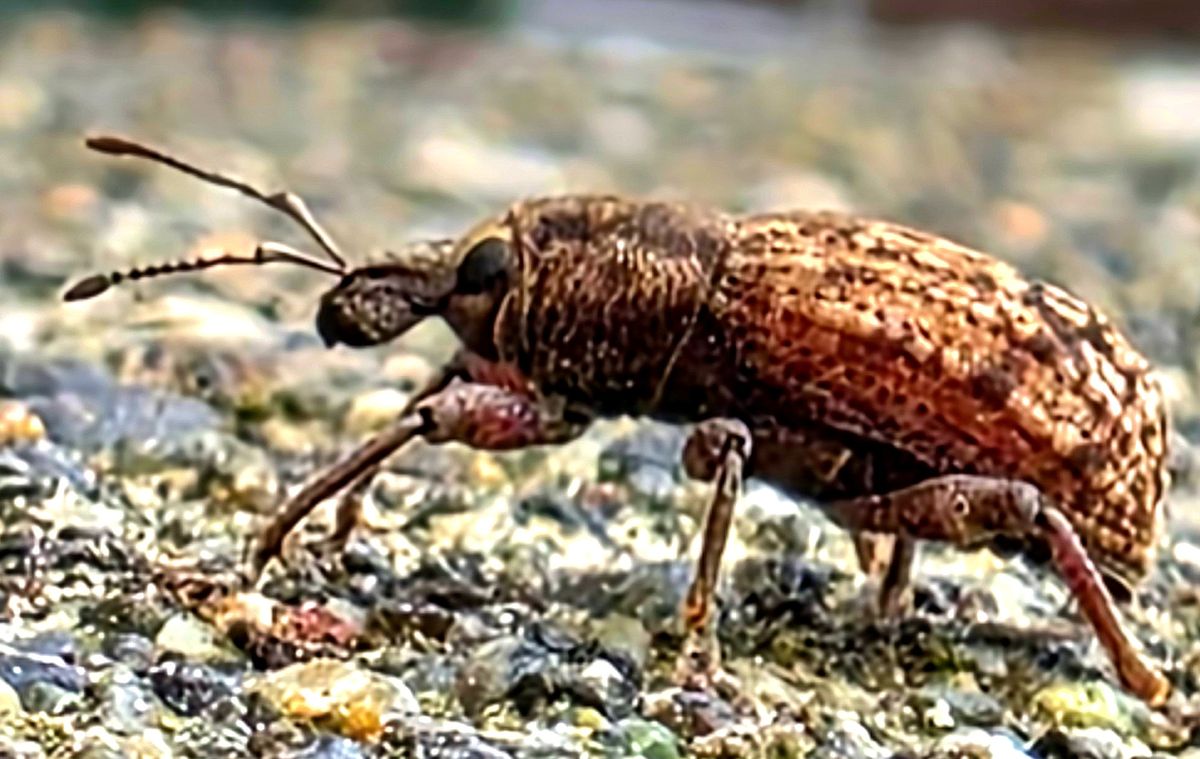
Sometimes worth treating, sometimes not — it depends on what is below.
Wood-boring weevil at a glance
| Size and color | About two and a half to three millimeters; cylindrical, dark brown to nearly black |
|---|---|
| Head | A long snout with elbowed antennae hinged partway along it |
| How to tell it from a powderpost beetle | Ragged, slit-like exit holes and wood a screwdriver sinks into; beetle holes are clean circles in firm wood |
| Frass | Gritty, pellet-like and coarse rather than floury |
| What it needs | Timber that decay fungi have already broken down — never sound seasoned wood |
| What the finding means | The member has decayed and water has been arriving for years |
| Do we treat it | Depends — structural members usually need replacing, and the water fix matters most |
Signs you have them
- Oval or slit-shaped exit holes with ragged edges in damp framing
- Small gritty pellets of frass below the holes
- Timber around the holes that gives when a blunt probe is pushed in
- Small snouted adults running on the surface of damp wood, a vapor barrier or a sill plate
- Discoloration, cubical cracking or a stringy white fungal mat in the same member
An insect this region actually has and nobody writes about
There is a short list of wood-destroying organisms that turn up in Whatcom County buildings, and one of them is almost entirely absent from the material published about the Pacific Northwest. It gets found, it gets misidentified as something else, and the misidentification quietly changes what happens next.
The insect is Euophryum confine, the wood-boring weevil. It is small, it is dark, it lives in wet rotted timber, and it is routinely written up as a powderpost beetle because the exit holes and the pale debris underneath look close enough at a glance.
The correction is worth making for a practical reason rather than a taxonomic one. A beetle finding says the wood is damp. A weevil finding says the wood has already gone through decay. Those are different sentences about your building, and only one of them means somebody should be pulling a board off.
Where it came from, and why it likes it here
This species is not native to North America. It is a New Zealand insect that has traveled with timber and cargo: recorded in Great Britain in 1937, and in Canada by around 1980.
It has done well on this coast for the obvious reason. The conditions it evolved in — mild, wet, no hard freeze, wood that stays damp for most of the year — are the conditions under a Whatcom County floor from October to May. A crawlspace in Bellingham is closer to a New Zealand forest floor than a crawlspace in Spokane is, and the insect has found that out.
Its presence in the county is therefore unremarkable rather than alarming. It is not an emerging threat, it is not spreading in some newsworthy way, and there is no quarantine story attached to it. It is simply a naturalized insect that has been quietly occupying rotten wood here for decades while the local pest literature described something else.
Look at the head
Everything about the identification comes down to one feature, and it is unmistakable once you know to look.
The snout. A weevil’s head extends forward into a long rostrum, with the antennae hinged off it partway along in a distinct elbow. On this species the body runs about two and a half to three millimeters — small, cylindrical, dark brown to nearly black, with a pronotum narrowing toward the front so the whole outline looks slightly pear-shaped from above.
No beetle in your framing has that. An anobiid’s head is small, blunt and tucked down beneath a hood. A lyctid’s is flat and unremarkable. Put a weevil next to either under a phone camera and the difference is the first thing you see.
The larva is white, curved and legless, which is unhelpfully similar to a beetle larva. Identify from the adult if you possibly can.
You are more likely to see the adult than you are with the beetles. Weevils run about on the surface of damp timber, on a vapor barrier, along the top of a sill plate, under a piece of stored wood. Anobiid adults spend nearly their whole lives hidden and appear for a few weeks in summer. If somebody has actually seen the insect rather than only its work, that alone shifts the odds toward this one.
The requirement that defines it
Here is the fact that makes this species useful rather than merely unwelcome.
It cannot develop in sound wood. The species feeds on timber that fungi have already predigested — decay organisms break the wood down first, and the weevil works the softened material that results. It will continue in wood that has since dried, provided the fungal breakdown already happened, and it remains viable in material down around twenty percent moisture content, which is drier than the decay itself needs.
Read that carefully, because the sequence is the whole point. Water arrives. Water stays long enough for decay fungi to establish. Fungi soften the wood over a period measured in years. Only then can this insect use it.
So a weevil in a joist is not the beginning of a story. It is a late chapter, and the earlier chapters happened whether anybody noticed them or not.
That puts it in the same category as the moisture ant: an organism whose real value to a household is diagnostic. It marks the failed timber precisely, which is more than a meter sweep across a surface can do, and it marks it as failed rather than merely damp.
What the damage looks like
Four features, and three of them separate it from the beetles.
Exit holes are irregular. Oval to slit-shaped, with ragged edges, rather than the clean punched circles a beetle leaves. This is the field mark most often available, because the insect itself is usually gone by the time anybody looks.
Tunnels run along the grain. Roughly a sixteenth of an inch across, generally straight, following the grain direction through the softened material.
Frass is gritty and pellet-like. Small ellipsoidal pellets, coarse rather than floury. It reads much closer to anobiid frass than to the talc-fine powder a true powderpost beetle produces — which is a large part of why the two get conflated in the first place.
The wood around it gives. This is the check that settles it in the field. Push a blunt probe into the timber beside the holes. Weevil-infested wood has been through fungal decay by definition, so a screwdriver sinks in. Anobiid timber is damp but still resists.
Telling it from the anobiid, in order
These two account for nearly all the small round-ish holes found in Whatcom County structural timber, and running the checks in this order gets you there fast.

One — probe the wood. Soft and punky points to the weevil. Firm points to the beetle. This is free, immediate and correct more often than any other single test.
Two — look at the hole outline. Ragged and irregular against clean and circular.
Three — find an adult if you can. Snout or no snout. Conclusive.
Four — check the moisture. Anobiids sit in a band of roughly thirteen to eighteen percent, the range the Pacific Northwest handbook gives for timber open to attack, which is damp-but-sound territory. Weevil timber has generally been well beyond that for years and may have dried back since.
Five — look for the fungus. Discoloration, cubical cracking, a stringy white mat, or the general crumbling texture of brown rot. Where that is present with holes in the same member, the weevil is the better bet.
The anobiid profile covers the other half of this comparison in the same detail.
Where it turns up in this county
Follow the water to its worst point in the building and that is where to look.
Crawlspace framing over bare soil. Where no ground cover was ever installed or where the sheeting is in torn pieces, the timber above takes ground moisture continuously through a wet winter. The joists nearest the wettest ground go first.
Sill plates under a failed downspout or a blocked gutter. A specific column of wall that has been getting soaked at the same point for many winters.
Joist ends built into damp masonry or concrete, where the end grain sits in a pocket that never dries.
Beneath long-running plumbing leaks — under a bath, behind a dishwasher, below a laundry, at a hose bib weeping into a rim joist.
Deck ledgers with no flashing, which is a chronic defect in this county’s housing and produces exactly the sustained wetting decay requires.
Window and door joinery on the weather side, particularly sills that have lost slope and bottom corners of frames. Where a sill has gone soft, this is one of the insects that may be in it — soft wood around a window sill covers how to judge the extent.
Outbuilding and greenhouse timber, fence posts and sleepers at ground level. Not structural, but they are reservoirs sitting near the house.
The pattern across the county follows the same lines as every other moisture organism here. The older Bellingham housing produces the crawlspace findings, the shaded lots around Lake Whatcom produce the deck and joinery findings, and the farm country produces the outbuilding findings. What is common to all of them is about thirty-five inches of rain a year and no freeze to interrupt it.
Season and life cycle
Slower than an insect this size suggests.
Eggs hatch after roughly sixteen days. The larval stage runs six to eight months inside the wood. Pupation takes about another sixteen days and typically falls between June and October. Adults are long-lived by beetle standards — up to sixteen months — which is part of why they are seen on the surface more often than the beetles are.
The practical implications are two. Generations overlap, so you can find eggs, larvae and adults in one piece of timber at the same time, and activity is not confined to a narrow emergence window the way it is for anobiids. And a population can build faster than a beetle population in the same board, because the cycle is under a year rather than four to six.
That said, the timber it is building up in has already lost most of its strength to something else. Speed of colonization is not the same as speed of damage.
What the finding is actually worth
Proportion matters here, and the honest framing is unusual for a pest page.
The insect is not the expensive part. The USDA Forest Products Laboratory’s figures on decay explain why: substantial toughness is lost by the time decayed wood has shed even one percent of its weight, and most strength properties can be down by more than half by ten percent weight loss. A member soft enough to host this weevil has already been through a large part of that. The galleries are added to a loss that was already taken.
So the value of the finding is information. It says, precisely and without a meter, that this member has decayed, that water has been arriving for years, and that the repair decision is a carpentry decision rather than a pest one.
That is worth more than a treatment, and it is why this species deserves a page rather than a footnote in somebody else’s.
What the misidentification costs
It is worth spelling out what goes wrong when this insect is written up as a powderpost beetle, because the error is common and it is not harmless.
The moisture conversation gets pitched at the wrong level. An anobiid finding sends everybody after a target of drying framing to below roughly fourteen or fifteen percent — a real and achievable goal in a crawlspace with a proper ground cover and open vents. A weevil finding means the wood went past that a long time ago and stayed there. Aiming at the beetle number in a building that has already produced rot is aiming at a line the structure crossed years back.
The probe never gets used. Called a beetle, the timber gets treated. Called a weevil, somebody puts a screwdriver into it, and that is the moment the actual condition of the member becomes known. A great many of these findings turn out to be more serious than the holes suggested, and the seriousness has nothing to do with insects.
The wrong trade gets hired. A beetle problem is genuinely a pest job with a drainage tail. A weevil problem is frequently a carpentry job with a small pest component, and the sequence of who does what is different. Getting that backwards means paying for an application to timber that is about to be cut out.
And the diagnosis loses its value. The single most useful thing this insect does is mark decayed structural wood precisely. File it under powderpost beetles and that information is thrown away in the filing.
None of this requires anybody to be an entomologist. It requires one look at the head of the insect and one push with a blunt tool.
What to do before anybody comes out
Four things, and they are the ones that make a visit worth having.
Probe the wood, properly. A flat screwdriver or an awl, firm steady hand pressure, no hammering. Test the member with holes in it, then test somewhere you believe is sound so you know what resistance is supposed to feel like. Test at several points along the member rather than at one, because decay runs in a column and the visible part is rarely the whole of it.
Leave the debris alone. Frass swept up is evidence destroyed, and it is the only proof of current activity anybody had. Photograph it where it lies.
Catch an insect if one is running. A specimen in a sealed bag ends the beetle-or-weevil question immediately, and this is the species you are most likely to actually manage to catch.
Find where the water is arriving. Look up from the wet timber, not at it. Gutters, downspout discharge, grade against the siding, a hose bib, a deck ledger, an irrigation head, a bathroom above. That answer determines everything that follows, and it is usually visible from outside on a rainy afternoon.
How urgent this is, honestly
Somewhere between the two positions people arrive with, and closer to the calm end than the marketing suggests.
Nothing collapses because of a weevil. The insect is small, the galleries are narrow and the population is working material that had already lost most of its strength before the first egg was laid. Anybody telling you this species threatens your building this winter is selling urgency rather than describing an insect.
What deserves attention is the condition it is reporting. Decay in a structural member does not reverse, the water causing it is almost certainly still arriving, and each additional wet season takes more timber and widens the eventual repair. The cost curve on that is steep, and it is steep whether or not anything is living in the wood.
Signals that raise the urgency: a probe sinking into a sill plate, a post or a rim joist; springiness or movement in the floor above; cubical cracking or a visible fungal mat; standing water under the house; the same condition in more than one location; or a member that is carrying load and cannot be seen along its whole length.
Signals that lower it: the affected timber is a fence post, a sleeper, an outbuilding frame or a piece of trim; the wood is soft but the member is not structural; the water source has already been corrected and the timber has dried; or the workings are old, gray and producing nothing.
Where it lands on that scale decides the answer, and it is a question about the building rather than about the insect.
What treatment involves, and what it depends on
The verdict is depends, and the variable is not the insect.
Whether the member is structural. A sleeper or a shed door frame is one conversation. A rim joist, a post or a sill plate is another entirely, and there the answer is nearly always replacement rather than treatment.
Whether the water is still running. Meter readings on the surrounding framing separate an active moisture problem from a historical one. Where a leak was fixed a decade ago and the timber dried, the weevils may already have finished and the job is a repair.
Whether anything is still alive in there. Fresh gritty frass appearing after an area has been cleaned, or live adults on the surface, versus an old riddled board that has been quietly inert.
Where there is active infestation in material worth keeping, treatment is straightforward in principle: the accepted approach is to arrest the fungal growth and bring the moisture down, with an appropriate application to the affected wood alongside it. Borate materials suit bare accessible framing and penetrate damp wood better than dry, which for once works in the customer’s favor here.
But every honest account of this species ends in the same place. Drying the assembly and correcting the water source is the intervention that matters, and much of it is a plumber’s, a roofer’s, a gutter contractor’s or a drainage specialist’s work rather than ours. Some of it is crawlspace restoration or exclusion and repair, and the crawlspace guide explains why these spaces fail here in the first place.
Decayed timber does not regain strength when it dries. Where section is gone, it gets cut out and replaced, and that is a builder’s job. New material going into a location with this history is worth borate-treating before the bay closes up.
What we will not sell you
A treatment over an unrepaired leak. The wood will be wet again by February and the fungi will still be working. Applying product to it changes the invoice and not much else.
Treatment of old workings in dry timber. Riddled wood is a permanent record. If nothing is moving and nothing is wet, there is nothing to treat.
A recurring plan for an organism that cannot establish without decay. Fix the water and the entry requirement is gone. A subscription against that is a subscription against a condition you no longer have.
A pest job where the honest answer is carpentry. If a probe sinks into a sill plate, the insects are the smaller half of your problem and we will say so.
What you get in writing
Stated plainly, because it is the point where this category gets slippery.
Our paperwork is a record of the treatment performed — what was applied, to which members and locations, on what date. Keep it with the house records; it is a useful document and it is what our work produces.
We do not issue a document setting out findings of wood-destroying organism damage. Under Washington’s rules that document is regulated and belongs to a separately licensed credential, and we are not structural pest inspectors — the licensing we hold is for treatment. That boundary is not a limitation we are apologizing for. It is the reason the rest of what we tell you can be taken at face value.
Related work
Because the finding is a decay finding, most of the follow-through sits with crawlspace cleanout and restoration and exclusion and repairs. The insect is grouped with the other timber borers on the wood-boring bee and beetle page, and the wider structural picture is on termite and wood-destroying pest control. The same wet timber supports dampwood termites and moisture ants, which is ant control, and all three are regularly found in the same few feet of framing.
Frequently asked questions
What is the difference between this and a powderpost beetle?
The snout. A weevil's head runs forward into a long rostrum with the antennae elbowed off it partway along, and no beetle in local framing has that. The hole shape helps too: weevil exits are ragged and slit-like, while beetle exits are neat circles.
Why can it only attack rotten wood?
Because it depends on fungi to do the digestion first. The species feeds on timber that has already been broken down by decay organisms, which is why it never appears in sound seasoned lumber and why its presence is a statement about the condition of the wood rather than about bad luck.
Is it native to Washington?
No. It comes from New Zealand and has spread through introduction, reaching Britain by 1937 and Canada by about 1980. It has settled comfortably into the mild wet building conditions of this coast, which resemble the ones it evolved in more closely than most of North America does.
Does treating the weevils fix the problem?
Only the smallest part of it. The decayed timber that made the infestation possible is still decayed afterward, and the water that caused the decay is still arriving. Arresting the fungal growth and drying the wood is what changes the outcome.
How much structural damage does it do on its own?
Less than the decay it follows. By the time this insect can develop in a member, fungi have already taken most of the strength that member has lost. The weevil galleries are added on top of that, but the repair decision is nearly always driven by the rot.
Where would I find it in my house?
In the wettest wood in the building. Crawlspace framing above bare soil, a sill plate below a failed downspout, a joist end buried in damp masonry, a windowsill that has been soft for years, or the bottom of a door frame in an unheated outbuilding.
Can I tell whether it is still active?
Fresh gritty frass appearing after you have cleaned an area is the practical test, along with live adults, which are more often seen than beetle adults because they run on the surface of damp timber rather than staying inside it.
Sources
- MuseumPests.net Integrated Pest Management Working Group — Wood-Boring Weevil (Euophryum confine) fact sheet — read September 2, 2026
- UC IPM Pest Notes — Wood-Boring Beetles in Homes — read September 2, 2026
- Pacific Northwest Pest Management Handbooks — Wood-infesting pests: Beetle — read September 2, 2026
- USDA Forest Products Laboratory — Wood Handbook FPL-GTR-282, ch. 14: Biodeterioration of Wood — read September 2, 2026
- WSU Extension EB1577E — Anobiid Beetles in Structures — read September 2, 2026
Rules change. This page is scheduled for review against its sources by September 1, 2027. If you are reading it after that date and something looks out of step with the current rule, the rule is right and we are wrong — please tell us.
Pest problem in Whatcom County?
Family-owned, no long-term contracts, and every treatment is backed by our 100% Service Guarantee.
Most calls in Whatcom County are out within 1–2 days, about 3 during the late-summer peak.
Last updated