
Pacific Dampwood Termite
Zootermopsis angusticollis · Structural pests
The Pacific dampwood termite is the termite of northwest Washington, and it only attacks wood that is already wet. Finding one is news about a water problem that has been running for years. Mud tubes are not the sign here, and most termite advice online describes a different insect entirely.
Call 360-410-2199 Request a free inspection
We treat this, and finding it usually warrants treating.
Pacific dampwood termite at a glance
| Winged swarmers | Over an inch including wings; brownish body, four long smoky wings well past the abdomen |
|---|---|
| Soldiers | About three quarters of an inch, heavy reddish-brown to near-black head with oversized jaws |
| Nymphs | White to cream, soft, roughly half an inch, and never seen unless the wood is opened |
| How to tell it from a carpenter ant | Straight beaded antennae, no pinched waist, and four wings of about equal length |
| Where it lives | Only in timber that is already wet — sill plates, rim joists, deck ledgers, leaky framing |
| When it flies | Warm evenings in late summer or fall, especially a day or two after rain |
| Mud tubes | None — it lives inside the wet wood, so tubes point to a different termite |
Signs you have them
- Large winged insects at a porch light or lit window on a mild September or October evening
- Small heaps of same-sized shed wings on an indoor sill or on the crawlspace vapor barrier
- Hard, gritty pellets about a millimeter long and faintly six-sided below a kick-out hole
- Galleries packed with dark material, running across the grain as well as along it
- Wood that lets a screwdriver sink in where it should stop
The termite that actually lives here
Type a question about termites into a search engine and almost everything that comes back describes an insect that does not live in northwest Washington. The material is about aggressive soil-nesting species in the South and Southeast: shelter tubes climbing a foundation, chemical soil barriers, perimeter bait stations, tented houses. That content dominates because that is where the volume of termite money is, and it gets copied onto regional sites without anybody checking whether the biology travels.
It does not travel. The termite of this region is the Pacific dampwood termite, Zootermopsis angusticollis, and it behaves differently in the one respect that changes every practical decision: it does not come out of the soil to find your building. It arrives by air, as a pair of winged reproductives, and it lands on timber that is already saturated.
Two things follow immediately, and both of them are the opposite of the received advice.
Mud tubes are not the sign to look for. Soil-nesting termites build those tubes because they have to keep a moist connection back to the ground. A dampwood colony has no such requirement — it lives inside the wet wood it is eating, so there is nothing to bridge and no tube to build. A homeowner who walks the foundation, sees no tubes, and concludes the building is clear has checked for the wrong thing.
Soil treatment is the wrong mechanism. There is no ground-dwelling colony to intercept, so a chemical barrier around the perimeter of a house does nothing about an insect living in a window header eight feet up.
The Pacific Northwest Pest Management Handbooks put the distribution plainly: this species is more prevalent in western Washington and Oregon than the subterranean species is. WSU Extension bulletin EB0787 goes further and states that the subterranean termite occurs only as far north as Seattle in western Washington. Whatcom County sits well north of that line. Subterranean termites are not impossible here — distributions shift, and material moves around on trucks — but treating them as the default assumption is a mistake imported from somewhere else.
If you do find genuine soil tubes running up a stem wall or a pier, that is a different conversation and worth saying so at the first phone call, because the scope and the method both change.
What it looks like
Most people meet this insect in one form and never see the other two.
Alates, the winged reproductives. Large — WSU puts them at over an inch including the wings, which makes this the biggest termite in the region. Brownish body, four long smoky wings extending well past the abdomen. These are the ones that turn up at a window or a porch light, and they are what nearly every call about this species begins with.
Soldiers. Around three quarters of an inch, with a heavy reddish-brown to almost black head and oversized jaws on a cream-colored body. They only appear when timber is opened, and the head is unmistakable once seen.
Nymphs, which do the eating. White to cream, soft, roughly half an inch. In this species the immature stages do the colony’s work rather than a separate sterile worker caste. They avoid light completely, which is why you can have a substantial colony in a joist and never see a single individual.
Colonies here are modest by termite standards. There is no vast underground network. What there is instead is a population living in one piece of wet structural timber, or a group of connected pieces, quietly enlarging its galleries.
Telling them from winged carpenter ants
This is the identification that goes wrong most often in Whatcom County, and it goes wrong in both directions. Carpenter ant swarmers are also large, also winged, also alarming, and also turn up around a building. Three field marks separate them and none needs magnification.

Antennae. A termite’s are straight and look like a string of small beads. An ant’s have a clear elbow partway along, like a bent arm. This is the most reliable single character and it is visible on a phone photograph.
Waist. A termite is broad and straight-sided from thorax to abdomen, with no narrowing at all. An ant has the pinched waist that everybody already pictures when they think of an ant.
Wings. All four of a termite’s wings run to roughly the same length. An ant’s forewings are noticeably larger than the hindwings. And termite wings detach easily — a small heap of same-sized wings on a sill, all shed within a few feet of each other, is a termite signature. Ant wings come off less readily and are unequal when you find them.
There is a fourth difference that is not about the insect at all. Carpenter ants excavate galleries to live in and push the debris out, so you get coarse fibrous shavings below a nest containing recognizable insect parts. Dampwood termites eat the wood and leave hard pellets instead, roughly a millimeter long and slightly six-sided, either stuck to the gallery walls or loose on the gallery floor depending on how wet the wood is.
Keep a few specimens. A dozen insects in a sealed bag or a jar settles the question in seconds and removes every subsequent guess from the process.
When you will see them, and why it is autumn
The flight season here runs late. WSU Extension describes swarming flights on warm evenings in late summer or fall, especially after rains, and that matches what we get called about — a mild September or early October evening, a day or two after a wet spell, with alates coming to a porch light, a lit window, or a security lamp over a garage door.
That combination of warmth, humidity and darkness is worth understanding because it explains the peculiar clustering of these calls. Nobody reports one insect. They report thirty of them against a lit window on the same evening, and then nothing for another year.
Where they emerged matters far more than how many there were. Alates appearing outdoors around an exterior light have flown from somewhere, and somewhere may well be a stump, a fallen alder, a landscape timber, a woodpile or a neighbor’s shed rather than your house. Alates emerging inside a room, or a pile of shed wings on the inside face of a window, is a much stronger indicator that the colony producing them is within the structure.
Also worth knowing: a swarm means a mature colony. Reproductives are produced after a colony has been running for years, not months. So the flight is not the arrival of a new problem. It is the announcement of an old one, and the wet wood that supports it predates the insects by longer still.
The alates themselves are harmless and mostly die within hours. Killing the ones on your windowsill accomplishes nothing about the colony that sent them, though collecting them is genuinely useful.
What the finding actually means
Here is the part that separates this species from everything you have read.
A dampwood colony cannot establish in sound, dry lumber. The requirement is absolute rather than a preference — EB0787 states that a high moisture level is necessary for attack and establishment, and the PNW handbooks say the same thing: wet or damp wood is required to infest and establish a colony.
So the discovery is really a moisture discovery with an insect attached to it. And it is not a recent moisture discovery either, because the wood generally has to have been wet long enough for decay fungi to soften it first.
The numbers are worth being exact about, because they are routinely quoted backwards. The USDA Forest Products Laboratory puts serious decay above the fiber saturation point of wood, which averages around thirty percent moisture content. Below roughly twenty percent, air-dry timber carries a reasonable margin of safety against fungal damage. Twenty is the safe threshold — the level at which you are comfortable — and thirty is where serious decay is running. Those two numbers get inverted constantly, including on pest-control sites, and the inversion matters: a meter reading of twenty-two percent in a sill plate is not “already decaying,” it is “wetter than it should be and heading the wrong way.”
What that means for a household is that the useful questions are all plumbing and drainage questions. Where is the water coming from. How long has it been arriving. What will stop it. The insect question is downstream of all three.
Where they turn up in Whatcom County buildings
The locations are predictable because they follow water, and in this county water follows the same short list of building defects.
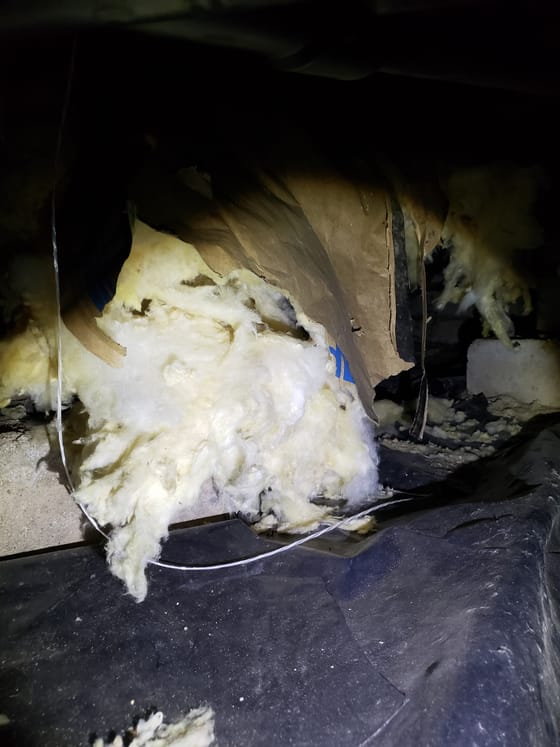
Crawlspace sill plates and rim joists. The timber sitting on the foundation, absorbing splash-back, ground moisture wicking through concrete, and the persistent humidity of an unlined crawl area. Structural, low, and the single most common location.
Framing under a long-running slow leak. Under a bathroom, behind a dishwasher, below a laundry, at a hose bib that has been weeping for a decade.
Deck ledger boards and the rim behind them. Where a deck was fastened to a wall without flashing, the framing behind it stays wet through every wet season. This is a chronic defect in the county’s housing stock.
Window and door framing on the weather elevation. Failed head flashing, a sill without slope, a bead of sealant that gave up years ago, and the water then runs down inside the assembly.
Posts and piers in ground contact, including form boards left in place after construction and old timber debris under an addition.
Outbuildings, fence posts and stored lumber. Not structural, but they are colony sites within easy flight distance of the house, which is why the flights happen at all.
The older Bellingham housing — Lettered Streets, Columbia, Sunnyland, York, South Hill — produces most of the crawlspace findings, because post-and-pier foundations put timber close to grade and a century of gutter history has run water down the same walls repeatedly. Around Lake Whatcom and along the forest edge the recurring one is deck framing, with plenty of downed wood on the surrounding lots holding colonies. In Lynden, Everson, Nooksack and Sumas it is outbuildings and structures built low to the ground. On newer stock in Barkley or Cordata it is rare, and where it happens there is nearly always one specific defect behind it — a failed flashing detail, or an irrigation head aimed at siding.
When they are in a stump rather than the house
A fair share of dampwood findings in this county are not in a building at all, and the right answer for those is different.
Colonies live perfectly happily in fallen alder and maple, in old fir stumps, in buried construction debris, in landscape timbers, in the bottom row of a woodpile that has been sitting on soil since 2019, and in fence posts and retaining sleepers that have gone soft at ground level. None of that is a structural problem. Rotting wood on a wooded lot in northwest Washington contains insects, and that is what rotting wood is for.
What it is, though, is a source of the flights. Alates do not travel far, so a colony in a stump twenty yards from a house is the likeliest explanation for a September evening of winged insects at a lit window — and it is also a supply of founding pairs looking for the next piece of wet wood, which might be a stump again or might be the rim joist behind your deck.
So the sensible response to wood-borne colonies in the yard is not treatment. It is removing or relocating the wood that sits closest to the building, getting firewood up off the ground and away from walls, pulling out buried offcuts and old form boards, and grinding stumps where that is practical. That reduces the population pressure near the structure without anybody spraying a woodlot, and it costs a weekend rather than an invoice.
The exception worth flagging is timber in ground contact that is doing a job — a post, a sleeper, a deck footing. That is structural, it is wet, and it is worth looking at properly rather than filing under yard debris.
Reading the damage
Opened timber tells you which insect you have even when nothing is moving.
Galleries run across the grain as well as along it, producing a chambered, layered look. Carpenter ants follow the softer spring growth and leave smooth channels that look almost sanded.
The galleries are not swept clean. Termites pack them with dark material — pellets and chewed wood — while ants housekeep and eject theirs. Finding galleries full rather than empty is one of the more dependable distinctions in the field.
Pellets accumulate below kick-out points, hard and gritty rather than powdery or fibrous, about a millimeter long and faintly hexagonal.
The wood around it gives. Because decay preceded the insects, a blunt probe sinks in where it should be stopping. Sound timber resists a screwdriver pushed by hand.
Shed wings collect on the vapor barrier, in corners, along sills.
Worth noting what EB0787 adds about established colonies: once running, they can extend activity into sound wood and even into relatively dry wood, and produce substantial structural damage where the conditions persist. The moisture requirement governs how a colony starts. It does not fence in forever what a colony that has already started will reach.
What treatment involves
The shape of the work is set by the biology, and it is unlike the soil-barrier approach that dominates termite marketing.
Settle the species first. Dampwood, carpenter ant, wood-boring beetle or decay alone. Everything downstream depends on that answer, and all four occur in the same crawlspaces here.
Establish how far it runs. Probing and sounding the length of the affected member rather than looking at the part that was visible from the hatch. Damage is almost always longer than the sign that revealed it.
Trace the water to a source. Not “the wood is wet” but where it is arriving from and what stops it. Meter readings on adjacent framing separate an active problem from a historical one, which sometimes changes whether treating is warranted at all.
Treat the wood, not the soil. Direct application into the galleries and into the affected members, with borate-based materials or other appropriate products depending on the situation. The colony is in the timber, so that is where the work goes.
Sequence the moisture correction. Drainage, grading, downspout extensions, a lapped vapor barrier, ventilation, the plumbing repair, the flashing detail. Some of that is crawlspace restoration or exclusion and repair work we do ourselves. Much of it belongs to a plumber, a roofer, a gutter contractor or a drainage specialist, and we say which is which.
Replace what has lost capacity. Decayed timber does not recover strength on drying. A failed sill plate, rim joist or post needs cutting out, and that is a builder’s job rather than a pest job. New material going into a location with a history is cheap to borate-treat before it is closed up and expensive to treat afterward.
Come back once the space is dry. A follow-up on a corrected crawlspace confirms the conditions have genuinely changed rather than been reported as changed.
What you get in writing, and what you do not
Worth being exact about, because this is where pest control companies are routinely vague.
What you get from us is a record of the treatment performed: the product used, the members and locations treated, and the date it was carried out. That is a useful document to keep, and it is what our work actually produces.
What you do not get from us is a document setting out findings of wood-destroying organism damage. Under Washington’s rules that is a regulated report with requirements of its own, and we are not structural pest inspectors — we hold treatment licensing rather than an inspector credential, and we do not issue that document. Anybody who tells you a treatment record is the same thing is either confused or hoping you are.
That boundary costs us nothing worth having. It is also the reason the rest of what we tell you is worth relying on.
What we will not sell you
A soil barrier for a dampwood colony. No soil dependency, no colony in the ground, no mechanism. Treating the perimeter of a house for an insect in a wet header is money aimed at the wrong place.
Tenting or fumigation. That is a response to drywood species in warmer, drier regions, and it is not a Whatcom County treatment. If it has been proposed to you locally, get a second opinion before signing anything.
A recurring annual program on a dry, sound building. Where pressure is genuinely recurring, a program earns its keep. Where the water has been fixed and the failed timber replaced, the condition that supported the colony is gone and a subscription is just a subscription.
Treatment of galleries with nothing living in them. Damage outlives insects by decades. Old workings in a joist are a record of history, not evidence of current activity, and treating them changes nothing.
A treatment over an unrepaired leak. The PNW handbooks are blunt about this: chemical application alone will not resolve this pest and should be discouraged where the underlying moisture problem persists. We agree, and we would rather say so before taking money than after.
Keeping them out, which is really water management
Every preventive measure for this species is a building maintenance task. That is the honest summary of the whole page.
Keep gutters clear and get downspout discharge well away from the foundation. Maintain a complete lapped vapor barrier over crawlspace soil and deal with standing water rather than living with it. Keep crawl vents open, screened and unburied by landscaping. Grade soil to fall away from the building and keep bark mulch below the siding line. Break every timber-to-soil contact you can find, including form boards and buried offcuts. Store firewood off the ground and away from walls, because a woodpile against a house is both a colony site and a bridge. Flash deck ledgers properly. Renew exterior sealant before it fails rather than after. Keep irrigation off the siding. Fix slow leaks while they are still slow.
And borate-treat new structural timber going into any location with a history. It costs very little at the moment the wall is open and it is effective for a long time.
How urgent this is, honestly
Somewhere between the two extremes people arrive with.
Nothing is going to fail this winter because of a dampwood colony. Section is lost across years, and anybody selling you urgency about imminent collapse is overselling a slow insect.
But the material involved is structural and sits at the base of the building, and the decay that preceded the colony has usually taken more capacity than the insects have. A moisture source left running for two more wet seasons costs substantially more to remedy than the same source dealt with now, and takes more timber with it on the way.
The signals that raise the urgency: a probe sinking into a sill plate or a post; springiness or visible movement in the floor above; standing water under the house; activity in more than one location; or soil tubes, which change the species question entirely.
The signals that lower it: one member affected, wood that is wet but still firm under a probe, an obvious and cheap water source, and a crawl area that is otherwise dry and ventilated.
Related work
The insect biology and the county-wide picture sit on our termite and wood-destroying pest page. Where the finding is in a crawl area, dampwood termites in a crawlspace goes through what the space itself is telling you. Where it is at a window, soft wood around a window sill covers the probe test and how far the damage usually runs. The same wet timber supports moisture ants, which is ant control, and correcting the conditions is generally crawlspace restoration.
Frequently asked questions
Should I be looking for mud tubes on my foundation?
Not as the primary sign, no. Mud tubes belong to soil-nesting species, and the dampwood termite does not build them because it lives inside the wet timber it eats. Looking for tubes and finding none tells you almost nothing about whether you have this species.
Large winged insects came to the porch light in September. What were they?
Most likely dampwood alates. WSU Extension records their flights on warm evenings in late summer or fall, especially after rains, and they come to lights readily. At roughly an inch including wings they are startling, and they are the way most households first learn the species exists.
How wet does wood have to be before this matters?
Wetter than most people picture. Serious fungal decay needs moisture content above the fiber saturation point, an average of about thirty percent, and air-dry timber below roughly twenty percent carries a reasonable margin of safety. Twenty is the safe line, not the point where trouble starts.
Is it a termite or a flying ant?
Antennae, waist and wings settle it. Termite antennae are straight and beadlike, the body has no pinched middle, and all four wings run to about the same length. A winged ant has elbowed antennae, an obvious narrow waist, and a front wing pair noticeably larger than the rear.
They swarmed indoors. Does that mean the colony is in the house?
It raises the odds considerably. Reproductives emerging inside a room, or a scatter of shed wings along an interior sill, points at wet timber within the building envelope. Alates around an outside light may have flown in from a stump, a log pile or a neighboring structure.
Will treating the insects fix it?
Only the insect half. This species cannot establish in sound dry lumber, so the wet wood that made the colony possible is still there after any treatment. The moisture correction is the part that changes the outcome, and it usually belongs to a plumber, a roofer or a drainage contractor.
How fast does the damage happen?
Slowly enough that panic is misplaced and steadily enough that waiting is a bad idea. Section is lost over years, not seasons. What raises the stakes is that decay was already at work in that timber before any termite arrived, and the two losses add up in the same members.
Sources
- WSU Cooperative Extension EB0787 — Termites: Biology, Prevention, and Control — read September 1, 2026
- Pacific Northwest Pest Management Handbooks — Wood-infesting pests: Termite — read September 1, 2026
- USDA Forest Products Laboratory — Wood Handbook, Chapter 14: Biodeterioration of Wood — read September 1, 2026
- OSU Extension Solve Pest Problems — Termites — read September 1, 2026
Rules change. This page is scheduled for review against its sources by September 1, 2027. If you are reading it after that date and something looks out of step with the current rule, the rule is right and we are wrong — please tell us.
Pest problem in Whatcom County?
Family-owned, no long-term contracts, and every treatment is backed by our 100% Service Guarantee.
Most calls in Whatcom County are out within 1–2 days, about 3 during the late-summer peak.
Last updated