
House Mouse — Small, Local, and Quick to Multiply
Mus musculus · Rodents
A house mouse needs about a quarter inch of gap, seldom travels more than thirty feet from its nest, and breeds fast enough that a single autumn arrival becomes a household by spring. It is not the hantavirus mouse in Washington — that is the deer mouse — but it warrants acting on early.
Call 360-410-2199 Request a free inspection
We treat this, and finding it usually warrants treating.
House mouse at a glance
| Size | Body about two and a half to just under four inches, tail another two and three quarters to four; under an ounce |
|---|---|
| Color | Gray to gray-brown above, only slightly paler beneath, blending rather than switching |
| Tail | About as long as head and body, scaly, nearly hairless and one color all the way round |
| How to tell it from a deer mouse | A deer mouse has a sharply white belly, bigger eyes and ears, and a furred two-tone tail |
| Droppings | An eighth to a quarter inch, pointed at both ends |
| Range | Seldom more than thirty feet from its nest; gets through a quarter-inch gap |
| When it moves in | From late September, hardest through October and November, elevated all winter |
| Health | Linked to LCM, salmonella and leptospirosis — not the hantavirus Washington reports |
Signs you have them
- Small droppings pointed at both ends in a drawer, a low cupboard or on top of a stored box
- A corner chewed open on a cereal box, or a pinholed bag of rice leaving a trail of grains
- Light, quick scurrying low in a wall around dusk and again before dawn
- Small tucked heaps of finely shredded paper, insulation fiber or fabric
- A faint, persistent smell in a closed cupboard or utility cabinet that matches nothing stored there
- A cat or dog that keeps returning to the same spot along a wall or cabinet
What a house mouse is
Mus musculus is small, gray-brown above and only slightly paler beneath, with small eyes, a pointed muzzle and a tail about as long as its head and body together that is nearly hairless and the same color all the way round. An adult weighs less than an ounce. Cornell’s rodent identification guidance gives the body at roughly two and a half to just under four inches, with the tail adding another two and three quarters to four.
It is not a native animal and it does not do well in competition with our native mice outdoors. What it is very good at is living inside human buildings, and it has been doing that alongside us for long enough that a modern house is effectively its native habitat.
The practical consequence, and the reason this profile is organized the way it is: a house mouse does not commute. It settles into a small territory inside a structure, feeds within it, nests within it, and breeds within it. Almost everything that goes wrong in dealing with one comes from treating it like an animal that ranges.
House mouse or deer mouse
This is the one identification on the page that changes the health advice, so it goes near the top.
A house mouse is one color from the shoulder to the belly — gray to gray-brown, blending rather than switching. Its eyes and ears are modest for its head. The tail is scaly, sparsely haired and uniform in color.
A deer mouse has a sharply white belly with a clean line where the brown stops. Its tail is well furred and distinctly two-toned, dark above and white below, and the line between the two runs straight. Its eyes and ears are noticeably larger. UC IPM uses those same features to separate the two, and once you have seen the tail difference you will never need the rest.
Habitat is a strong prior. Deer mice are animals of woodland edge, field margin and outbuilding, so a Sudden Valley cabin, a Lake Whatcom shoreline property, a seasonal home at the edge of forest or a barn out toward Everson is deer mouse country. A downtown apartment, a Sunnyland kitchen or a student rental near campus is house mouse country. Neither rule is absolute and both are useful.
You cannot tell the two apart from droppings. That matters, and it is why the cleanup method further down this page applies to all rodent waste regardless of what you believe left it.
A quarter of an inch, and a coin that is not
The single number worth carrying around is a quarter of an inch.

Washington’s Department of Health tells residents that mice can squeeze through openings as small as a quarter of an inch. Whatcom County’s own rodent guidance instructs sealing holes and gaps bigger than a quarter inch. The eXtension wildlife damage guidance gives the same threshold and specifies twenty-four-gauge quarter-inch mesh as the material for it. UC IPM is more precise again: a house mouse gets under gaps a quarter inch tall and through openings three-eighths of an inch wide.
For a physical reference, use a pencil. A standard hexagonal pencil is a quarter inch across the flats, it is in every drawer in the county, and it can be pushed into a suspect gap in a way a mental image cannot.
What not to use is the comparison that dominates online pest writing. A mouse hole is endlessly described as “the size of a dime,” and the dime is the wrong coin by a wide margin. The United States Mint publishes it at 0.705 inches across — very nearly three times a quarter inch, and larger than the half-inch figure the same literature gives for rats. Somebody sealing a house to the dime standard closes almost nothing and reasonably believes the job is done.
We have carried that phrasing ourselves in older writing, which is a fair part of why it appears here in this much detail. The number was always right. The comparison never was.
Thirty feet, and why it changes the whole job
UC IPM records that house mice seldom venture more than thirty feet from their nest site and food supply. That one behavioral fact explains most of what is peculiar about mouse work.
It explains why a mouse problem is so often confined to one part of a building while the rest of it is untouched. A kitchen infestation and a garage infestation in the same house can be two separate populations that have never met.
It explains why traps have to go close to the evidence. Ten feet apart along the active area, tight against a wall, trigger end toward the wall. A trap in the middle of a room is in a place a mouse has no reason to visit, and a trap in a different room may as well be in a different building.
It explains why a mouse can live in a wall cavity above a kitchen for months without anybody in the house seeing one.
And it explains why the exclusion work is different in emphasis from rat work. With a rat you are closing a building against an animal ranging in from outside. With mice you are frequently closing the interior route between a void and a living space at the same time as the exterior shell — the hole cut for a supply pipe under a sink, the gap behind a dishwasher, the open back of a cabinet run, the toe-kick void that connects to the floor structure.
The arithmetic nobody expects
Two sets of figures explain why “there was only one” is not the reassurance it sounds like.
Breeding. UC IPM gives five to ten litters a year of about five or six pups, with the young reaching sexual maturity in five to six weeks. That compounds rather than adds. A pair arriving in the second week of October has, by the standards of that arithmetic, a household by February.
Feeding. A mouse eats roughly twenty percent of its body weight daily, taken in something like two hundred separate nibbles over a night. It is not eating your food so much as sampling all of it, which is why contamination outruns consumption and why a single animal fouls far more than it removes.
Droppings. Cornell puts house mouse droppings at an eighth to a quarter inch, pointed at both ends. A single mouse leaves dozens of them a day. So a light scatter of fresh droppings in one cupboard usually means a recent arrival rather than a small tolerable population, and recent arrival is the cheap version of this problem.
Where they nest here
Mice nest in something soft, dark and within a few steps of food. In Whatcom County housing that is a short and predictable list.
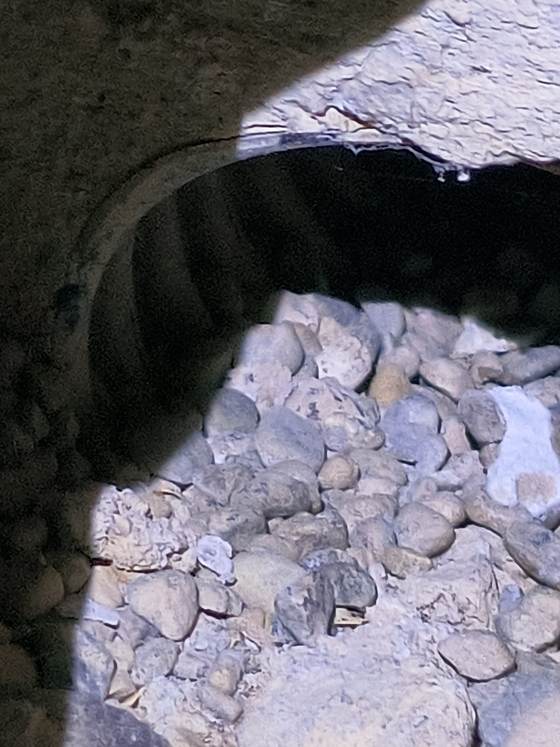
The void beneath a kitchen toe-kick, and the dead space at the back and underneath of a cabinet run. The insulated cavity behind a dishwasher or beside a range. The base of a hot water tank enclosure. The back corners of an attached garage, especially where stored boxes meet the wall. Inside stored soft goods — camping gear, upholstered furniture, a bag of cloth in a loft. Under a bath, and inside the boxed-in section of ceiling that carries the plumbing.
And, more than any of those, in insulation.
Signs, in the order they usually appear
Mice are quiet, small and mostly nocturnal, so the evidence generally arrives before the animal does.
Droppings, somewhere enclosed. A drawer, the back of a low cupboard, the shelf above a toe-kick, the top of a stored box. Fresh ones are dark, soft and slightly glossy; within a couple of days they dull and harden, and old ones crumble under pressure from something disposable. A mixture of both is the common finding and it means the activity has been running for a while and is still running.
Gnawed packaging. A corner opened on a cereal box, a bag of rice with a pinhole and a trail of grains, a chewed edge on a paper sack. The damage is often small enough to miss until you are looking for it.
A faint, persistent smell in a confined space — a cupboard under a sink, a utility cabinet — that does not correspond to anything stored there.
Sound. Light, quick scurrying rather than the heavier movement a rat makes, usually within an hour of dusk and again before dawn, and usually low in a wall where the cavity meets the floor structure.
Shredded material. Small heaps of finely worked paper, insulation fiber or fabric, tucked rather than scattered.
A pet that will not leave one spot alone. Cats and dogs are frequently the first detector in the house, and they are frequently right.
If you find droppings, it is worth leaving a representative patch undisturbed for a day rather than cleaning immediately. Where they are, how many and how fresh are the three questions that set the trap plan, and once the evidence is wiped away all three become guesswork.
Shared buildings, where one unit is never the whole story
Mice are the dominant rodent in apartments, duplexes and the student rental belt around campus, and shared construction changes what a solution has to cover.
A stud bay that runs behind two units is one space. A utility chase carrying supply pipe up through four floors is one route. A shared attic over a row of townhouses has no interior walls at the level the animal is using. So a mouse population in a building of that kind is a building-level population, and treating a single unit moves it sideways rather than reducing it.
That has an awkward practical consequence for whoever is calling. A tenant can seal the gap behind their own kitchen cabinet and gain something real, because that closes the route into the living space. What a tenant cannot do is close the foundation vent or the roofline that admitted the animals to the structure, and that is where the durable work is. If you are renting, the useful move is to document what you are finding and where, and to raise it as a building issue rather than a unit issue.
For an owner or a manager, the cheapest moment to do this properly is at turnover, when a unit is empty, the access is unobstructed and nobody’s schedule has to be worked around.
What mice do to insulation
Mouse damage in an attic or a crawlspace looks different from rat damage and is frequently underestimated because of it.
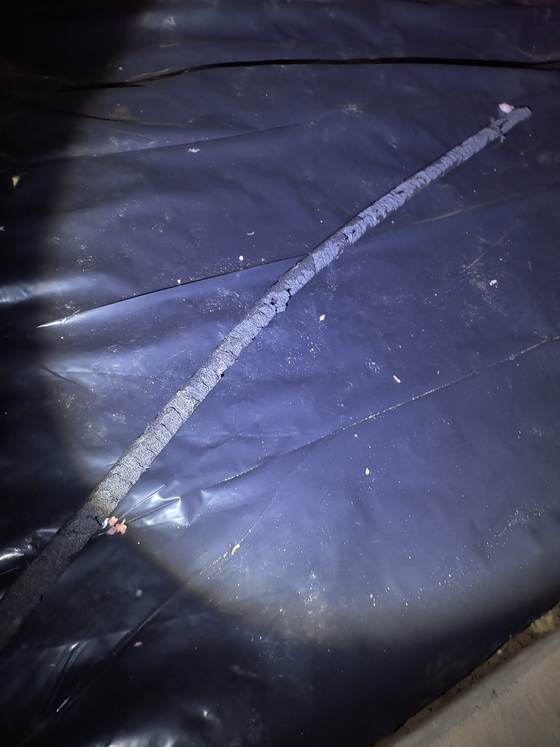
There is no dramatic swathe of material pulled down across several joist bays. What there is instead is a set of discrete, roughly fist-sized nests tucked against a top plate or into a corner, a network of shallow tunnels running through loose fill, and a general urine load along the routes between them, because mice are incontinent as they travel rather than depositing in one place.
Each of those reduces the still air the material holds, and trapped air is the whole mechanism by which insulation performs. So the loss is real even where the material looks broadly intact from the hatch, and in a climate with a long mild heating season it is a cost that runs quietly for years rather than announcing itself.
Where it goes far enough — nesting distributed through the material, saturation you can smell, tunneling that has taken the structure out of loose fill — the honest answer is removal and replacement rather than cleaning, which is attic insulation work, or in a crawlspace, cleanout and restoration. Where it has not, localized removal of the affected area and cleaning of the rest is the proportionate response, and that is more often the case with mice than with rats. Anybody quoting a full replacement for a mouse problem should be asked to show you why.
The sequencing is not negotiable either way: animals out, building closed, insulation last. New material laid into a building that is still open is bought for the benefit of next year’s mice.
What house mice carry, and what they do not
They do not carry the hantavirus Washington reports. This is the correction worth making loudly, because the internet is careless about it. The Washington State Department of Health states that hantavirus-infected deer mice excrete the virus in urine, saliva and droppings, that infected deer mice live throughout the state, that people are at risk anywhere in Washington, and that one to five cases are reported per year with roughly a one-in-three fatality rate. The species named in that guidance is Peromyscus maniculatus. Whatcom County’s health department repeats the attribution. Neither names Mus musculus, and neither names rats.
The department’s surveillance guideline adds the proportions, and they are worth carrying alongside the annual figure rather than instead of it: 58 Washington cases in total through 2022, 20 of which were fatal, and roughly seven in ten reporting their exposure east of the Cascades. Both halves of that matter to somebody reading this in Bellingham. The state genuinely does not carve the west side out of its risk statement, and the great majority of the exposure history this state has recorded sits on the other side of the mountains. Fewer than sixty cases in decades, most of them east, in a state of eight million people, is a different proposition from the impression a search result usually leaves.
That is not a reason to relax about house mice. It is a reason to be accurate about which animal is doing what, because a health warning attached to the wrong species eventually stops being believed for the right one.
What house mice are actually associated with is a shorter and less dramatic list. UC IPM names leptospirosis, salmonella and lymphocytic choriomeningitis. CDC’s LCM fact sheet is direct on the last of those: the primary host is the common house mouse, roughly five percent of house mice across the United States carry the virus, they shed it for life without appearing ill, and exposure comes from fresh urine, droppings, saliva or nesting material. Illness is usually mild and fatality is under one percent, but infection during pregnancy can affect a fetus, which is the one circumstance in which this is more than a nuisance.
Allergen load is the underrated one. Mouse urine is a significant indoor allergen, and in a building with a long-running population it accumulates in exactly the dust that gets disturbed by cleaning. In a household with an asthmatic occupant this is frequently the most consequential thing a mouse population is doing.
The cleanup rule follows and applies to everything. Air an enclosed space for at least thirty minutes before you go in. Do not sweep and do not vacuum dry droppings or nesting material. Wet it down with a ten percent bleach solution and give it ten minutes. Pick up with disposable towels, wearing gloves, and bag it for an outside bin. That is Washington’s own guidance and it is written for the worst case, which is the correct way to write it when the species cannot be told apart by eye.
Trapping, and where it goes wrong
Mice are, helpfully, the opposite of rats on the one behavior that matters most. Rats avoid new objects for days. Mice investigate them, sometimes within hours of placement. So a mouse trap line that is set correctly usually produces results the first night, and a line that produces nothing for a week is telling you something about the setting rather than about the population.
The usual error is quantity. One trap under a sink is a gesture. Six to a dozen across the active area is a trap line, and the cost of the extra traps is trivial against a second visit.
The second is distance. Thirty feet is the animal’s world; traps outside it are ornaments.
The third is orientation. Set tight against a wall with the trigger end toward the wall, so the animal running its usual route along the baseboard passes over the trigger rather than around the back of the trap. Pairs set an inch or two apart increase the odds. Peanut butter works, and so does a wisp of nesting material, which is sometimes better in a house with abundant food.
The fourth is the one people do not expect. Where mice are living in insulation, floor traps catch the animals traveling and miss the ones that never come down. Traps have to go into the material’s plane — against top plates, along the joist runs, at the edges of the affected bays — and that means somebody willing to go up or under rather than leaving a box by the hatch.
Glue boards we do not use. They are slow, indiscriminate, and they leave you with a live animal to deal with.
Bait, and the two reasons for caution
Rodenticide has a legitimate role in exterior and commercial pressure management. Inside a house with mice it is usually the wrong tool, for two separate reasons worth stating rather than implying.
The first is where the animal dies. A mouse that has taken bait goes back to the place it feels safest, which is inside a wall cavity, a floor structure or a cabinet base. Washington’s health department makes the same point in its own guidance. The odor runs for weeks, it draws flies on top of itself, and sometimes the only remedy is opening the wall.
The second is everything downstream. Anticoagulants kill slowly, poisoned animals keep moving, and predators take the dose with the prey. EPA removed the second-generation anticoagulants — brodifacoum, bromadiolone, difenacoum and difethialone — from consumer products specifically because they pose greater risks to non-target species that eat bait once or eat animals that have, and left them available to professionals. That places the responsibility on product choice and placement rather than on the label. Owls, hawks, coyotes, cats and dogs are the animals on the receiving end of getting it wrong, and in the rural parts of this county the owls are doing more rodent work than any of us.
So: trapping inside the envelope, bait outside it and in tamper-resistant stations where property pressure genuinely warrants it, and products selected to limit secondary exposure rather than by cost per block.
The season, and the honest verdict
Mouse pressure in this county climbs from late September, runs hard through October and November and stays elevated all winter. What changes is not the number of mice outdoors but the relative appeal of a heated building once cover has died back and outdoor food has declined. A house that was untroubled all summer and has mice in the second week of October did not get worse; the weather did, and the quarter-inch gap was always there.
Which sets up the qualification this page owes you. The verdict above says we treat this, and we do. But trapping is a recurring cost and sealing is a one-time one, and a building that gets trapped every autumn is a building whose shell was never closed. Quarter-inch hardware cloth over vents, sheet metal at chewable edges, closed penetrations under the sink and behind the range, a door sweep with a gap under a quarter inch, and a crawlspace hatch that actually latches. That is exclusion and repair, and on a mouse problem it is what makes the trapping the last time rather than the first of many.
The window for doing it comfortably is the second half of August, on an empty shell, before anything has moved in.
When it is not a house mouse
If the animal has a white belly with a hard edge to it and a two-tone furry tail, it is a deer mouse, and the cleanup guidance above matters more rather than less.
If the droppings are noticeably bigger than a grain of rice and blunt at the ends, the trap line and the gap sizes both change — that is a Norway rat or a roof rat, and being under-trapped for a rat is a common and expensive way to lose a month.
If what you are finding is closer to coarse ground pepper than to a pellet, it is not a rodent at all.
And if the noise is overhead in daylight and heavier than a mouse could produce, it is very likely something we do not handle, in which case we will say so on the phone rather than after driving out.
Where to start
Tell us what you have found and where, leave a representative patch of droppings undisturbed if you reasonably can, and get dry goods into rigid sealed containers in the meantime. Somebody will look at the building rather than the room — the connected voids, the crawlspace with a light, the exterior at ground level — and give you a plain account of the entry points, the trap plan, and whether the insulation genuinely needs to come out.
The broader shape of that work sits on rodent control, and the specific case most people arrive with is covered at droppings in the kitchen.
Frequently asked questions
How small an opening does a house mouse really need?
About a quarter of an inch, which is the width of a standard pencil. UC IPM puts it more precisely still: mice squeeze under gaps a quarter inch tall and through openings three-eighths of an inch wide. Washington's health department and Whatcom County both use the quarter-inch figure.
Do house mice carry hantavirus?
Not the hantavirus Washington reports. The state health department attributes hantavirus pulmonary syndrome here to deer mice and names the species directly. House mice are associated with a different virus, LCM, along with salmonella and leptospirosis, so careful cleanup still applies.
I have only seen one mouse. Is that really a problem?
It is worth acting on now rather than later. Females can produce five to ten litters a year of about five or six pups, and those pups are breeding within five or six weeks. The cheapest version of this problem is the one you deal with in week one.
Why do the traps in my kitchen catch nothing?
Often because they are outside the animal's world. A house mouse seldom goes more than thirty feet from its nest, so traps belong within a few feet of the droppings, tight against a wall, roughly ten feet apart along the active area — not spread evenly around a house.
Can mice really damage the insulation?
They shred it for nests, tunnel runs through it and urinate as they travel, and all three reduce the trapped air that makes insulation work. Mouse damage is patchier than rat damage, which is why the honest recommendation is more often localized cleaning than a full replacement.
Is it worth sealing if I am already trapping?
Sealing is the part that changes next autumn. Trapping empties a building of the animals in it and leaves the opening they used, so a house that is trapped every October is a house with an unresolved quarter-inch gap somewhere in its shell.
Sources
- UC IPM Pest Notes 7483 — House Mouse — read September 1, 2026
- Washington State Department of Health — Rodents — read September 1, 2026
- Washington State Department of Health — Hantavirus — read September 1, 2026
- Washington State Department of Health — Hantavirus surveillance guideline (DOH 420-056) — read September 2, 2026
- CDC — Lymphocytic choriomeningitis (LCM) fact sheet — read September 1, 2026
- Cornell University IPM — Mouse and rat biology and behavior — read September 1, 2026
- Whatcom County Health and Community Services — Rodents — read September 1, 2026
- eXtension Wildlife Damage Management — Rodent exclusion methods — read September 1, 2026
- US EPA — Restrictions on rodenticide products — read September 1, 2026
- United States Mint — Coin specifications — read September 1, 2026
- Washington State Department of Health 333-161 — Plague Surveillance in Washington State, Summary Report 1975-2008 — read September 3, 2026
Rules change. This page is scheduled for review against its sources by September 1, 2027. If you are reading it after that date and something looks out of step with the current rule, the rule is right and we are wrong — please tell us.
Pest problem in Whatcom County?
Family-owned, no long-term contracts, and every treatment is backed by our 100% Service Guarantee.
Most calls in Whatcom County are out within 1–2 days, about 3 during the late-summer peak.
Last updated