
Is This a Hobo Spider?
Most spiders identified as hobo spiders in Whatcom County are not hobo spiders, and the reputation attached to the name has been substantially walked back. Reliable identification needs magnification, and the practical question — whether a spider in your house is a danger — has a reassuring answer.
Call 360-410-2199 Request a free inspection
What to do, in order
- Look at the legs from a foot away: visible dark bands rule a hobo spider out, but plain legs prove nothing
- Catch it with a glass and a stiff card; a small jar of rubbing alcohol keeps it identifiable, while a squashed spider usually is not
- If you photograph it, shoot from above, from the side and up through the base of a clear container, with something in frame for scale
- If a wound is worrying you, see a doctor rather than trying to name the spider
- Cut the numbers indoors by changing bright white lights near doors, fitting door sweeps and knocking webs down weekly for a month
- Send us the photo or bring the specimen for a free opinion, and call for a visit if a black widow turns up in a woodpile, shed or crawlspace
The question behind the question
Nobody really wants to know the species. What they want to know is whether the large fast brown spider in the bathtub can hurt them, and whether they should be worried about their children or their dog.
So we will answer that first, plainly: no spider that commonly lives in Whatcom County homes presents a meaningful danger to a healthy person. The species most often called a hobo spider is usually not one, and the hobo spider itself is no longer regarded by the people who study this as medically significant.
The longer version is worth reading, because the reputation attached to this particular spider has done a great deal of unnecessary damage, and the way it came apart is instructive.
How the reputation was built and taken apart
The hobo spider arrived in the Pacific Northwest from Europe some decades ago and spread through the region. In the late 1980s a small body of work proposed that its bite caused necrotic skin lesions — tissue death — similar to those attributed to the brown recluse.
That claim was picked up widely. It reached public health guidance, it reached newspapers, and it reached the general awareness of anybody living in this part of the country. For years it was simply what everyone knew.
It has not held up. Subsequent researchers were unable to reproduce the original findings. The case reports underpinning the claim were re-examined and found to be weak, largely because the wounds involved were attributed to a spider that was rarely, if ever, actually caught in the act. Studies of verified bites — cases where the spider was captured and identified — did not produce the lesions.
The Centers for Disease Control removed the hobo spider from its list of venomous spiders, which is about as clear a public retraction as that kind of guidance produces. We are deliberately not attaching a year to that. The date usually quoted for the removal cannot be traced back to any agency page, and a correction that leans on an unverifiable detail hands the argument straight back to whoever wants the old story kept. What can be checked is the removal itself, which the regional insect management handbook published jointly by Washington State University, Oregon State and the University of Idaho records, and the current federal guidance on venomous spiders for outdoor workers, which names the black widow and the brown recluse and nothing else.
Washington’s own health department has moved the same way. The Department of Health states that hobo spiders are not considered dangerous as previously thought, describes them as shy and reluctant to bite, and says directly that there is no evidence hobo spider venom has caused skin necrosis or necrotic wounds in people. That is the state agency for the state you are standing in, not a contrarian reading of the literature.
Meanwhile, in Europe, where the same spider has lived alongside people for far longer, it has never had this reputation at all.
None of that means a hobo spider bite is pleasant, and we are not offering medical advice. It means the specific fear — that this spider causes rotting wounds — rests on evidence that did not survive scrutiny.
Why identification is genuinely hard
We are frequently sent photographs and asked to confirm. We answer honestly, which usually means saying it cannot be done from the image.
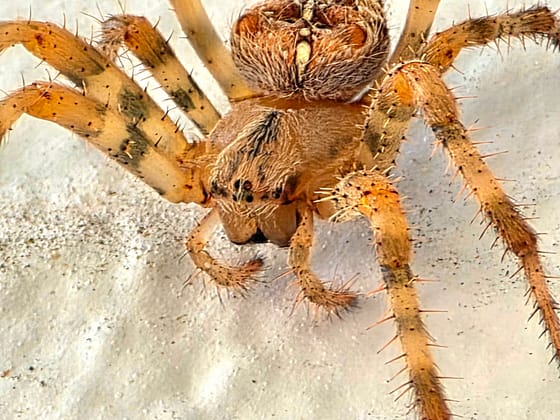
Hobo spiders belong to a group of funnel weavers that look very similar to each other. Separating them reliably requires magnification and examination of anatomical details — the reproductive structures, the pattern on the underside of the abdomen, features of the pedipalps in mature males. These are not things visible in a phone photograph of a spider on a wall.
The features people commonly rely on do not settle it. The chevron pattern on the abdomen is the test that circulates most widely, and the thing worth noticing about it is that neither WSU Extension’s identification factsheet nor UC IPM’s pest note on the species uses it at all. Both skip the markings and go to the reproductive structures. Size overlaps as well, and it overlaps in the reassuring direction: the giant house spider is generally the larger animal, so a big frightening spider is an argument against the hobo rather than for it.
Leg banding deserves a paragraph of its own, because a real character has been buried under a bad folk test. WSU’s key uses banding as an exclusion and nothing else. Visible dark rings on the legs rule the hobo spider out, because its legs are uniformly colored, and that is a genuine piece of information you can use from a foot away. What people do with it instead is run it forwards — plain legs, therefore a hobo — and in that direction it is worthless, because a great many harmless funnel weavers have unremarkable legs too. Ruling a species out is not the same as ruling one in, and most of the confident kitchen-table identifications made in this region have come from reversing that test.
The one field character that does real work needs the spider on its back, which usually means looking up through the base of a clear container. The sternum is the plate on the underside between the leg bases. WSU’s key gives the hobo spider a pale stripe running down the middle of it, and gives the giant house spider and the barn funnel weaver three or four pairs of pale spots along the sides instead. Spots mean it is not a hobo. On a live animal moving at the speed these things move, that is harder than it sounds.
Arachnologists themselves generally will not identify these to species without a specimen and a microscope. So when a pest control company confidently tells you what you have from across a room, that confidence is not coming from the spider.
What you probably have
In this region, the large brown spiders found in houses are most often one of these.
Giant house spider. Closely related to the hobo, considerably more common in homes here, and larger — a leg span that genuinely surprises people. Fast, which is what makes it alarming. Entirely harmless. This is what the majority of “hobo spider” sightings turn out to be. UC IPM goes further than mere abundance and records that in parts of the Pacific Northwest this larger species has competitively displaced the hobo spider. We say displaced rather than eaten on purpose: giant house spiders do take other spiders, but the published claim about the two of them is about which one holds the ground, and we are not going to dress a competition result up as a hunting story.
Other funnel weavers. A group of similar-looking spiders that build the flat sheet webs with a funnel retreat at one edge, in corners, window wells, wood piles and vegetation.
Cellar spiders. Very long thin legs, small body, in loose tangled webs in corners and crawlspaces. Harmless, and they eat other spiders.
Cross orb weavers. The large garden spiders that build the classic wheel webs outside in late summer, often across doorways overnight. Striking, completely harmless, and one of the more useful animals on a property.
Wolf spiders. Ground hunters that do not build webs, sometimes large, sometimes seen carrying an egg sac or young. Harmless.
Black widow. The western black widow is a Washington spider, and the state Department of Health describes it as common to eastern Washington. Its range follows the drier, warmer country east and south of the Cascades, which is roughly the opposite of what this county offers it, so on this side of the mountains it is uncommon rather than routine. Where one does appear here it is in something dry and undisturbed — the underside of stored material, a woodpile, a meter box, a crawlspace corner — and not in living space. Identifiable by the glossy black body, the globular abdomen and the red hourglass on the underside. It is the one local spider worth treating with respect, and even so, bites are rare and serious outcomes rarer.
The brown recluse question
Because it comes up in nearly every conversation: brown recluse spiders do not live in western Washington.
Their established range is the central and southern United States. We have never encountered one in Whatcom County. Nationally, the occasional specimen turns up outside the range having arrived in freight or in somebody’s belongings, and those cases are notable precisely because they are rare.
Meanwhile a very large number of skin wounds get attributed to brown recluse bites in places where the spider does not exist. Studies looking at this have found that the great majority of such wounds turn out to be something else entirely — bacterial infections including staph, other skin conditions, and a range of causes with nothing arachnid about them.
The practical consequence is that if you have a wound you are worried about, the right response is medical attention rather than spider identification. A doctor can treat the wound. Knowing what spider was or was not in the room does not change the treatment and can delay it.
Reading the web instead of the spider
If you want a practical way to narrow things down without catching anything, the web is easier to identify than its occupant and it is right there in the corner.
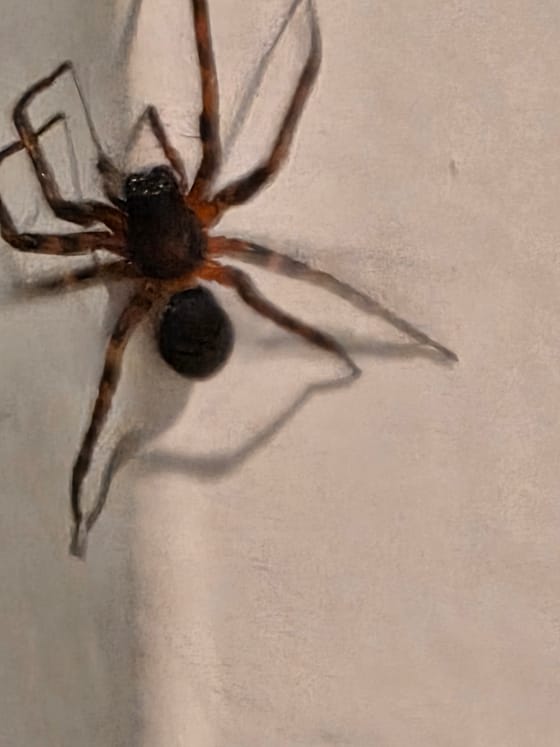
A flat horizontal sheet with a funnel or tube at one edge, usually in a corner, a window well, against a foundation, or in low vegetation. That is a funnel weaver, which is the group the hobo and the giant house spider both belong to. The spider waits in the tube and rushes out across the sheet. These webs are not sticky; they work by tangling and by speed.
A classic wheel-shaped web with radiating spokes, usually rebuilt daily and often across a doorway or between shrubs. Orb weaver, almost certainly a cross orb weaver here. Outdoors, seasonal, harmless and worth admiring.
A loose, messy, three-dimensional tangle in a corner of a ceiling, a crawlspace or a garage, with a very long-legged spider hanging upside down in it. Cellar spider.
A small, dense, irregular tangle low down in a dark undisturbed place — under a shelf, behind stored material, in the corner of a crawlspace — with a notably strong, almost crackly silk. This is the one worth a second look, because that description fits a black widow. Look for a papery tan egg sac about the size of a pea.
No web at all, spider on the ground or a wall, moving purposefully. A hunter — a wolf spider, or a wandering male of a web-building species during the autumn walk.
That taxonomy of webs will resolve most household questions faster than trying to photograph a spider that is moving.
Why so many in autumn
The seasonal wave that drives most spider calls here has a simple explanation.
Male spiders of several species mature in late summer and leave their webs to find females. They walk, often considerable distances, and they walk into buildings. That produces a few weeks in late summer and autumn where people suddenly see spiders every day — in bathtubs, crossing floors, on walls — having seen almost none all year.
They are not moving in for the winter and it is not an infestation. It is a mating season, and it ends.
There is a second reading of those same weeks, and it comes from the reference collection for this region rather than from the pest control trade, so it is worth carrying. The Burke Museum’s arachnology material holds that house spiders are largely a distinct indoor-adapted lineage rather than garden spiders that wandered in, and that generally fewer than five percent of the spiders seen indoors have ever been outdoors at all. Read that way, the male crossing your hallway did not enter the house in September. He hatched in it, or in the crawlspace under it, and what changed this month is that he stopped sitting in a web and started walking.
Both readings are probably true in some proportion, and the proportion is a question for people with a museum collection rather than a work van. For a household it does not matter which one dominates, because they recommend the same things. Under either, the animals were in and around the building long before anybody noticed them. Under either, the gap at floor level is worth closing, because it is a route in from the foundation and a route up from the crawlspace at the same time. Under either, the insect supply is the lever. And under either, the season stops in November on its own.
The bathtub thing has its own explanation, since everyone asks: a spider that walks into a smooth-sided tub or sink cannot climb back out. It did not come up the drain. It fell in and got stuck.
What actually reduces spiders indoors
Spiders follow their food. A house with a lot of spiders has a lot of insects, and dealing with the insects does more than dealing with the spiders.
Exterior lighting. This is the largest lever and the least used. Bright white lights near doors and windows draw insects in quantity, and everything that eats insects follows. Switching to warmer color temperatures, using motion sensors, or moving a light away from a doorway reduces the whole chain.
Door sweeps and weatherstripping. Most spiders indoors walked in at floor level. Closing that gap is genuinely effective and it helps with several other problems at once.
Screens repaired, and window frames sealed where they have moved.
Webs knocked down regularly, inside and out. A web that is removed consistently is not rebuilt indefinitely, and the effort of doing it weekly for a month is repaid.
Vegetation off the walls. Shrubs and climbers touching a building are both habitat and bridge.
Clutter reduced in garages, crawlspaces and storage areas, which is where the few spiders worth avoiding actually live.
Moisture addressed, because damp ground produces insects in volume and the whole food chain scales with it.
Treatment has a place — a targeted application at entry points and harborage before the autumn wave, and specific attention where a black widow is found in a crawlspace or a woodstore. What it will not do is make a wooded lot in Whatcom County spider-free, and anybody promising that is selling a subscription.
Where they come in, specifically
Since sealing is the measure that actually works, it helps to know the openings that matter for spiders in this county’s housing.
The gap under an exterior door, particularly a garage side door or a basement door where the sweep has hardened or worn at the corners. This is the single biggest one at ground level.
Sliding door tracks, which are almost never sealed at the ends and which open directly into living space.
Window frames on older stock where the trim has moved away from the siding, and window wells that hold leaf litter and become a spider habitat in their own right.
Crawlspace vents and the crawl access hatch, which connect a damp insect-rich space to the floor structure above it.
Utility penetrations — the holes cut for water, waste, gas, power, cable and heat pump lines — which in most buildings were sealed to keep weather out rather than arthropods.
Unscreened or poorly screened attic and gable vents.
And the route people never think of: dryer and bathroom vent outlets whose flaps have stopped closing.
Every one of those is also a rodent, moisture or heat-loss issue, which is why closing them is worth doing regardless of how you feel about spiders.
The case for leaving most of them alone
We will make this argument even though it costs us work.
Spiders are predators of the insects people actually mind — flies, mosquitoes, moths, and a good deal else. A cellar spider in a crawlspace corner and an orb weaver on a porch are doing useful work, for free, continuously.
They are also, with the single local exception of the black widow, harmless. Spider bites in general are far less common than people believe; most spiders cannot readily penetrate human skin, and the great majority have no interest in biting anything that is not prey.
Our practical recommendation for most households is to remove the ones you do not want to live with — the ones in bedrooms, the ones over a bed, the webs across a doorway — and leave the rest. That is a completely legitimate approach and it costs nothing.
What the internet gets wrong about this
A brief note on sources, because this is a topic where searching makes people more frightened rather than better informed.
A great deal of what circulates about hobo spiders online predates the retraction. Articles from the 1990s and 2000s repeating the necrosis claim are still indexed, still shared, and still read as current. Nothing marks them as superseded.
Photographs labeled as hobo spiders are frequently something else, because — as above — most people cannot identify them and the labels get copied along with the images.
Wound photographs attributed to spider bites are, in the great majority of documented cases, something with a different cause. That is not a fringe view; it is the consistent finding when researchers follow up on such cases.
And the general shape of the coverage rewards alarm. An accurate article saying that the large spider in your basement is harmless does not travel the way a frightening one does.
If you want to check something, the useful sources are the university extension services in this region and the arachnologists who publish on it. Washington State University’s extension material on Pacific Northwest spiders is a good starting point and it reflects the current position rather than the retracted one.
Where we do treat without hesitation
Black widows in a location people reach into. A woodpile, a crawlspace, a garage shelf, the underside of outdoor furniture, a shed used regularly. Worth dealing with and worth being told about.
Heavy autumn pressure at entry points, where a targeted application before the wave takes the edge off a genuinely difficult few weeks.
Any situation involving someone with a serious anxiety about spiders. That is a real quality-of-life issue and we do not think it is silly. The approach is the same — entries, lighting, webs, insects — but the priority is different.
Crawlspaces and garages with heavy webbing and populations, where the underlying moisture and insect situation usually needs attention as well.
Catching one safely
If you want a specimen identified, catching it intact is straightforward and does not require touching anything.
The glass-and-card method works on almost any spider: put a glass or a jar over it, slide a piece of stiff card underneath, and lift. From there it goes into a sealed container. If you want it identified rather than released, a small jar of rubbing alcohol preserves it perfectly and keeps the features that matter intact; a squashed spider on a tissue usually cannot be identified at all.
If you would rather not get that close, a vacuum with a hose captures them reliably, though it damages the specimen.
For photographs, the useful angles are from directly above showing the whole animal, from the side, and — if you can manage it through the base of a clear container — from underneath. Something for scale in the frame helps a great deal. Even then, we may tell you it cannot be resolved to species, and that answer is more useful than a confident guess.
What we will tell you
Send a photograph or bring us a specimen and we will tell you what we think it is, including when the honest answer is that it cannot be identified without magnification.
If you want the whole property looked at, we will do that free of charge and tell you where the insects are coming from, what is drawing them, and which of the practical measures above would make the most difference in your particular building.
What you will not get is a claim that a spider on your wall is dangerous when the evidence does not support it, or a recurring program sold on the back of a fear that has been retired by the people who study these animals for a living.
Frequently asked questions
Are hobo spider bites really dangerous?
The evidence behind that reputation has largely fallen apart. The claim rested on a small number of studies that later work did not support, and the agency that once listed the species as medically significant removed it. Current expert opinion does not treat it as dangerous.
How can I tell if mine is one?
Honestly, from a photograph you usually cannot, and neither can we. Reliable identification requires magnification and examination of features on the underside and the pedipalps. Anyone identifying one confidently from across a room is guessing.
What is the big fast brown spider in my basement then?
Most often a giant house spider, which is closely related, considerably more common in this region, and harmless. It is larger, it runs fast, and it is what the great majority of hobo spider sightings actually turn out to be.
Do we have brown recluses here?
No. Brown recluse spiders do not live in western Washington. We have never encountered one in this county and the occasional specimen found nationally outside their range arrives in freight. A wound blamed on one here almost always has another cause.
Why do I see so many in the fall?
Those are mostly mature males walking in search of females, which happens across a few weeks in late summer and autumn. It reads as an infestation and it is a mating season. It ends on its own.
Can you get rid of the spiders entirely?
No, and nobody can. What genuinely reduces what you see indoors is sealing entry points, reducing the insects they follow, changing exterior lighting and removing webs regularly. Treatment alone is temporary.
Does it cost anything to have you identify one?
No. Bring us a specimen or send a photograph and we will tell you what we think, including when the honest answer is that it cannot be identified from a picture.
From the blog
Spider Control in Whatcom County?
Family-owned, no long-term contracts, and every treatment is backed by our 100% Service Guarantee.
Most calls in Whatcom County are out within 1–2 days, about 3 during the late-summer peak.
Last updated