Yellow Sac Spider — Cheiracanthium spp.
Cheiracanthium spp. · Spiders
The yellow sac spider is a small pale hunter that spends the day in a silk pocket in a ceiling corner and hunts at night without a web. Washington's health department lists it as one of only two spiders of medical significance in the state. Its bite stings and then fades; the necrosis reputation is not supported.
Call 360-410-2199 Request a free inspection
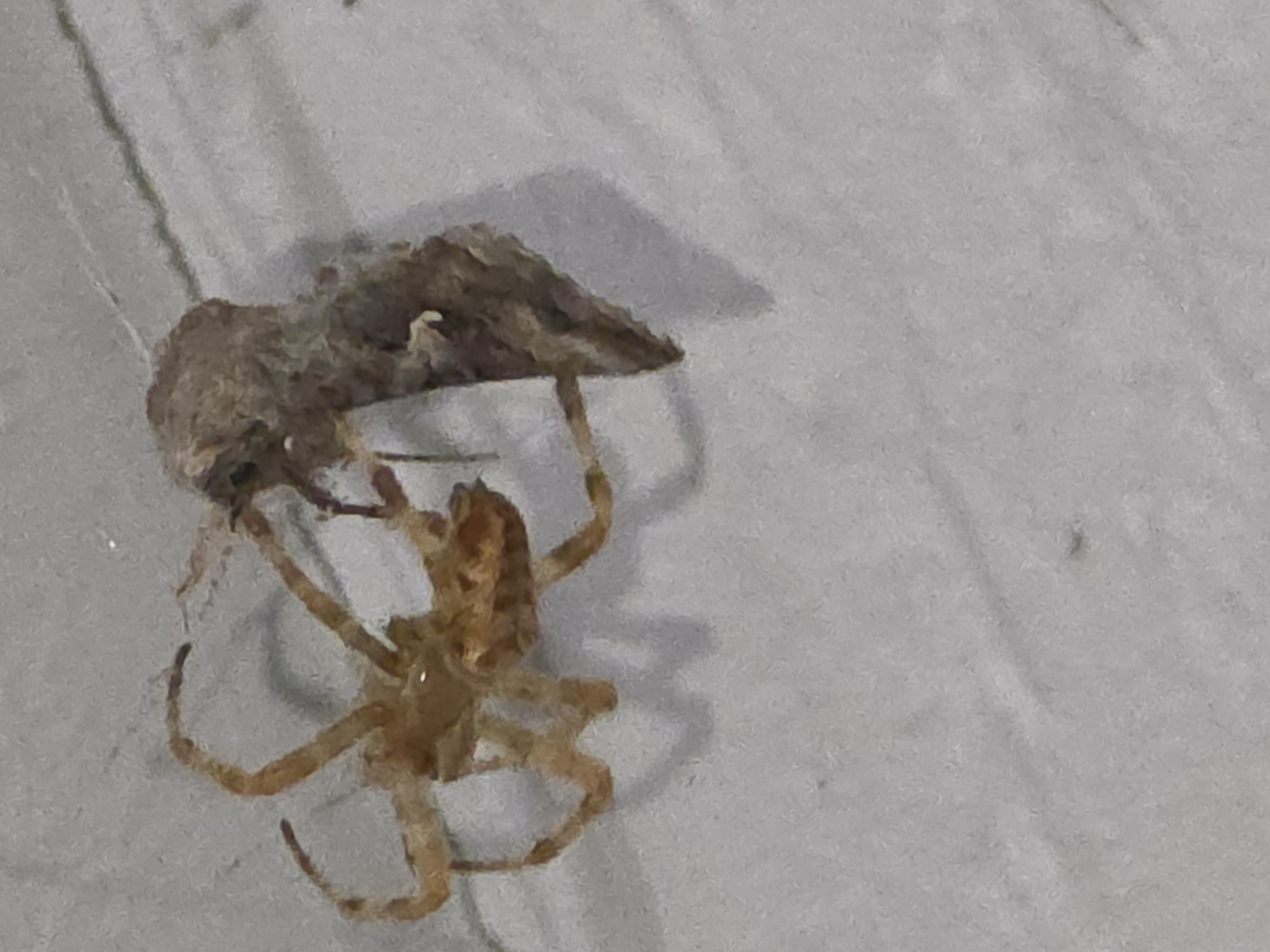
Sometimes worth treating, sometimes not — it depends on what is below.
Yellow sac spider at a glance
| Size | Females 5 to 10 millimeters, males 4 to 8 — roughly a quarter to half an inch |
|---|---|
| Color | Pale cream, light yellow or faintly greenish, with a darker head end and legs |
| Legs | Dark tufts at the tips that look like small socks |
| How to tell it from a giant house spider | Far smaller and pale, high on walls and ceilings; the house spider is brown, big and at floor level |
| Web | No capture web — a small closed silk pocket where walls meet walls or ceilings |
| Bite | A bee-sting pain, redness and itching that settle in a day or two; the necrosis story is not supported |
| Do we treat it | Depends — worth acting on in bedrooms or with repeated bites, not for one on a wall |
Signs you have them
- Small flattened pockets of dense white silk in ceiling corners and along window heads
- Silk retreats behind picture frames, at the top of door casings and in curtain folds
- A pale spider walking across a ceiling or wall at night
- A sudden sharp sting when pulling on a sleeve or rolling over in bed
- More retreats appearing in bedroom corners as autumn nights cool
Why this one gets its own page
Most of what this library has to say about spiders is that the frightening ones are harmless. This page is the exception, and it is worth being straight about in both directions.
The yellow sac spider is small, pale, easy to miss, and almost never mentioned by the companies that will happily sell you a treatment against a hobo spider. It is also the spider in a Whatcom County house most likely to actually bite somebody. Washington’s Department of Health names exactly two spiders in the state as being of medical significance: the black widow, which is a species of the drier country east and south of the Cascades and uncommon on this side of them, and this one.
So on our side of the mountains, in an ordinary bedroom, this is the realistic answer to “what could bite me.”
And then the second half, which matters just as much: the bite is a minor event. It stings sharply, it goes red, it itches, and within a day or two it is finished. The reputation this spider carries for eating a hole in people’s skin is the same kind of story the hobo spider carries, built the same way, and it is not supported by the evidence either.
Getting both halves right is the whole job of this page. A real bite is a real if small thing, and the horror stories are not.
What it looks like
Small, pale, and unremarkable, which is most of why people do not spot them.
Size. Penn State Extension puts females at 5 to 10 millimeters in body length and males at 4 to 8. UC Davis gives the same range as roughly a quarter to half an inch. That is a spider the size of a grain of rice with legs, and it is a fraction of the bulk of the large brown spiders that generate autumn phone calls.
Color. Pale throughout — cream, light yellow, or with a faintly greenish cast to the abdomen. UC Davis notes that the legs and the front body section run darker than the abdomen, which reads as a pale body with a slightly tea-colored head end.
Jaws. On the agrarian species, Penn State records distinctly dark brown chelicerae against the pale body, which is often the most visible marking on the animal.
Feet. Utah State Extension gives the field mark most people can actually use without a lens: brown-to-black tufts of hair at the ends of the legs that look like small socks. On a pale spider on a white ceiling, the dark tips are the part your eye catches.
Eyes. Eight, in two level rows of four, which matters only if you have the animal in a container and a magnifier, but it does separate the group cleanly from the funnel weavers.
There are two species involved in most of North America. Penn State describes Cheiracanthium inclusum, the agrarian sac spider, across much of the country, and C. mildei, a European arrival, now established throughout the United States north of Virginia, Utah and California — which includes all of Washington. The regional handbook that WSU, Oregon State and the University of Idaho publish jointly lists both under the yellow-legged sac spider for the Pacific Northwest. For a household the two behave identically and nothing turns on which one is on the ceiling.
The silk pocket, which is the real field mark
You are far more likely to find the retreat than the spider.
This species does not build a capture web. What it builds is a small flattened tube or pocket of dense white silk, closed at one end, tucked exactly where two surfaces meet — Utah State’s description is where walls meet other walls or ceilings. Behind a picture frame, at the top corner of a door casing, in the angle above a window, along the underside of a shelf, in the folds of a curtain where it hangs against the wall, or under the lip of outdoor siding.
The spider spends the day inside it. At night it leaves, hunts, and either returns or spins a new one somewhere else, which is why an actively occupied house accumulates small silk patches in ceiling corners over a season.
On a white or cream ceiling these are close to invisible. Penn State’s note is that the retreats blend in with the background coloration of light-colored walls, and in practice most people only notice them once they have been told what to look for and then find eleven of them in one room.
If you are trying to work out whether you have this spider, look at the junctions rather than for the animal. A flashlight held at a low angle across a ceiling corner picks the silk out immediately.
It hunts, and that is why it bites
The behavior is the whole explanation for the medical entry, so it is worth laying out plainly.
A funnel weaver or an orb weaver sits in a structure and waits. It has no reason to cross a person and considerable reason to avoid one. A yellow sac spider does the opposite: it leaves its retreat after dark and walks, over ceilings, down walls, across furniture, over bedding, hunting insects and — Utah State includes this — other spiders. It climbs slick surfaces easily, so glass, gloss paint and polished trim are all routes rather than barriers.
An animal that patrols a bedroom at night eventually ends up somewhere awkward. Both UC IPM and Washington’s health department describe the same mechanism: bites usually happen when the spider becomes trapped against a person’s skin inside clothing or bedding. A sleeve pulled on in the morning, a sheet rolled into at two in the morning, a towel left on a bathroom floor overnight.
Utah State’s phrasing is that yellow sac spiders are not known to be a health hazard but can aggressively bite when trapped against the skin, and both halves of that sentence are doing work. The spider is not hunting you. It is responding to being crushed, which is the only situation in which almost any spider bites anything the size of a person.
That is also why the practical advice on this page is about shaking things out rather than about fear.
What a bite is actually like
From the verified-bite literature rather than from the internet.
The onset is sharp. Both UC IPM and the verified-case research describe an immediate pain comparable to a bee sting — not a bite that goes unnoticed and turns up as a mystery lesion three days later, which is worth knowing because that pattern is the signature of the other things people blame on spiders.
Then redness, mild swelling and itching around the site. UC Davis adds that a blister sometimes forms at the point of the bite and may break, leaving a small sore that takes a few weeks to close over.
For duration, the verified-bite study is the best figure available: pain typically running one to two hours, occasionally persisting 24 to 48, with minimal systemic effects. In other words, unpleasant for an evening, mildly annoying for a day or two, and then over.
UC Davis makes one further point that is genuinely reassuring and rarely repeated: this spider’s jaws cannot pierce the skin of everyone, and it does not necessarily inject venom on every bite, which leaves a large margin of safety. A great many contacts produce nothing at all.
The necrosis story, and why the evidence does not support it
This is the same correction this site makes about the hobo spider, applied to a different species, and it comes from the same body of work.
For decades the yellow sac spider was carried in medical references as a cause of dermonecrotic lesions — wounds where tissue dies and leaves an ulcer. Some of that reputation was borrowed from the brown recluse, which is not established in Washington at all. Some came from animal studies and from circumstantial cases where a spider was assumed rather than caught.
Then somebody went and collected the cases where a spider was actually caught and identified.
The 2006 study in the American Journal of Tropical Medicine and Hygiene gathered 20 newly documented bites in which the spider was verified — ten in the United States, ten in Australia — and reviewed 39 more verified bites from the existing literature, for 59 in total. Not one of the 20 new cases produced a dermonecrotic lesion. Across the 39 from the literature there was a single instance of mild necrosis, in a European species not found here. The authors’ conclusion is that dermonecrosis in this genus is a rare event and mild at best, that the reputation rests on misread circumstantial evidence and animal work, and that clinicians should stop reaching for these spiders as an explanation for necrotic ulcers in the absence of a verified bite.
Penn State’s own entry now carries the same caveat: studies of a large number of verified human bites have failed to confirm the necrotic lesions the species was credited with.
We publish that because it is what the evidence says, and because a pest control company has every commercial incentive to publish the opposite. A spider that eats holes in people sells a treatment. A spider that stings like a bee and is forgotten by Thursday does not.
What survives the correction is still worth taking seriously. This is a spider that genuinely bites people, more often than any other one in a Washington house, and Washington’s health department lists it as medically significant for that reason. It just does not do the thing it has been accused of.
When to see a doctor
We are not qualified to give medical advice and this is not it. What we can do is repeat what the state health department says and be clear about where our competence stops.
Seek care promptly if a wound is spreading, if it is getting worse rather than better after a couple of days, if there is pus, streaking or fever, or if there is any difficulty breathing or swallowing, chest pain, or swelling of the face or mouth — those last ones are emergencies regardless of cause.
And carry the health department’s more important warning with you: unexplained wounds are frequently misdiagnosed as spider bites, and that misdiagnosis leaves the actual condition untreated. The conditions that get mistaken for spider bites include bacterial infections such as MRSA and a range of fungal and other skin problems, some of which are far more consequential than anything a Cheiracanthium can do.
If you caught the spider, bring it. We will identify it at no charge and tell you what it is. What we will not do is look at a wound and tell you what made it, and any pest control company willing to do that is going beyond what it knows.
Telling it from the big autumn spider
Almost every spider call this county produces in September is a giant house spider, and the two are not easily confused once you have a size in mind — but people who have read about sac spiders start seeing them everywhere, so it is worth a short list.
Size. A giant house spider runs half an inch to an inch in the body with a leg span that can reach four inches. A yellow sac spider tops out around ten millimeters overall. If it startled you from across a room, it was not this species.
Color. Brown to grayish-brown against pale cream or yellow.
Where you find it. Floor level, bathtubs, sinks, crawlspaces and window wells for the funnel weavers, because they are poor climbers. Ceiling corners, walls, curtain folds and bedding for the sac spider, because it climbs extremely well.
Web or no web. A flat sheet with a funnel at one edge means a funnel weaver. A small closed pocket of silk with no capture structure attached means a sac spider.
Season. Funnel weaver sightings spike hard from August into October when mature males walk. Sac spiders are present through the year and move indoors more noticeably as the weather cools in autumn.
Both identifications matter, and for once they matter differently. Getting the funnel weaver right saves you an unnecessary treatment. Getting this one right occasionally means the bites somebody has been getting have an explanation.
Where they turn up in this county
The pattern is about vegetation outside and junctions inside.
Houses with planting against the walls. The regional handbook associates this group with dense vegetation, and a shrub line touching siding is both a population and a bridge. Properties around Sudden Valley, Silver Beach, Edgemoor and the greenbelt margins run heaviest for that reason.
Bedrooms and upper floors rather than basements. This is not a crawlspace animal. It goes up, and the retreats end up in the rooms people sleep in, which is the entire reason it is on this list at all.
Older housing in the Lettered Streets, Columbia, Sunnyland and York, where original window casings, picture rails and deep trim give a spider that likes junctions a great many junctions to choose from.
Newer construction gets them too, in the ceiling corners of bedrooms and around window heads, but usually in smaller numbers because there are fewer routes in.
Rural properties toward Lynden, Everson, Nooksack and Sumas, where field margins and outbuildings sit close to the house.
Autumn is when indoor numbers rise, along with everything else in this county, and it is the season when bites are reported.
The year, and the eggs
The seasonal shape is less dramatic than the funnel weavers and it still has a shape.
Through spring and summer the outdoor population lives in vegetation — shrubs, tall grass, the leaf edges of ornamental planting, and the field margins that surround so much property in this county. That is where the regional handbook places the group, in dense vegetation rather than in buildings, and it is why a house with planting hard against the siding runs a different risk from a house with a gravel strip.
As nights cool in autumn, movement toward buildings increases, along with everything else that happens here in October. Retreats start appearing in ceiling corners of rooms that had none in July.
Egg-laying happens inside a retreat. The female closes herself into a silk chamber with the eggs and stays with them, which is why a sac that feels slightly bulky and that a spider will not leave is worth removing rather than leaving alone. Vacuuming a retreat takes the eggs with it, and a retreat cleared in winter is a small number of spiders that never hatch into a bedroom in spring.
Indoors, in a heated building, none of this is strongly seasonal — a warm house in this climate lets the cycle run on regardless of what the weather is doing. Which is the practical reason the retreat check is worth doing twice a year rather than once.
What actually reduces them
Physical work, in this order, because the product does the least of it.
Clear the retreats. Vacuum the ceiling and wall junctions in bedrooms, then behind headboards, picture frames, curtain rods and wardrobes. Removing the retreat removes the spider and its eggs together, and it is the single most useful thing anybody does about this species.
Shake things out. Clothing left on a floor, bedding that has been folded on a chair, towels, gloves, boots. Almost every bite in the literature happened because something with a spider in it was put on or laid on. This one habit removes most of the actual risk.
Move the bed off the wall and keep the bedding off the floor, which cuts the routes onto it.
Pull the planting back from the siding, thin dense ground cover against the wall, and get vines off the building. That is where the outdoor population lives, and vegetation touching a house is a bridge for a spider that climbs this well.
Fix the lighting. Warm-toned bulbs, motion sensors, or fixtures moved away from doors and bedroom windows. Fewer flying insects at the wall at night means less reason for a night hunter to be on that wall.
Close the gaps. Utah State’s list is the right one: seal exterior cracks and crevices, fit tight door sweeps, and make sure window screens seat properly. That work is exclusion and repairs and it pays against several unrelated problems at once.
Then treat, if it is warranted. Targeted application to harborage and entry points, not blanket interior spraying. UC IPM’s general finding on spiders is that spraying is only temporary without the housekeeping alongside it, and that holds here as much as anywhere.
Our verdict, and where the line sits
This one genuinely depends, and here is what it depends on.
Worth doing something about: a population established in living space, particularly bedrooms; a household where somebody is getting bitten repeatedly; retreats accumulating in ceiling corners faster than they can be cleared; or a building where the outdoor population against the walls is heavy enough that clearing indoors does not hold. In those cases the work is real — retreat removal, harborage treatment, the vegetation and the gaps — and we will do it without apologizing for it.
Not worth doing anything about: one small pale spider on a wall; a few retreats in a garage or a shed; a bite that has already happened and is resolving on its own. A single sac spider in an outbuilding is a predator doing useful work on insects, and the same species outdoors in shrubbery is part of the ordinary fauna of every garden in this county.
The honest middle ground is that this is the one local spider where the answer is not automatically “leave it,” and also not “panic.” It is a small animal with a small bite that lives in the corners of rooms, and how much attention it deserves depends entirely on whether it is in a bedroom or a barn.
What we will not tell you
That it causes flesh-destroying wounds. Fifty-nine verified bites say otherwise, and we would rather cite them than trade on the story.
That you need a treatment because you found one. You almost certainly do not.
That we can tell you what caused a wound on your arm. We identify spiders. A physician reads skin, and the health department’s warning about misdiagnosis exists because that distinction gets blurred constantly.
That a single autumn treatment settles it. The population is outdoors on the vegetation and indoors in the junctions, and clearing the retreats plus closing the building does considerably more than product does alone.
Related work
The large spider people actually meet in autumn is the giant house spider, and the one carrying an undeserved reputation is the hobo spider. Our general approach, including why spraying underperforms on spiders, is on spider control. Sealing the gaps and getting the planting off the walls is exclusion and repairs.
Frequently asked questions
Is the yellow sac spider dangerous?
It is the local spider most capable of giving you a genuine bite, and the bite is minor. Washington's health department lists it as one of two spiders of medical significance in the state, and verified-bite research describes a bee-sting-like pain, redness and itching that settles within a day or two.
Does its bite cause a necrotic wound?
The evidence says no. A study of 20 newly verified bites plus 39 from the literature found no dermonecrotic lesions in the new cases and one mild instance among the rest, concluding that dermonecrosis is a rare event and mild at best in this genus.
What does a bite actually feel like?
A sharp sting comparable to a bee, then redness, mild swelling and itching. Verified cases put the pain at one to two hours, occasionally lingering a day or two, with minimal effects beyond the site. UC Davis notes a blister sometimes forms and takes a few weeks to heal.
Why do they bite when other spiders here do not?
Because of how they live. This is an active night hunter that walks over walls, ceilings and bedding rather than sitting in a web, so it ends up pressed against skin inside clothing or a bed far more often than a spider that waits for prey to come to it.
What is the little silk pocket in my ceiling corner?
That is the retreat. The spider spins a small flattened sac of silk where a wall meets another wall or a ceiling, spends the day inside it, and comes out to hunt after dark. On a pale ceiling they blend in well enough that most people never notice one.
How do I recognize the spider itself?
Small and pale — Penn State gives females at 5 to 10 millimeters and males 4 to 8 — in cream, yellow or a faintly greenish shade, with the head end darker than the abdomen. Utah State points to dark tufts at the leg tips that look like little socks.
When should I see a doctor about a bite?
If a wound is spreading, worsening after a couple of days, producing pus or fever, or if you have any breathing or swallowing difficulty or facial swelling. Washington's health department warns that unexplained wounds are often misdiagnosed as spider bites, which delays treating what is really there.
Do you treat for yellow sac spiders?
Sometimes, and it depends on where they are. A few in a garage are not worth anything. A steady population in bedrooms, where somebody is being bitten in their sleep, is a legitimate reason to clear retreats and treat the harborage rather than to shrug about it.
Sources
- Washington State Department of Health — Spiders — read September 2, 2026
- Vetter et al. 2006, Am J Trop Med Hyg 74(6) — Verified bites by yellow sac spiders (Cheiracanthium) in the United States and Australia: where is the necrosis? — read September 2, 2026
- PNW Insect Management Handbook — Public health pests: Spider — read September 2, 2026
- Penn State Extension — Agrarian sac spider and longlegged sac spider — read September 2, 2026
- Utah State University Extension — Yellow sac spiders — read September 2, 2026
- UC IPM Pest Notes 7442 — Spiders — read September 2, 2026
- UC Davis Human Skin Parasites — Yellow sac spider — read September 2, 2026
Rules change. This page is scheduled for review against its sources by September 2, 2027. If you are reading it after that date and something looks out of step with the current rule, the rule is right and we are wrong — please tell us.
Pest problem in Whatcom County?
Family-owned, no long-term contracts, and every treatment is backed by our 100% Service Guarantee.
Most calls in Whatcom County are out within 1–2 days, about 3 during the late-summer peak.
Last updated