
Crawlspace Vent Screening
Crawlspace vents are the most common way rodents get under a Whatcom County house. The original screening corrodes or gets broken, and a failed vent is not a small gap — it is a doorway. Rescreening in metal is the highest-value exclusion work on most older buildings here.
Call 360-410-2199 Request a free inspection
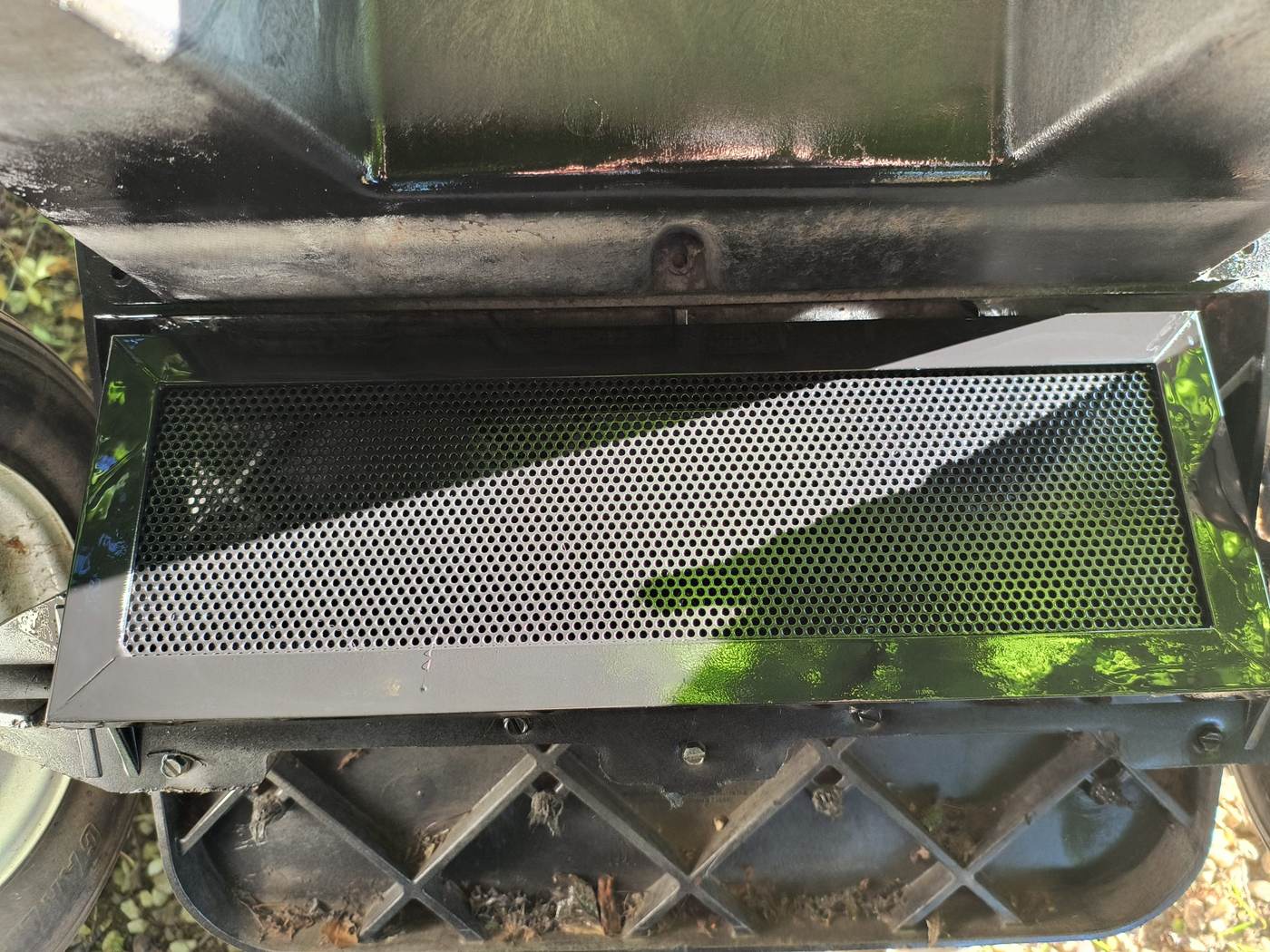
What to do, in order
- Walk the whole foundation with a flashlight and find every vent, including the one behind a shrub, under a deck or buried by a raised bed
- At each vent, push gently on the mesh and check the bottom edge: corroded metal breaks, brittle plastic cracks, and fiberglass screen stops no rodent
- Look around each opening for smear marks, small droppings, a worn track or gnawed edges, and photograph anything you are unsure of
- Shine a light into the crawl area before closing a single vent; droppings, runs or nesting material down there mean trapping comes first
- Do not board, foam or plug the vents shut, because the crawlspace needs that airflow to stay dry
- Rescreen in quarter-inch galvanized or stainless hardware cloth, fastened every three or four inches around the edge rather than at the corners
- If you would rather hand it over, our free visit walks every vent, the crawl hatch and each penetration before anything is quoted
The single most common way in
If we had to pick one defect that accounts for more rodent entries into Whatcom County homes than any other, it would be a failed crawlspace vent screen.
The reasoning is simple. Older housing here almost universally has a vented crawlspace, which means a row of openings deliberately cut through the foundation at ground level. Those openings were screened when the house was built. The screening was often a light metal mesh, sometimes a plastic or fiberglass insect screen, occasionally nothing at all beyond a decorative louver.
Then thirty, fifty or eighty years happen. Metal corrodes in a wet climate. Plastic goes brittle in sunlight and cracks. A string trimmer catches an edge. A pressure washer punches a hole. A contractor removes one to run a pipe and never replaces it properly. Somebody’s dog digs at one.
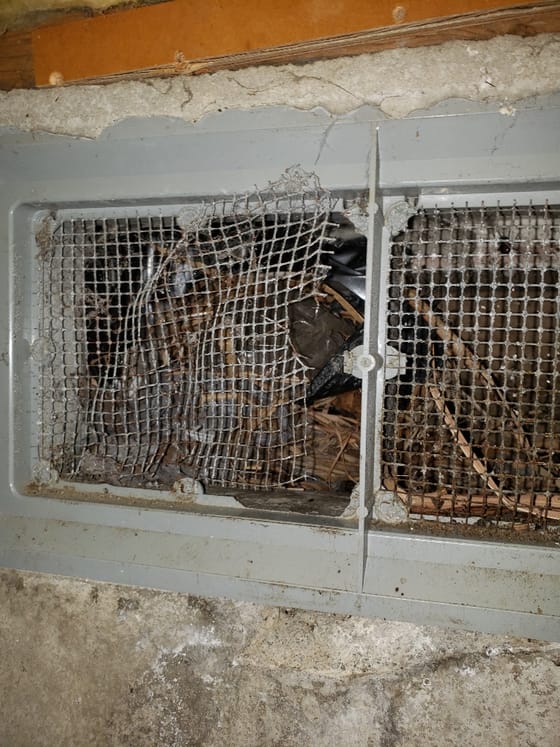
And a failed vent screen is not a small defect. The opening behind it is sized for airflow, which means it is very generously sized for an animal. Extension guidance from UC IPM gives a rat slightly more than half an inch to pass through and a mouse slightly more than a quarter, and a torn vent screen leaves far more room than either. A crawl vent with a hole in it is, functionally, a door left open.
The mesh spec follows from a second figure rather than from those two. Washington’s Department of Fish and Wildlife notes that a rat needs only a quarter-inch hole to chew larger and squeeze through, so half-inch cloth over a vent gives a rat an edge to work on as well as letting every mouse straight past. Quarter-inch cloth denies both, which is why it is the specification on this page and not a cautious over-build.
The good news is that this is one of the cheapest and most permanent fixes available on a building.
Why not just close them
The intuitive response is to block the vents entirely, and it is a genuinely bad idea in this climate.
A vented crawlspace works by exchanging air with the outside, which carries away the moisture that comes up out of the ground and in through the foundation. Close the vents on a traditional crawlspace and that moisture has nowhere to go.
What follows is predictable and expensive: humidity rises, framing takes on moisture, decay establishes in the sill plate, rim joist and joists, insulation loses its function, and the whole community of moisture-driven insects moves in — moisture ants, springtails, sowbugs, millipedes, silverfish, and in the worst cases dampwood termites. Structural decay in this climate takes capacity out of a building faster than rodents do.
So the requirement is specific: exclude animals while preserving airflow. That rules out boards, foam, plastic sheet, and anything else that closes the opening. It leaves mesh.
There is a legitimate alternative approach — a fully sealed and conditioned crawlspace with the vents closed, the ground covered and the space managed as part of the building envelope. That is a substantial building project with its own requirements, done properly by somebody who understands it. It is not the same as putting a board over a vent, and we will say so if anybody has suggested otherwise.
What actually works as a material
The specification matters more than the labor here, and most of the failures we find are material choices rather than workmanship.
Galvanized or stainless hardware cloth, quarter-inch mesh. This is the answer for the great majority of situations. Quarter-inch because a house mouse gets through anything larger. Metal because rodents chew, and galvanized or stainless because this climate destroys unprotected steel.
Nineteen gauge or heavier. Very fine hardware cloth exists and it is not worth using here; it corrodes faster and it can be worked apart at the edges.
Fastened, not leaned. The mesh has to be secured around its full perimeter into sound material, with fasteners appropriate to the substrate — screws and washers, masonry fasteners into concrete or block, or a purpose-made frame. Mesh held in place by friction or by a couple of nails at the corners gets pushed in.
Fitted behind or over a sound louver, depending on the vent design, so that the mesh is protected from mechanical damage and the appearance is acceptable.
Where the vent frame itself has failed — rusted through, rotted, or loose in the opening — a complete new vent assembly is usually better value than trying to screen a frame that is disintegrating.
What does not work
We spend a fair amount of time removing previous attempts, so here is the list.
Fiberglass and plastic insect screening. Stops flies. Does not stop anything with teeth. This is the most common material we find failed.
Standard aluminum window screen. Marginally better and still chewed through or pushed aside without much effort.
Expanding foam. Rodents go through it quickly, it blocks ventilation where used in quantity, and it degrades in sunlight. It has a legitimate use as a filler behind a metal barrier and none as a barrier.
Steel wool alone. Better than foam, and it compresses, rusts and works loose over time. Reasonable as a temporary measure or as packing behind mesh; not a repair.
Plywood or sheet material over the opening. Excludes animals and creates a moisture problem.
Chicken wire. The mesh is far too large and the wire too light. It stops nothing you care about.
Half-inch hardware cloth. Stops rats, admits mice. On a property with mice — which is most properties — the job is half done and it will not be obvious why.
The rest of the ground-level picture
Vents are the headline and they are rarely the only opening, so a proper job looks at the whole foundation line.
The crawl access hatch. Second on the list and often worse than the vents. A great many are a sheet of plywood resting in a rebate, warped, or missing altogether. Utility work has usually had it off and back on several times. A properly fitted, latching, animal-resistant access cover is a genuinely worthwhile item.
Utility penetrations. Water supply, waste, gas, electrical, cable, heat pump line sets — every one of them passes through the foundation somewhere and most were sealed to keep weather out rather than animals. These need closing with metal and an appropriate sealant, not foam alone.
The gap under a garage door, particularly at the corners where the seal has hardened, and the connection between an attached garage and the rest of the house.
Where grade has risen against the building, burying vents or bringing soil into contact with siding, which both blocks ventilation and offers a route.
Deck and porch skirting, which is usually decorative rather than sealed and which creates a protected void connected to the crawl area.
Where an addition meets the original structure, a junction built at a different time to a different standard, and one of the most reliable places to find an opening nobody has ever seen.
Foundation cracks and gaps at the sill, where a rat can enlarge an existing defect.
Sequence matters
There is one rule that governs the order of this work and it is not negotiable.
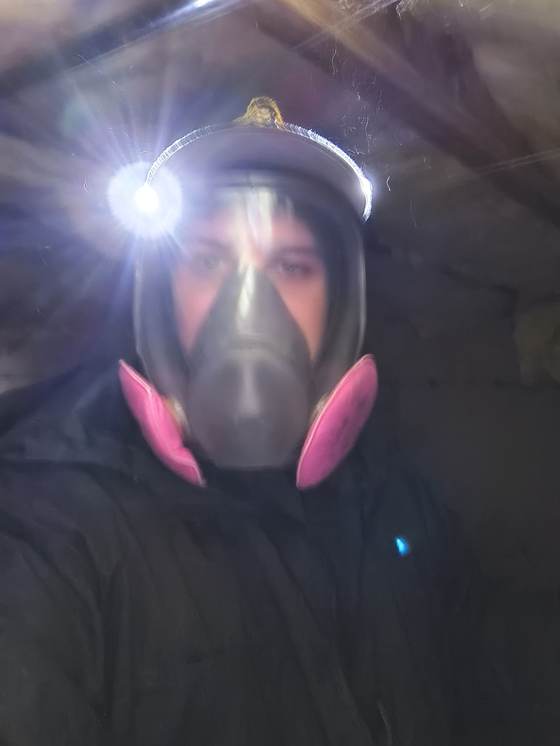
Do not seal a crawlspace with an active population inside it.
Close the openings on a building that has rodents under the floor and you have not excluded them; you have enclosed them, with your insulation, your wiring and your ducting, and no way out. What follows is worse damage, animals dying in inaccessible places, and eventually a hole chewed somewhere new — sometimes upward into the building rather than back outside.
So the order is: establish whether anything is living down there, trap and remove it, confirm activity has stopped, and then seal. Where the crawlspace is clear, the sealing can go ahead immediately.
We check before we close anything, every time, which occasionally means telling somebody who wanted vents rescreened this week that there is a fortnight of trapping first.
What else the vents affect
Rescreening does more than keep rodents out, which is worth knowing when weighing the cost.
It excludes the other things that use those openings. Cats, which get under houses and cannot always get out. Snakes and amphibians. Wasps and yellowjackets looking for a nesting cavity. And, in the buildings where it happens, larger wildlife, which is outside what we handle but which arrives the same way.
It reduces windblown debris. Leaf litter accumulating in a crawl area holds moisture and supports insects.
It keeps the ventilation working as designed, because a vent full of leaves or buried by landscaping is not ventilating anything. Part of doing this properly is clearing what has accumulated and making sure the openings are actually open.
And it is one of the few pieces of pest work that is genuinely permanent. Correctly specified metal mesh, correctly fastened, lasts decades. Compare that with a recurring treatment plan and the arithmetic is not close.
Automatic and foundation vents
A note on the vents themselves, since people ask.
Some buildings have automatic vents, designed to open and close with temperature. They are a reasonable idea and they have a failure mode: the mechanism seizes, usually in the closed position, and the crawlspace loses its ventilation without anybody noticing. Where we find them we check whether they still operate.
Some have manually operated louvers that somebody closed one winter and never reopened. This is more common than it should be and it produces exactly the moisture problem described above.
And some vents have been fitted with covers — foam blocks, magnetic covers, purpose-made plugs — as a heat-saving measure. In a traditional vented crawlspace in this climate, we would advise against them, because what you save on heating you pay for in decay.
If you want a crawlspace that is sealed rather than vented, that is a legitimate and different project, and it involves ground cover, air sealing, insulation at the walls rather than the floor, and usually mechanical drying. Doing half of it is worse than doing none of it.
Doing it yourself
This is well within reach of a competent homeowner and we will not pretend otherwise.
Buy quarter-inch galvanized hardware cloth. Cut pieces with a two-inch overlap all round. Fasten with screws and fender washers into the framing or with masonry fasteners into concrete, at intervals close enough that the mesh cannot be pushed in — every three or four inches around the perimeter. Trim the edges cleanly, because cut hardware cloth is genuinely sharp. Wear gloves.
The parts most people get wrong: fastening only at the corners, using a mesh size that admits mice, and doing it before checking whether anything is already under the house.
If you are doing it yourself, at least look in the crawlspace first with a good light, and if you find droppings, runs or nesting material, deal with that before you close anything.
How to tell whether yours have failed
You can assess this yourself in about fifteen minutes with a flashlight and it is worth doing before anybody quotes anything.
Walk the full perimeter of the building and find every vent. Most houses here have between four and a dozen, and there is nearly always one somewhere awkward — behind a shrub, under a deck, tight against a fence, or buried by a raised bed — that nobody has looked at in years. That is usually the one that has failed.
At each vent, look for a hole, a torn corner, a section of mesh pushed inward, or screening that is missing entirely. Push gently on the mesh with a finger. Corroded metal breaks under light pressure and brittle plastic cracks.
Look at the bottom edge in particular. Water runs down a wall and collects there, so that is where metal rusts through first and where debris packs in.
Check what the vent is made of. If you can see woven plastic or fiberglass, that is not excluding a rodent regardless of its condition.
Look for evidence around the opening: greasy smear marks on the concrete, small droppings, a worn track in the soil leading to it, gnawed edges, or disturbed material immediately outside.
Then shine a light through into the crawl area. If you can see clearly through a vent with no mesh in the way at all, you have found your answer.
Photograph anything you are unsure about. It saves a conversation.
What it looks like when it has been used
Once you know what to look for, an active entry point is fairly obvious, and knowing helps you judge urgency.
Smear marks. Rodents travel repeatedly along the same routes and their fur leaves a greasy dark deposit on concrete, block and timber at the point of passage. A dark polished patch at the edge of a vent opening means regular traffic.
A worn path. On soil or bark mulch, a route used nightly for weeks shows as a flattened track leading to the opening.
Droppings immediately outside or just inside the vent.
Gnawing. Where an animal has enlarged an opening rather than found one, the edges of timber or plastic show tooth marks.
Nesting material caught at the edges — insulation fibers, shredded paper, dry grass — pulled through and dropped.
Insects. Flies at a vent in numbers can indicate something dead inside, which changes the job.
None of this means panic. It does mean the vent is currently in use rather than merely defective, and it moves the trapping conversation ahead of the sealing one.
Landscaping is half the problem
A surprising share of failed and non-functioning vents are not failed at all. They are buried.
Grade rises over time. Beds get topped up, mulch gets added each spring, gravel gets spread, a lawn is built up, and after twenty years the soil level against a foundation is several inches higher than it was. Vents that were a foot above grade end up at grade or below it.
The consequences stack. A buried vent does not ventilate, so the crawlspace gets damper. Soil against the foundation holds water where it does the most harm. Bark mulch packed against an opening is both a moisture source and excellent rodent harborage sitting directly at an entry point. And soil bridging up to siding gives insects a route past the foundation entirely.
The remedy is unglamorous: cut the grade back to expose the vents properly, keep a clear band of ground against the building, pull mulch and bedding away from the wall, and cut back shrubs so the foundation line can be seen and can dry.
We raise this on nearly every visit because it costs nothing but an afternoon and it improves the crawlspace, the rodent situation and the decay risk at the same time. It is also the thing most likely to be undone next spring when somebody tops the beds up again.
What it costs and what it saves
We will not put a figure on a page, because vent counts, access and condition vary too much to be honest about it. What we can set out is the shape of the decision.
Rescreening a set of crawl vents in metal is a one-off cost in the low hundreds for a typical house, sometimes less. Replacing failed vent assemblies adds modestly to that. A properly fitted crawl access cover is an inexpensive item.
Against that, consider what an unaddressed entry produces over a few years: repeated trapping visits, contaminated insulation, gnawed wiring, damaged ducting and, in the worst cases, a full crawlspace cleanout and reinsulation running into several thousand.
And unlike a treatment plan, this does not recur. Correctly specified mesh, correctly fastened, is still doing its job in twenty years.
That arithmetic is why we lead with exclusion rather than with recurring service. It is a smaller invoice today and it is the recommendation that keeps people from needing us.
What we do
We walk the whole foundation line rather than the vents you have noticed — every vent, the access hatch, every penetration, the garage, the skirting, the grade and any junction between structures.
We check the crawlspace itself first, because sealing a building with something living in it is the one mistake that makes things worse.
Then a specification: which vents need rescreening, which need replacing, what else on the perimeter needs closing, and what it costs. In metal, fastened properly, with the ventilation preserved.
Assessment is free, there is no term agreement, and this is the sort of work we would rather sell you once than treat around forever.
Frequently asked questions
Can I just cover the vent with something?
Not if it blocks airflow. Crawl vents exist to keep the underfloor space dry, and closing them off creates a moisture problem that costs more than the rodents would. The material has to exclude animals while still ventilating.
What screening material actually holds?
Galvanized or stainless hardware cloth at quarter-inch mesh, properly fastened. Plastic and fiberglass insect screen does not stop a rodent, and standard window screen is chewed through easily. The mesh size and the metal both matter.
Why quarter inch and not half?
Because a house mouse gets through a gap around a quarter of an inch across. Half-inch mesh stops rats and lets mice through, which on most properties means the job is only half done.
Is expanding foam any use here?
Not on its own. Rodents chew through foam in an evening, and it blocks ventilation where it is used in quantity. It has a place as a filler behind a metal barrier and no place as the barrier itself.
What if something is already living under the house?
Then the sealing waits. Closing a crawlspace with an active population inside traps animals in with your insulation and wiring. Trapping comes first, sealing follows once activity has stopped.
Do the vents need replacing entirely?
Sometimes. Where a frame is sound, rescreening in metal behind it is enough. Where the frame itself has rusted or rotted, a new vent assembly is the better answer and it is not an expensive item.
What does it cost to have somebody look?
Nothing. We will walk the foundation, look at every vent and the crawl access, tell you which are compromised and what the whole exclusion picture on your building looks like before quoting anything.
Guides
Pest Exclusion & Repairs in Whatcom County?
Family-owned, no long-term contracts, and every treatment is backed by our 100% Service Guarantee.
Most calls in Whatcom County are out within 1–2 days, about 3 during the late-summer peak.
Last updated