
Ant Trails Across the Kitchen Counter
A line of ants crossing a counter is a chemical trail laid between a nest and a food source. It is the single most useful thing in the room, and wiping or spraying it destroys the evidence that would otherwise lead straight to the colony.
Call 360-410-2199 Request a free inspection
What to do, in order
- Before wiping anything, follow the ant line both ways: one end shows what they are eating, the other shows the gap where they come in
- Note both ends, then wipe the counter with soapy water and cover the food instead of spraying the trail
- Leave the aerosol under the sink alone, because a repellent spray can split an odorous house ant colony into several smaller nests
- Pick up pet bowls overnight, rinse the recycling, fix the drip under the sink and clear crumbs from beside appliances
- If the ants are large and black, or small, pale and swarming near a bathroom, treat it as a different problem from a kitchen trail
- Call for a free look once the trail keeps coming back: we identify the species, bait beside the route, treat the outdoor nest and seal the entry
- Expect more ants for the first two to four days after baiting, since that is the bait being carried back to the queen
The trail is the most useful thing in your kitchen
A line of small ants moving in both directions across a counter, along the back of a sink, or up the wall behind a kettle is one of the most common calls we take, and the universal first reaction is to wipe it away or hit it with a spray.
It is worth resisting that for ten minutes, because the trail is not a random wandering. It is a chemical road.
Foraging ants that find food lay a pheromone trail on the way back to the nest. Other workers follow that trail to the source, reinforce it on their own return, and within a short time a strong, self-sustaining two-way route is established. The line you can see is the shortest practical path between a food source and a colony, drawn for you by the ants themselves.
Which means that before you clear it, that line will tell you two things you cannot easily work out otherwise: exactly what they are eating, and exactly where they are coming in.
Follow it in both directions. One end will finish at something — a smear behind a jar, a pet bowl, a leaking tap, a bin, a bag of sugar with a split corner. The other end will disappear at a specific point: a gap at a window frame, a joint in the countertop, a crack where the wall meets the floor, the hole around a pipe under the sink, or the edge of a door frame.
Write both down. That is nine tenths of a diagnosis.
Why spraying it makes things worse
The aerosol under the sink kills the ants it lands on. Everyone knows that part. What is less well known is what it does to the rest of the population.
Most retail ant sprays are repellent formulations. They create a treated zone that ants avoid rather than cross. For some species, and particularly for odorous house ants — one of the most common small ants in this region — that disturbance can trigger budding: the colony splits, satellite groups relocate, and new queens establish separate centers.
The result is that a household with one visible trail sprays it for three weekends and ends up with ants appearing in the bathroom and the utility room as well. That is not bad luck. It is a predictable response to a repellent applied at the wrong point.
The second cost is informational. Once you have sprayed and wiped, the trail is gone, the ants stop using the route, and when somebody comes to look there is nothing to follow. We can still work it out, but it takes longer and it costs more.
If you want to do something in the moment, wipe the counter with soapy water after noting where the trail runs, and keep the food source covered. That removes the pheromone without dispersing the colony.
What they probably are
The small ants that come into kitchens here fall into a handful of groups, and the identification changes the treatment.
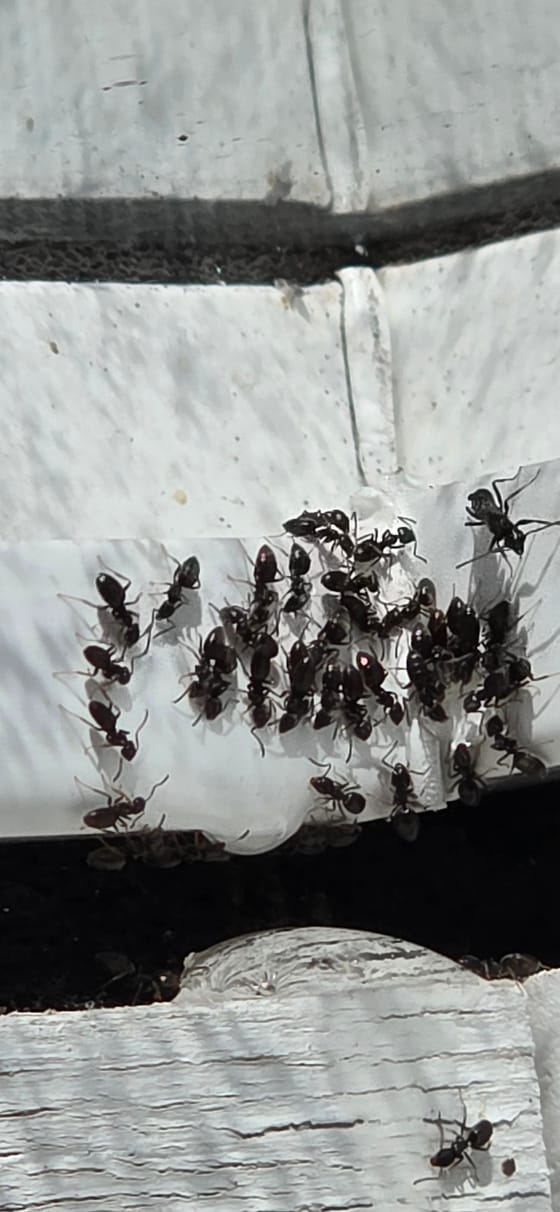
Odorous house ants. Very common, small, dark brown to black, and named for the smell they give off when crushed — usually described as coconut, or something faintly rancid. They are strongly attracted to sweet material, they form large colonies with multiple queens, and they are the species most prone to budding when treated with repellents. Bait is the right tool.
Pavement ants. Small, dark, and nesting under slabs, driveways, paths and against foundations. They tend to come in at ground level and along the base of walls. Less prone to budding, and generally straightforward to bait.
Small field and lawn species. A range of ants that live outdoors entirely and enter opportunistically, particularly after heavy rain. These frequently need nothing more than the entry point closed and the attractant removed.
Thief ants and similar very small species. Tiny — small enough to be mistaken for specks — and attracted to greasy and protein foods more than to sugar, which matters because it changes which bait works.
Carpenter ants. Not really in this category, and easy to separate on size: they are much larger, generally black, and their presence indoors points at nesting in the structure rather than foraging from outside. If the ants on your counter are big, that is a different page and a different job. UC IPM keeps a page on carpenter ants with the size and the nesting habit set out, which settles most kitchen-table arguments about whether the big black one matters.
The distinction we care about most is nuisance versus structural. Most kitchen trails are nuisance ants, which is genuinely good news: they are not damaging your house.
Why now
Ant calls in this county follow the weather more closely than they follow anything else.
The first wave comes in spring, as colonies become active and foraging resumes. The second and larger wave follows heavy rain: shallow outdoor nests in soil, under slabs and in mulch get flooded, and the colony moves to higher, drier ground, which is frequently the inside of a building.
A third pattern shows in a dry warm spell, when the ants are looking for water rather than food. That is why trails so often run to a sink, a dishwasher, a pet bowl or a leaking pipe rather than to anything edible, and it is why a kitchen can get ants during a stretch of weather with nothing left out at all.
Autumn brings a further push as outdoor resources decline.
Understanding which of these you are in helps set expectations. A rain-driven incursion often subsides as the ground dries. A colony that has established itself indoors will not.
The response that works
Identify first. Species determines bait choice, and bait choice determines whether this works. A sugar bait offered to a grease-feeding species sits untouched.
Bait, and bait patiently. This is the counter-intuitive part for most people. Effective baiting means letting ants feed and return to the nest, which means for a few days you will see more ants rather than fewer. That is the treatment working. Killing the foragers on sight interrupts exactly the process that reaches the queen.
Place bait next to the trail, not on it. Beside the route, near the entry point, out of reach of children and pets. Not on the food surface itself.
Remove competing food. Bait competes with whatever the ants are already eating, so the crumbs, the spill under the toaster, the pet bowl left down overnight and the sticky recycling all need dealing with for the bait to be the best thing on offer.
Use non-repellent products where a product is needed, so that workers carry the material back rather than avoiding the treated area.
Close the entry. Once activity has dropped, seal the point where the trail entered — the gap at the pipe, the crack at the frame, the joint in the trim.
Treat outside where the nest is. The colony is usually within a short distance of the building: under a slab, in a landscape bed, beneath a paver, in mulch against the foundation, in a retaining wall. Dealing with it there is what makes the indoor result durable.
The things that help and the things that do not
Helps: dry goods in sealed rigid containers; wiping trails with soapy water; lidded bins, rinsed recycling, and pet food picked up rather than left down; fixing the slow drip under the sink; a clear band of ground against the foundation with mulch and vegetation pulled back; sealing the gaps around pipes and at the base of cabinets; and patience with bait.

Does not help: repellent aerosols on trails; ultrasonic devices; cinnamon, chalk lines, coffee grounds and vinegar barriers, which at best move a trail a few inches; and perimeter sprays applied without knowing where the nest is.
Mixed: diatomaceous earth has a real mechanism and works slowly on dry surfaces where ants cross repeatedly, but it is useless once damp and it will not reach a colony.
Worth knowing: if a bait is being ignored, the answer is usually the wrong bait type rather than a resistant colony. Switching between a sugar-based and a protein or grease-based bait resolves most of these.
Where the nest actually is
People picture an anthill. In a residential setting here, the nest is usually somewhere less obvious and there is a fairly consistent shortlist.
Under a slab or paving. Patios, paths, driveways and garage slabs are ideal: warm, protected, with soil beneath and a clean edge to travel along. Pavement ants are named for this for a reason, and a trail that emerges at the base of an exterior wall near paving usually resolves here.
In mulch or landscape bedding against the foundation. Bark mulch holds moisture and warmth and offers a huge amount of protected space. Beds built right up to the siding are the single most common contributing feature we see on ant jobs.
Under a paver, a stepping stone, a planter or a stored object. Lift anything that has been sitting on soil for a season and you will often find the colony directly beneath it.
In a retaining wall or rockery. Dry-stacked stone is close to perfect ant habitat and it is very common in this county’s sloped lots.
In a potted plant. Genuinely frequent, and worth checking if a trail seems to begin indoors with no route to the outside. Ants will colonize the root ball of a large container plant, particularly one that has been outside over the summer and come in for the winter.
Inside a wall void or under a bath, where a colony has moved in permanently. This is the least common of the group and the one that takes longest, because the treatment has to reach a nest nobody can see.
Under a stump or a piece of buried wood. More often a carpenter ant situation, but small species use these too.
The relevance is practical: where we find the nest, the work is proportionate and quick. Where we cannot, baiting has to do the whole job and that takes longer.
What makes a kitchen attractive
Since the usual worry is that this reflects on the household, it is worth setting out what actually counts as a resource from an ant’s point of view. Almost none of it is what people expect.
A pet bowl left down. Ants do not need much and pet food is high value.
The recycling. Rinsed containers are fine; a bin holding unrinsed jars, cans and bottles is a substantial sugar source, and it is often the answer when nothing else in the kitchen explains the trail.
The gap between a counter and an appliance. Crumbs and spills go down beside a dishwasher, a range or a refrigerator and stay there, and nobody vacuums a gap that is a quarter inch wide.
Sticky residue on the outside of jars and bottles, particularly honey, syrup and sauces stored in a cupboard.
Fruit in a bowl, especially anything slightly overripe.
Water on its own. A dripping tap, condensation on a cold pipe, a damp cloth left in a sink, or a slow leak in a cabinet base. In a dry spell this is often the whole attraction.
And in some houses, nothing indoors at all — the trail passes through the kitchen on the way to somewhere else, because the route through the wall happens to emerge there.
When it is not a nuisance ant at all
Three findings change the conversation and are worth ruling out.
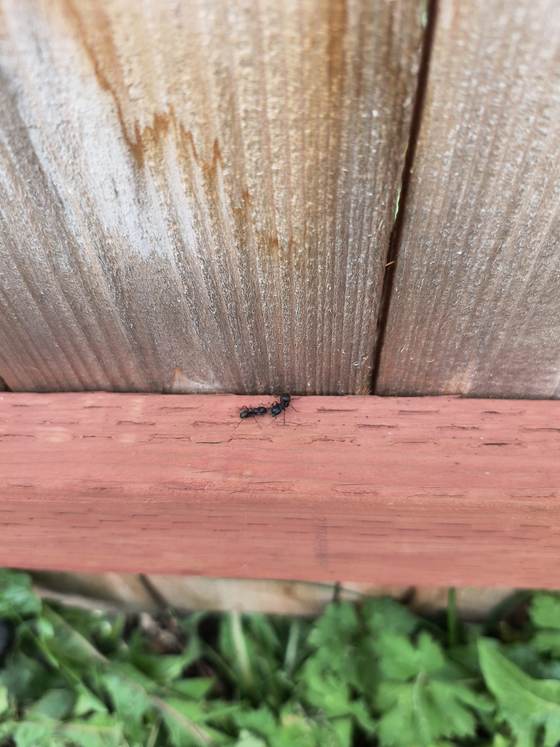
Large black ants, especially at night. Carpenter ants foraging from a nest in or near the structure. The job then involves finding a parent colony outdoors and looking hard at where water has got into timber.
Small pale yellowish ants in a bathroom, basement or utility room, sometimes swarming. Moisture ants, which nest only in wet decaying wood and are telling you about a water problem rather than a food one.
Winged ants indoors in numbers. Reproductives from an established colony. The question then is whether that colony is inside the building, which changes the scope considerably.
We separate these on site rather than by phone, because getting it wrong sends the whole job in the wrong direction.
How long it should take
Expectations are where most dissatisfaction with ant work comes from, so here is the honest shape of it.
The first two to four days after baiting, activity usually increases. More ants, sometimes visibly more, recruiting to the bait. This is the part people find hardest to sit through and it is the part that determines the outcome.
From roughly day four to day ten, numbers fall away as the material reaches the brood and the queens. For a straightforward pavement ant or field ant situation this is often the end of it.
Odorous house ants can take longer — two to three weeks is not unusual — because the colonies are larger, have multiple queens and are frequently spread across several connected sites.
A colony nesting inside a wall void takes longer again, and occasionally needs a second approach if the first bait is not being taken.
What should not happen is an indefinite series of visits with no change. If two rounds of correctly chosen bait have made no difference, the diagnosis is wrong somewhere — usually the species, occasionally the location of the nest — and the answer is to go back and look again rather than to keep applying the same thing.
Ants outside, and when to leave them
A last point that runs against the grain of this trade: most ants on your property are doing no harm and are worth leaving alone.
Ant colonies in a lawn, in a field margin, in the woods or in a bed away from the building are part of a functioning garden. They aerate soil, they predate other insects, and they are food for a great deal else. Treating them broadcast-style across a property is expensive, ecologically clumsy and does not meaningfully change what comes into a kitchen.
Where we treat outside, it is targeted: the specific nest supplying the trail into your building, and the band of ground immediately against the foundation where harborage sits directly against the structure. Not the whole yard.
If your problem is ants on a patio in July and nothing is coming inside, our honest advice is usually to move the food and enjoy the summer. That is not a job worth paying for.
Restaurants, cafés and food premises
If the counter in question is commercial, the same biology applies but the constraints do not.
Bait placement has to account for food safety and for the fact that customers and staff are moving through the space all day. Treatment windows are narrow and usually outside operating hours. Documentation matters, because a health inspector’s view of a controlled, recorded program is very different from their view of a reactive one.
Shared buildings complicate it further. A colony under a slab beneath a row of units serves all of them, and a neighbor with an open bin area can undo good work next door. Where that is the situation we will say so, and put the structural and waste-management issues in writing so they can be raised with a landlord or a neighboring tenant rather than absorbed as your problem.
If you are a food business, mention it on the first call and we will schedule and approach it accordingly.
What you get from us
We follow the trail rather than treating the counter.
That means identifying the species, tracing the route to the food source and to the entry point, working the exterior for the nest, and looking at the conditions supporting it — moisture, harborage against the foundation, the state of the ground contact around the building.
Then a plan that fits what you actually have: bait selected for the species, placed where it will be taken, exterior work at the nest, entry points closed, and a short list of the practical changes that keep it from recurring.
Assessment is free, there is no term agreement, and if what you have is a rain-driven incursion that will resolve on its own once the ground dries, we will tell you that instead of selling you a program.
Frequently asked questions
Why should I not spray the trail?
Two reasons. It erases the route that leads us to the nest, and most retail aerosols are repellent, which can cause some species to split the colony and relocate. You end up with several smaller problems in place of one.
What are these small ants likely to be?
In this county, most often odorous house ants, pavement ants or a small field species that has come in for water and food. They are nuisance ants rather than structural pests, and the response is different from carpenter ants.
How does bait work when spray does not?
Worker ants carry bait back and share it through the colony, including with the queen and the brood. That reaches the part of the population you cannot see, which is the part that decides whether the problem ends.
Why did they suddenly appear?
Usually weather. Heavy rain floods shallow outdoor nests and pushes ants indoors, and a dry warm spell sends them looking for water. Both produce a sudden line of ants in a kitchen with no change to your housekeeping.
Do they mean my house is dirty?
No. A few crumbs behind a toaster is enough, and plenty of the calls we take are from spotless kitchens. Ants are following a resource, and a resource can be a pet bowl, a recycling bin or a leaking pipe.
Will they come back next year?
They can, because the nest is usually outdoors and outdoors does not change. Sealing the entry points and removing what attracted them reduces it a great deal, and that is where the durable work is.
Does it cost anything to have you look?
No. We will identify the species, follow the trail to find where it enters and where it goes, and tell you what will actually resolve it before anything is quoted.
From the blog
Ant & Carpenter Ant Control in Whatcom County?
Family-owned, no long-term contracts, and every treatment is backed by our 100% Service Guarantee.
Most calls in Whatcom County are out within 1–2 days, about 3 during the late-summer peak.
Last updated