
Carpenter Ants in a Window Frame
A window frame is where carpenter ants show up because it is where wood gets wet. What you are seeing is nearly always a satellite nest in softened timber, supplied by a parent colony outdoors, and the frame is telling you about a water problem as much as an insect one.
Call 360-410-2199 Request a free inspection
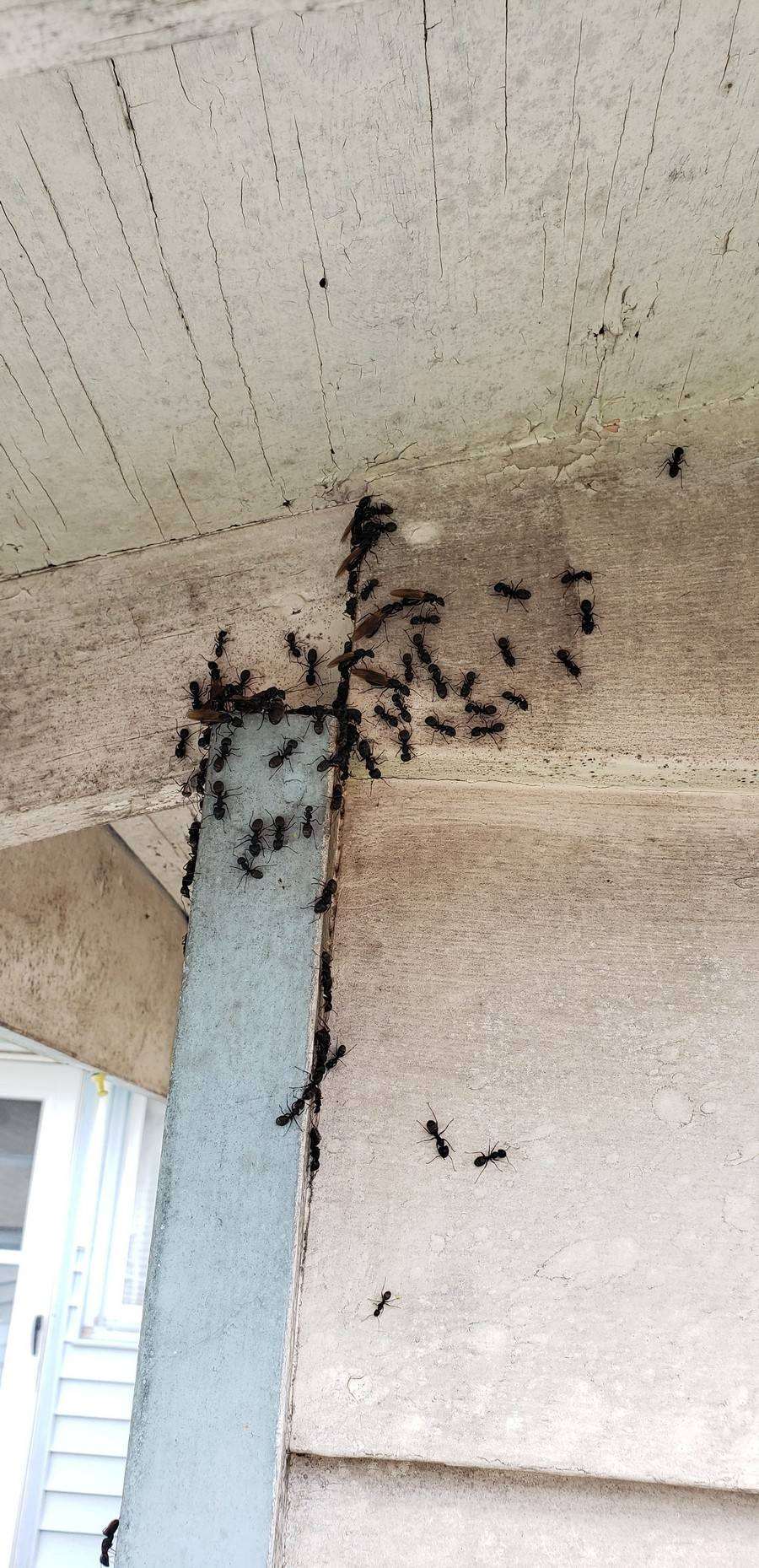
What to do, in order
- Watch the sill in the hour after dusk, and look for coarse fibrous frass with insect parts piled below a slot in the trim
- Leave the opening the frass comes out of unsealed, since it marks exactly where the gallery runs
- Skip the hardware store aerosol on the window, because a repellent at the nest can split the colony into new sites
- Do not cut the trim open to look until someone has decided whether the frame is being repaired anyway
- Look for how water reaches the window: cracked sealant, lifted flashing, a flat sill, overflowing gutters or sprinklers hitting the wall
- Call for a free visit: we treat the satellite nest and trails with non-repellent products and walk the grounds for the parent colony in stumps, deadwood or woodpiles
- Have a joiner fix the wet sill, trim or flashing, or the ants will come back to the same frame
Why it is the window
Carpenter ants around a window frame is one of the most frequent calls we take in this county, and the reason is not really about ants at all. It is about water.
Carpenter ants do not attack sound, dry timber by preference. They excavate galleries in wood that has already begun to soften — wood that has been damp long enough for decay to start breaking down its structure and make it workable. Sound Douglas fir is hard going. Timber that has been wet for three winters is not. UC IPM’s account of carpenter ants describes the same preference for wood softened by moisture and decay.
A window is the place in a wall assembly most likely to be in that condition. It is a hole cut through the weather envelope, closed with a system of sealant, flashing, glazing and trim, all of which have finite lives. When any part of it fails, the water goes into the framing and stays there, because the same construction that keeps rain out also keeps the wood from drying.
So the ants in your window frame are a symptom with two causes stacked on top of each other. There is an insect problem and there is a building problem, and solving only the first one is why this recurs for people.
What you are actually seeing
The signs cluster in a few recognizable forms.
Workers on the sill or the trim, particularly in the evening. Carpenter ants are largely nocturnal, so activity in the hour after dusk is more meaningful than activity at noon. Seeing several in a short period in the same place is more significant than seeing one.
Frass — the debris pushed out of the galleries. This is the most diagnostic sign and it is often mistaken for ordinary dust or sawdust. Carpenter ant frass is a coarse, fibrous material, more like shredded wood fiber than fine powder, and it usually contains insect fragments: discarded legs, wing pieces and body parts from the colony. It accumulates in a small conical pile below the opening they are using, on a sill, a windowsill ledge, a floor beneath, or the top of a radiator cover.
A small round or slotted opening in trim or in the frame itself, often at a joint. These are the slits they push debris out through.
Winged ants in spring, which are reproductives leaving an established colony. A swarm indoors is a strong indication that a mature nest is inside the structure rather than outside it.
A faint dry rustling from inside the frame or the wall beside it on a warm evening. People often think they are imagining this. Frequently they are not.
Damaged, spongy or discolored wood at the bottom corners of the frame and along the sill — the water damage that made the site attractive in the first place.
Satellite nests and the parent colony
This is the concept that determines whether the work holds, so it is worth setting out carefully.
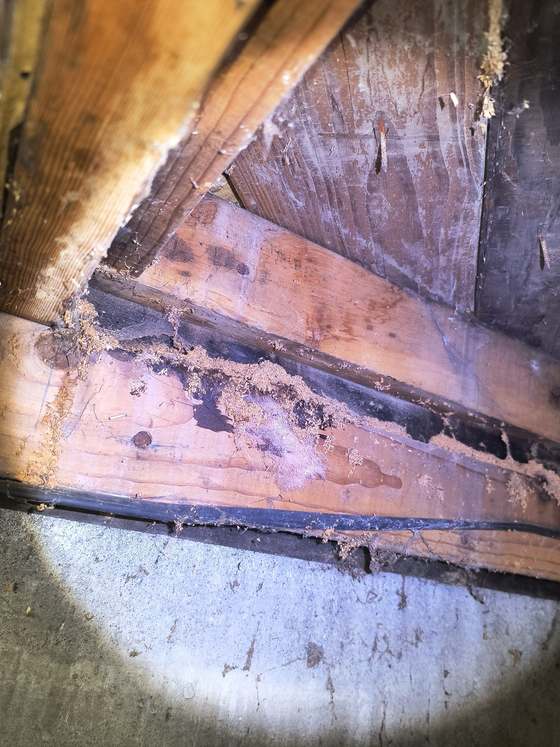
A mature carpenter ant population is not one nest. It is a parent colony containing the queen and the primary brood, plus a number of satellite nests containing workers, older larvae and pupae, connected by foraging trails and exchanging material continuously.
The parent colony is almost always outdoors, in wood with high moisture content: a stump, a buried root, a dead limb in an otherwise healthy tree, a fallen log, a landscape timber, an old fence post at ground level, or a woodpile that has been in the same place for years.
The satellites are what colonize a building. They tolerate drier conditions than the parent nest, they can be established quickly, and a window frame with soft wood in it is an ideal site.
The practical consequence is straightforward. Treating the satellite in your window kills what is in the window. If the parent colony is still sitting in a stump forty feet away, it will re-establish, often within the same season, and often in the same frame because the conditions that made it attractive have not changed.
That is why a serious carpenter ant visit spends most of its time outside.
Finding the parent colony
On a modest city lot this is usually quick. There are a limited number of candidates and they are all within sight of the house.
We look at stumps, particularly old ones that are well into decay. Standing deadwood and dead limbs in living trees. Fallen timber left in a corner of a garden. Landscape ties and retaining structures, which are frequently in contact with soil and rotting from the bottom. Fence posts at ground level. Deck framing, especially the ledger and the joist ends. Firewood, and the ground beneath where firewood used to be. Buried construction debris, which is more common than people expect on lots that were developed in stages.
We also follow trails. Carpenter ants forage along consistent routes and will use edges — a fence line, a foundation edge, a utility line, a branch touching the building. Following a trail in the evening, when they are actually moving, is often the fastest route to the nest.
On a large wooded property this becomes genuinely difficult and we say so honestly rather than pretending. A parent colony can be a hundred feet into the trees, and searching properly is real work rather than a lap of the house.
The moisture side of the job
You can treat the ants perfectly and still be back here in three years if the window stays wet, so the building work matters.
Typical causes at a window: sealant that has hardened, cracked or pulled away from the frame; flashing above the opening that was never installed or has lifted; a sill with insufficient slope, or one that has settled flat; a missing drip edge, letting water run back under the sill and into the framing; failed glazing seals; and paint or finish that has broken down and is holding water against the wood rather than shedding it.
Less obviously: gutters overflowing above the window, downspouts discharging against the wall, sprinkler heads hitting the siding, and vegetation growing tight against the wall so the wall never dries.
We are not joiners and we do not pretend to be. What we do is tell you exactly where the water is getting in and what has been compromised, so that whoever does the repair is fixing the right thing. Sometimes it is a tube of sealant and a drip edge. Sometimes a section of sill and trim needs cutting out and replacing. Occasionally the framing behind is gone and it is a bigger conversation.
What the treatment actually involves
Done properly, the work has several parts and none of them is a spray on a windowsill.
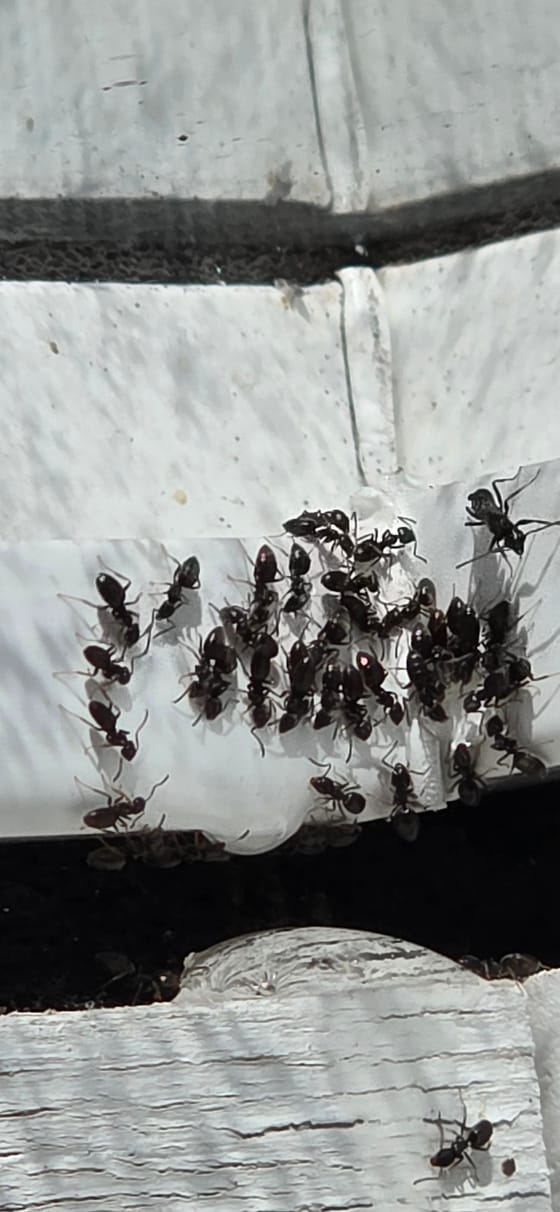
Direct treatment of the satellite nest, where we can locate the void it occupies — typically through the existing openings, using a dust or foam that distributes through the gallery system rather than sitting on a surface.
Non-repellent product on the trails and at the structural interface. Repellent products cause a colony to split and relocate, which makes the problem larger and harder to find. Non-repellents allow transfer between workers and back toward the nest, which is what you want.
Baiting where it fits. Carpenter ants change dietary preference through the season, which makes bait less reliable than it is for some other species, but in the right conditions it is an effective way to reach a nest you cannot see.
Treatment of the parent colony, once located. This is the piece that produces a durable result.
Perimeter and harborage work. Removing or relocating the woodpile, grinding or removing stumps close to the building, clearing fallen timber, cutting branches that bridge to the roof or wall, and correcting the ground contact of landscape timber.
The moisture correction, which is usually somebody else’s trade but is part of the plan.
Telling them apart from the alternatives
Two things get confused with carpenter ants and both change the answer.
Moisture ants. Smaller, usually yellowish, and associated with wood that is not merely damp but properly wet and decaying. Where they turn up, the finding is nearly always a water problem of some seriousness — a persistent leak, a saturated sill, a rotting section of framing. They are less structurally aggressive than carpenter ants and considerably more informative about the building.
Termites. Dampwood termites are present in this region and they do consume wood. The distinguishing signs are different: termite damage is packed with mud and debris rather than swept clean, the galleries look rough rather than sanded-smooth, and swarmers have four equal-length wings and a straight-sided body, where carpenter ant swarmers have a pinched waist, elbowed antennae and forewings noticeably longer than the hind pair.
We separate these on site, because the treatment differs and so does the seriousness. If what you have is a wood-destroying organism that somebody else’s report identified, that is squarely within what we are licensed to treat, and we will handle the treatment side.
What people try first
Nearly everybody does something before calling, and some of it actively makes the job harder.
An aerosol from the hardware store, sprayed at the window. This kills the ants you can see. It is also usually a repellent formulation, which is the specific thing you do not want: a repellent applied at a nest site frequently causes budding, where the colony splits and relocates into two or three new sites you now have to find. People who have sprayed for a couple of seasons often present with a more distributed problem than they started with.
Sealing the opening the frass is coming out of. Understandable and counterproductive. The opening is the most useful piece of information on the building — it tells us exactly where the gallery is. Closing it does not close the gallery; it just means the debris comes out somewhere less visible.
Grocery-store ant bait stations. These are formulated for sugar-feeding household ants. Carpenter ants shift between protein and carbohydrate through the season, and the small liquid stations are frequently ignored entirely. Not harmful, rarely useful.
Diatomaceous earth along a sill. It has a genuine mechanism and it works slowly on insects that walk through it repeatedly. It does nothing to a nest inside a frame and it is useless once damp, which in a window context it will be.
Cutting the trim open to look. Occasionally this reveals the gallery and is informative. More often it makes a repair job out of a treatment job, and it should wait until somebody has decided whether the frame is being repaired anyway.
If you have already done any of this, say so when you call. It changes what we expect to find and it is not something to be embarrassed about.
The species you actually have
Two carpenter ants account for most of what we see in Whatcom County, and knowing which one you have shifts where we look.
The larger and more familiar is the western black carpenter ant — big, matte black, with major workers that are genuinely striking in size. This is the one associated with parent colonies in stumps, logs and standing deadwood in conifer country, and it is the species behind most window and wall complaints in wooded parts of the county.
The second is a smaller, two-toned species with a reddish or brownish thorax against a darker body. It is more of a ground nester, more likely to have a parent colony under a rock, a slab, a landscape timber or a section of debris on the soil, and it turns up more often on open lots than in the trees.
Both build satellite nests in buildings and both respond to the same approach. The difference is search strategy: for the black species we work the trees and the deadwood, and for the two-toned one we work the ground, the hardscape and anything sitting on soil.
Size alone is a reasonable first cut, and workers within one colony vary considerably in size — a point worth knowing, because people frequently believe they have two different ants when they have one colony with a normal range of worker sizes.
Windows differ by building age
The buildings in this county fall into a few groups and each fails in its own way.
Pre-war and early post-war wood windows. Single glazed, painted softwood, often with the original sills. These have had a long time to take on water and the sill and lower rails are typically where it shows. The wood is usually good material and often worth repairing rather than replacing.
Mid-century and 1970s stock. Frequently aluminum frames in wood surrounds, with heavy condensation on the metal in winter. That condensation runs down and soaks the timber below, which produces exactly the softened sill carpenter ants want, without any external leak at all. It surprises people, because the water came from inside.
Replacement windows fitted into old openings. A very common situation and a frequent source of trouble. Where a replacement unit was installed without correcting the flashing and the sill detail behind it, the new window looks sound while the original framing continues to get wet. We find this often, and it is worth knowing before somebody spends money replacing a window that was not the problem.
Newer construction. Better detailed generally, but with its own failure mode where housewrap, flashing tape and sealant meet at the head and jambs. When those fail, the water is inside a well-sealed assembly with no way to dry, which can be worse than an old leaky wall that breathes.
What we will not sell you
A spray-and-go visit. It treats what you can see and leaves the colony.
A recurring plan over an unrepaired window. Wet timber will keep producing the same result, and a quarterly visit around it is a subscription.
A whole-house treatment for one frame when the finding is one satellite and one water leak.
A guarantee we cannot support. Where the parent colony is on a neighboring property or deep in woodland we cannot reach, we will tell you we are managing the building rather than eliminating the source, and price it accordingly.
When to act
Carpenter ant activity is most visible from spring through late summer, with a noticeable peak as the weather warms and again in the swarm period. A single ant in February in a heated house is more significant than a single ant in July, because it suggests something is overwintering inside rather than wandering in.
The best time to deal with a window is when the frame is dry enough to assess properly and repairs are practical, which in this county means the drier part of the year. The worst time is to leave it for another winter and let the same wet timber take on another season of water.
What happens when you call
We look at the window itself — the frame, the sill, the trim, the openings and the frass. We look at the wall assembly around it and at where the water is coming from. We walk the exterior and the grounds for the parent colony, in the evening if that is what it takes to follow a trail.
You get a plain account: what is nesting where, whether the main colony is on your property and whether we found it, what is compromised in the frame, what the treatment involves, and which parts belong to a joiner or a roofer rather than to us.
Assessment is free, there is no term agreement, and we would rather resolve a colony once than sell you a spring visit every year for a decade.
Frequently asked questions
Why a window and not somewhere else?
Because windows are where water gets into wood. Failed sealant, worn flashing, a sill without enough slope and years of driven rain all leave the framing damp, and carpenter ants specifically want timber that has already begun to soften.
Is the nest inside the frame?
Usually a satellite nest, which is workers and developing young but not the main colony. The parent colony is generally outdoors in a stump, a dead limb, buried wood or a woodpile, and it keeps supplying the frame until it is dealt with.
Are they eating the wood?
No, and the distinction matters. They excavate galleries to nest in and push the debris out. They do not digest wood the way termites do, so the damage is structural removal rather than consumption, and it follows wood that was already damp.
How much damage can they actually do?
Over a season, not much. Over years in a chronically wet frame, enough to cost you the sill, the trim and sometimes the framing behind it. The water usually causes more loss than the ants do, and the two go together.
Do I need the window replaced?
Not necessarily. Frequently the repair is sealant, flashing, a drip edge and replacing a section of rotten sill and trim. We will tell you what is compromised and what is sound, and where a joiner is the right next call rather than us.
Will spraying the window fix it?
It will kill the ants you can see and leave the colony intact. Surface treatment on a window without addressing the parent colony and the moisture is how people end up doing the same thing every spring for years.
What does it cost to have it looked at?
Assessment is free. That includes the exterior of the window, the frame and sill, and a walk of the grounds to look for the parent colony, which is the part that actually decides whether it comes back.
Ant & Carpenter Ant Control in Whatcom County?
Family-owned, no long-term contracts, and every treatment is backed by our 100% Service Guarantee.
Most calls in Whatcom County are out within 1–2 days, about 3 during the late-summer peak.
Last updated