
Sawdust Piles Below the Trim
A small heap of wood debris under trim is almost never sawdust. It is material pushed out of timber by something living in it, and the texture, color and contents of the pile identify which of four possibilities you have before anybody treats anything.
Call 360-410-2199 Request a free inspection
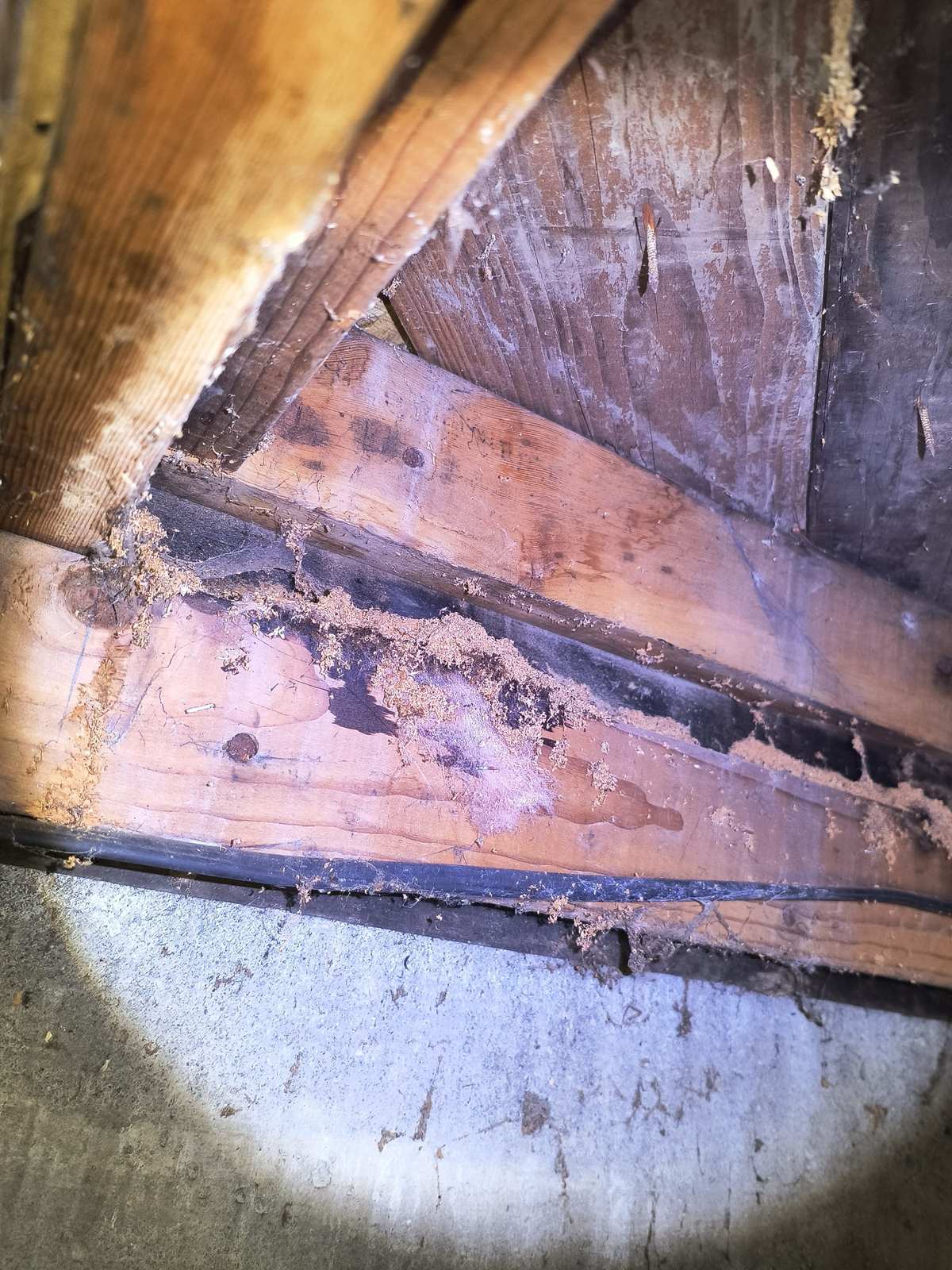
What to do, in order
- Put a tablespoon of the debris in a sealed bag or small jar, and keep it dry rather than wetting it
- Spread a little on white paper: coarse fibers with insect parts suggest carpenter ants, floury powder suggests beetles, hard six-sided pellets suggest termites
- Sweep up the rest of the pile, write down the date, and watch whether it builds back up and how quickly
- Trace the line straight up from the heap and photograph the slit or hole it falls from, with a coin or pencil tip for scale
- Note any leak, roof problem, burst pipe or condensation near that trim in recent years, since wet timber is what draws these insects
- Do not accept a treatment quote for the trim debris until someone has worked out which of the four causes it is
- Then bring us the sample for a free look at the debris and the timber above it, before anything is quoted
It is almost certainly not sawdust
Someone notices a small heap of pale wood-colored material on a floor, a windowsill, a stair tread or the top of a baseboard. It looks like sawdust, so that is what it gets called, and quite often it gets swept up and forgotten.
Then it comes back, and that is when we get the call.
Debris that reappears after being cleared is not sawdust. Sawdust is a by-product of somebody cutting timber, and once you have cleaned it up it stays cleaned up. Material that accumulates again over days or weeks is being actively pushed out of the wood by something living inside it, and identifying what that something is, before anybody treats anything, is the whole of the job at this stage.
There are four realistic answers in a Whatcom County building. They look superficially similar and they are easy to tell apart once you know what to look for.
Look at the texture first
Pick a small quantity up between finger and thumb, or better, put some on a sheet of white paper where you can see it properly.
Coarse and fibrous, like shredded wood or wood wool. Carpenter ants. The material is excavated rather than eaten, so it retains a fibrous structure, and individual pieces are visibly wood shavings rather than powder.
Fine, soft and floury, like talc or very fine flour. Wood-boring beetles. Larvae eat their way through the timber and what comes out has been through a digestive system, so it has no structure left at all. Some species produce a slightly gritty version, but the defining quality is that it is a powder rather than a shaving.
Hard, granular pellets that feel like coarse sand or fine gravel. Termites, specifically the drywood and dampwood species. The pellets are distinctly six-sided under magnification, uniform in size, and often colored like the wood they came from.
White, chalky, angular and mixed with paper fiber. Not an insect at all — this is drywall or plaster debris, and it points at something mechanical: settlement, a fastener working loose, or a route being made by an animal rather than an insect.
Then look at what is in it
This is the step that resolves most remaining ambiguity, and it needs nothing more than good light.
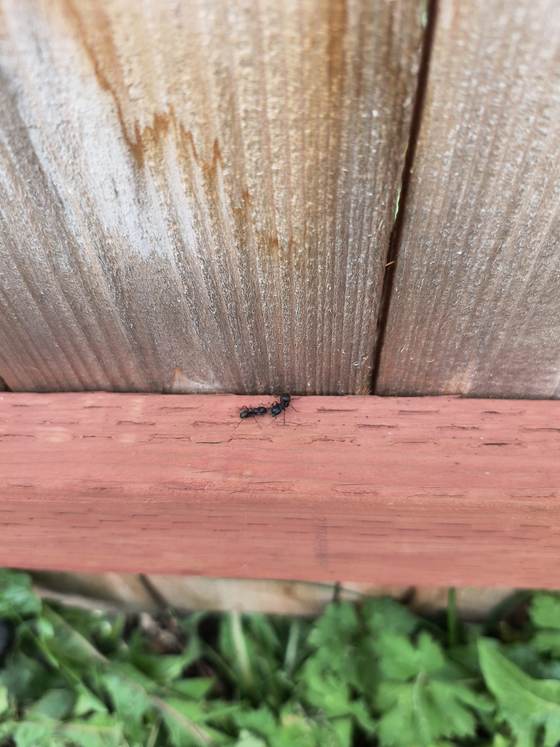
Carpenter ant frass contains insect parts. Discarded legs, wing fragments from spent reproductives, pieces of head and thorax from dead colony members. The colony housekeeps by pushing everything out through the same slits it uses for debris, so the pile is a mixture of wood fiber and body parts. Finding fragments in the pile is close to conclusive. UC IPM describes that mixture of wood fiber and body parts on its carpenter ant page, and it is the detail that separates them from beetles faster than anything else.
Beetle powder contains nothing but powder. No fragments, no fibers, no inclusions.
Termite pellets are uniform and clean. If your pile is entirely made of similar small hard granules with no dust and no fragments, that is what you are looking at.
And if the pile contains chewed paper, insulation fiber, fabric threads or plastic shreds, you have moved into a different category altogether — that is nesting material rather than excavated wood, and it means a rodent.
Where the pile sits
The location narrows it further, because each of these has habits.
Below trim, baseboard, casing or a stair stringer, in a heap that keeps returning: most consistent with carpenter ants working a gallery in framing or in the trim itself. The debris exits through a slit, often at a joint or a nail hole, and falls straight down.
Below a window sill or the bottom corner of a frame: carpenter ants again in most cases, with water damage behind it.
Under exposed structural timber in a crawlspace or a garage, on the concrete below a beam or joist: could be any of the three insects, and this is where identification matters most because it is structural material.
Scattered around small round holes in a wood surface: wood-boring beetles. The holes are the exit holes of emerging adults, typically between one and three millimeters across depending on species, and their presence with fine powder below is diagnostic.
In a loft or against a ceiling, mixed with other material: worth checking for the rodent answer before assuming an insect.
The four candidates in more detail
Carpenter ants. The most common of the four here by a wide margin. They excavate galleries to nest in and do not consume the wood. Galleries are characteristically smooth, almost sanded, and kept clean, which is why the debris ends up outside. Activity peaks in spring and summer, and it is strongly associated with timber that has been wet. Critically, what is in your wall is usually a satellite nest, with the main colony outdoors in a stump, a log, a dead limb or buried wood — so treating the debris site alone is not a resolution.
Wood-boring beetles. A group rather than a species, and the important question is which one, because the outlook differs enormously. Some infest only freshly felled or recently milled timber and die out on their own once the wood is seasoned — treating those is spending money on a problem that is already ending. Others will reinfest seasoned timber repeatedly and do need intervention. Fine powder and small round exit holes are the shared signature; telling the harmless from the persistent needs a look at the wood, the hole size and the moisture.
Termites. Present in this region, and in this county that means the dampwood species associated with wet, decaying timber. The soil-nesting subterranean species that builds mud tubes and works up from ground contact is documented in western Washington only as far north as Seattle, per WSU Cooperative Extension bulletin EB0787, so it belongs on the list as an outside possibility rather than as a co-equal candidate. Termite damage differs visibly from carpenter ant damage: the galleries are rough rather than smooth and are typically packed with mud and debris rather than swept clean. Where a report from an inspector has identified a wood-destroying organism in your building, the treatment side of that is within what we are certified to carry out.
Something mechanical or rodent-related. Worth keeping on the list, because we are called out to plaster dust and to rodent nesting debris often enough that it is not a remote possibility.
What to do before anyone comes out
Three things, none of which takes long, and all of which make the visit more useful.
Collect a sample. A tablespoon in a sealed bag or a small jar. Do not wet it. A sample tells us more in thirty seconds than a description does in ten minutes, and a photograph of a pile on a dark floor rarely resolves texture.
Clear the rest and date it. Note the day you cleared it. Whether it returns, how quickly, and how much, distinguishes an active gallery from historic debris that has simply been sitting there. A pile that does not return in three weeks is a very different situation from one that rebuilds in four days.
Look up. Debris falls, so the source is above the pile, not at it. Follow the line vertically and look for the opening — a slit, a small round hole, a gap at a joint. Photographing that opening is worth as much as the sample.
If you can also tell us whether there has been a leak, a roof problem, a burst pipe or persistent condensation anywhere near that spot in the last few years, you have probably explained the whole thing.
The openings tell you as much as the pile
Once you have followed the debris upward, the shape of the hole it came out of is its own identification.
A narrow slit or an irregular gap at a joint, often where two pieces of trim meet or where a fastener sits. Carpenter ants do not make round holes for debris disposal — they use existing gaps and openings they have widened, and the result looks like a crack rather than a bore.
A clean round hole between one and three millimeters across. A beetle exit hole, made by an adult chewing out of the timber after developing inside it. Round is the key word. Several of them scattered across a surface is typical.
A larger oval or D-shaped hole. A different group of beetles, generally associated with hardwood, and much less common in the framing and trim of houses here.
A hole plastered around the edges with mud or a hard packed material. That is a termite characteristic and it moves the finding up the priority list.
A ragged opening with fibrous or shredded edges at the base of trim. Not an insect. Rodents gnaw and the edge shows it.
Photograph the opening with something for scale — a coin, a pencil tip — and you have given us most of what we need before anyone has driven anywhere.
When the trim itself is the problem
Modern trim materials change this picture and it is worth knowing which you have.
Finger-jointed softwood trim, which is standard in a great deal of construction from the last few decades, is made of short pieces glued together. It takes on water readily at the joints once the paint film fails, and it softens quickly, which makes it more attractive than solid stock.
MDF and composite trim behaves differently again. It does not support carpenter ant galleries well, but it fails badly when wet — swelling, delaminating and losing all strength — and the framing behind it then takes the water instead. Debris below MDF trim is more often the material itself disintegrating than anything living.
Solid old-growth trim in older houses is dense, slow to wet and slow to decay, and where it is failing there is usually a specific and locatable water source rather than general weathering.
Painted trim hides everything until the paint film breaks, at which point the timber underneath has often been wet for years. Probing gently with something blunt at a suspicious point tells you more than looking does — sound wood resists, softened wood gives.
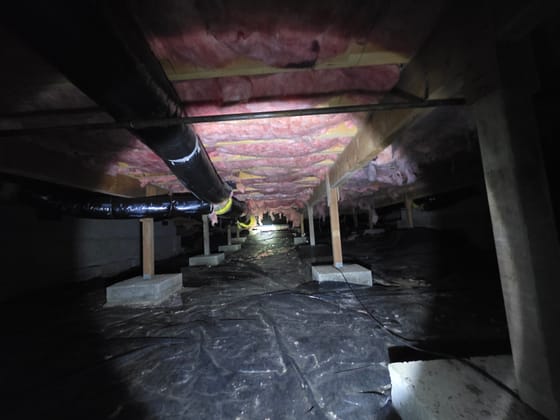
The crawlspace version of this finding
Debris found on a crawlspace floor, on a vapor barrier or on concrete below a beam is the same evidence in a more consequential location, and it deserves a different level of attention.
The material below you there is structural. Joists, beams, posts, the sill plate and the rim joist are what hold the building up, and they are also the parts of a house most likely to be damp in this climate, which puts them squarely in the range of everything discussed above.
Two additional signs matter down there. Mud tubes — pencil-width earthen tracks running up a foundation wall, a pier or a post — are a subterranean termite signature and are worth acting on. And a general softness in the sill plate or rim joist, where a blunt probe sinks in rather than stopping, indicates decay that has usually been running long enough to matter.
We look at the crawlspace on essentially every visit for exactly this reason, even when the reported problem is a small pile of dust upstairs. A remarkable proportion of the answers are down there.
What we will not sell you
A treatment before an identification. If we cannot tell you what you have, we are not going to quote you for treating it.
A beetle treatment for timber that has already seasoned out. Where the evidence points to an infestation that is ending on its own, that is what we will tell you, and there is no charge for the conversation.
A whole-structure treatment for a single localized finding. The scope should follow the evidence.
Recurring service in place of a repair. Where the driver is a leak, a drainage fault or a failed flashing detail, a quarterly visit does not address it and we will not pretend it does.
Work on a wood-destroying organism finding without seeing it ourselves. We treat what is genuinely there. If somebody else’s report says one thing and the timber says another, we will raise it rather than proceed quietly.
Why identification decides the price
Homeowners sometimes find it strange that we will not quote from a description, and it is because the four answers carry very different work.
Carpenter ants mean an outdoor search for a parent colony, treatment at both the satellite and the source, and a moisture correction. It is a moderate job, and the durable version of it is not the cheap version.
Beetles mean identifying the species and the moisture condition, and the answer is frequently that no treatment is warranted at all because the infestation is in timber that has already seasoned past the point where it can continue.
Termites mean a considerably more serious conversation about structure, extent and ground contact.
Rodent or mechanical debris means we are not the answer at all, or we are the answer to a completely different question.
Anybody willing to quote a treatment from a phone description of a small pile of dust is guessing, and a guess in this situation has a decent chance of being both expensive and useless.
Damage, in proportion
People are usually more frightened by the pile than the situation warrants, and occasionally less frightened than they should be, so here is the proportionate view.
Carpenter ants work slowly. A season of activity in a wall does not usually produce structural consequence. Years of activity in chronically wet framing can, and by that point the decay that attracted them has generally taken more material than the insects have.
Beetle damage in most cases here is cosmetic and historic. In the minority of cases where it is not, it is worth taking seriously.
Termite damage is the one that can move fastest and is most likely to reach structural significance, which is why identification matters rather than reassurance.
And in every case, the thing driving all of it in this climate is water. Dry timber in a well-drained, well-ventilated building is not attractive to any of these organisms. Most of what we recommend after an identification is about keeping wood dry, and that recommendation is worth more over a decade than any treatment.
Seasonality, and what it adds
When the debris appears is another piece of evidence, and it is free.
Carpenter ant activity here runs from early spring through late summer, with the strongest signs as the weather warms and again around the swarm period. Debris that begins accumulating in April and stops in October fits that pattern closely. Activity that continues through a cold January in a heated building is still possible but suggests a nest well inside the conditioned envelope rather than in an exterior wall.
Beetle emergence is tightly seasonal too, generally late spring into summer, which is when the exit holes and the powder appear. Debris that shows up once a year in the same weeks and then stops is very characteristic.
Termite swarming in this region tends to run late summer into autumn for the dampwood species, and spring for subterranean species.
Debris that accumulates steadily and indifferently all year, with no seasonal shape at all, is more likely to be mechanical or rodent-related than insect.
So a note of the date each time you clear a pile builds, over a few months, a picture that no single visit can give us. It is the cheapest diagnostic available and almost nobody does it.
Bring us the pile
The quickest route through this is to keep a sample, photograph the opening, and have somebody look at the timber it came from.
We will identify what you have, tell you whether it is active or historic, explain what is realistically at stake, and quote only what the identification actually supports — including, fairly often, telling you that what you have does not need treating.
Assessment is free, there is no term agreement, and we would rather be the company that talked you out of an unnecessary job than the one that sold it.
Frequently asked questions
How do I tell carpenter ant frass from beetle powder?
Texture. Carpenter ant debris is coarse and fibrous, like shredded wood, and usually contains insect body parts. Wood-boring beetle powder is fine and floury, often gritty between the fingers, with no fragments in it at all.
Should I clean it up or leave it?
Clear it, then mark the date. Whether it comes back, how fast and in what quantity is the single most useful piece of evidence, and it costs you nothing but a week of waiting to collect it.
Could it be actual sawdust?
Occasionally, yes. Recent drilling, a hole cut for a cable, or work above a ceiling all leave real sawdust, and it is uniform, angular and does not come back once cleared. Debris that reappears is not sawdust.
Does a small pile mean a small problem?
Not reliably. The pile shows what has been pushed out through one opening, not the size of the gallery behind it. A modest heap can sit beneath a long-established nest that has been excavating quietly for years.
Is it termites?
It can be. Drywood and dampwood termites produce hard six-sided pellets rather than fibrous debris, and they feel like coarse grit. Where somebody's report has identified a wood-destroying organism, treating it is within what we are certified to do.
Why does it matter which one it is?
Because the treatment, the urgency and the cost are all different. Carpenter ants need the outdoor parent colony found. Beetles need the source and the moisture identified. Getting the identification wrong wastes a season.
What does it cost to have somebody identify it?
Nothing. Bring us a sample or leave it in place and we will look at it, at the debris and at the timber it came from, and tell you what you have before anything is quoted.
Ant & Carpenter Ant Control in Whatcom County?
Family-owned, no long-term contracts, and every treatment is backed by our 100% Service Guarantee.
Most calls in Whatcom County are out within 1–2 days, about 3 during the late-summer peak.
Last updated