
Thatching Ants — Formica spp.
Formica spp. · Ants
A dome of dried grass and plant stems in a sunny part of the yard, worked by large red-and-black ants, is a thatching ant mound. They rarely nest in buildings. What they do is bite hard and spray formic acid into the bite, which is the complaint we usually hear.
Call 360-410-2199 Request a free inspection
Sometimes worth treating, sometimes not — it depends on what is below.
Thatching ant at a glance
| Size | 4 to 9 millimeters, with big and small workers mixed in one colony |
|---|---|
| Color | Often bi-colored red and black; some species are plain brown or black |
| How to tell it from a carpenter ant | A notch or dip on top of the thorax in profile — a carpenter ant's is smoothly rounded |
| Nest | A dome of dried grass, needles and small stems over soil or a rotten log, in a sunny spot |
| Bites or stings | No sting — it bites hard, then sprays formic acid into the wound |
| Indoors | Rarely nests in homes; foragers come in after sweet material |
| Winged ants | Late summer into early fall |
| Do we treat it | Depends — only where a mound conflicts with a lawn, path, play area or foundation |
Signs you have them
- A low dome of dried grass and conifer needles in open, sunny ground, its surface always freshly reworked
- Large red-and-black ants swarming out when a mound is disturbed or mowed over
- A burning bite, out of proportion to the mark, after kneeling or sitting near a bank
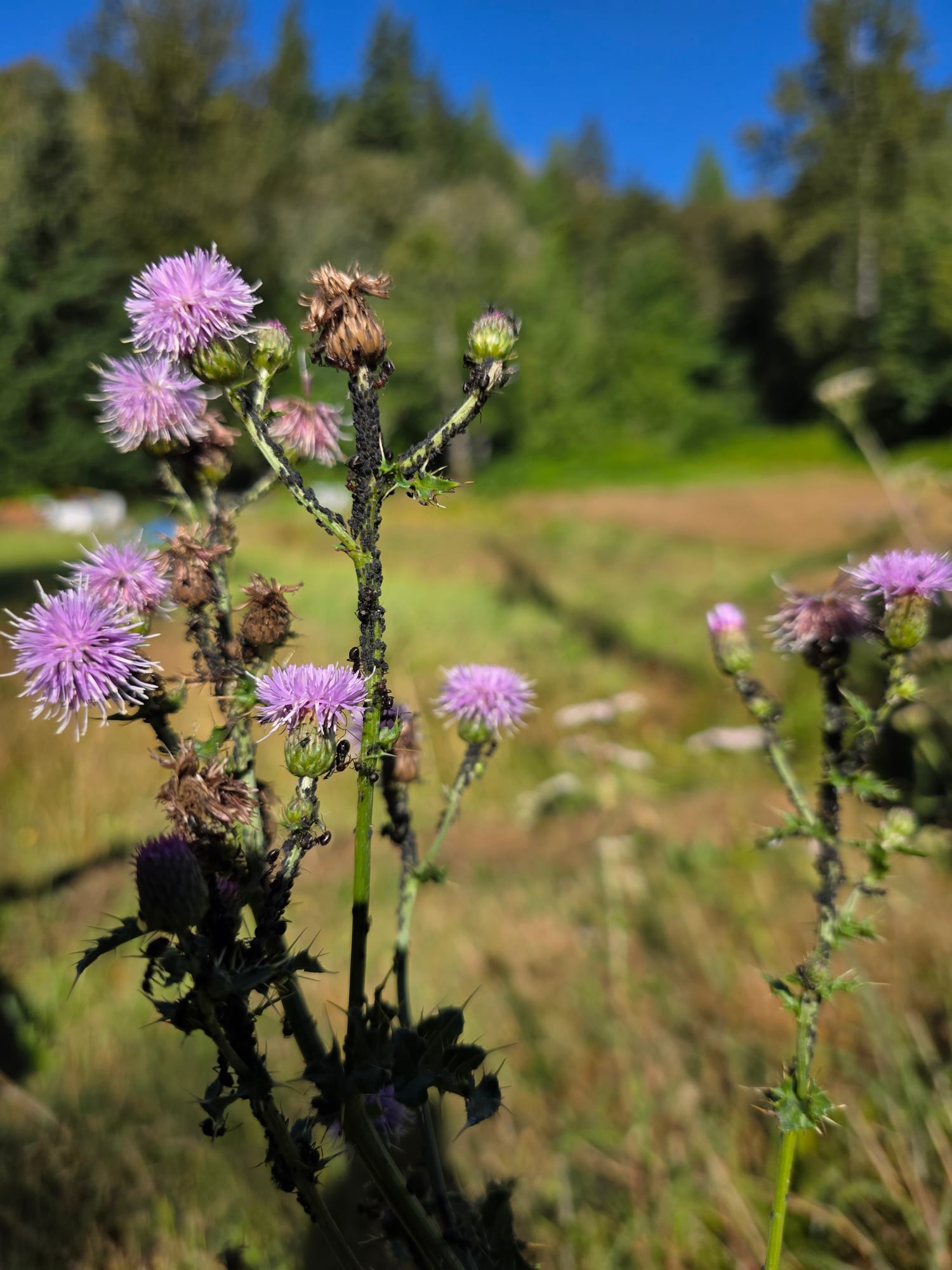
- Heavy ant trails up a shrub or fruit tree where aphids are being tended
- Winged ants indoors in late summer or early fall
What you are looking at
A low dome in a sunny part of the yard, built out of dried grass, conifer needles and small stems rather than soil, with large ants working over the surface. The mound may be a foot across or it may be waist high. It is usually in an open spot that gets sun, on a bank, at a woodland edge, along a fence line, or in rough ground beside a driveway.
That is a thatching ant nest. The ants are Formica, the guide the owner of this company works from lists them among the twelve key ant pests of this region, and they are one of the more misunderstood insects we get called about.
They rarely have anything to do with your house. What they do have is a bite that people remember.
Recognizing them
PNW 624, the WSU, OSU and University of Idaho extension key for this region, gives the identification in a few lines and they are worth quoting closely because the details are what separate this ant from the one people fear.
Size and build. Large ants, 4 to 9 millimeters, and polymorphic — meaning the workers in one colony come in a range of sizes rather than all matching. A trail with obvious big and small workers in it is a useful early clue.
Color. Many species here are bi-colored, red and black. Some are uniformly brown or black, which is where the confusion with carpenter ants begins.
The thorax. This is the one that settles it. Thatching ants possess a notch or depression on top of the thorax. Viewed from the side, the upper profile dips. A carpenter ant’s is evenly rounded and smooth.
The antennae. In the extension key, Formica keys out on antennae inserted close to the margin of the clypeus — the plate at the front of the head. That is a hand-lens character rather than a driveway one, but it is what a specimen gets identified on.
The mound, and what it is for
The thatch is the defining behavior. The ants gather plant material — most often grass, and needles where there are conifers — and pile it over a nest excavated in soil, or over a rotten log.

It is not decoration. The thatch sheds rain, holds heat, and lets the colony regulate temperature by moving brood up and down through it as the sun moves. Ants can be seen rearranging the surface constantly, which is why a mound never looks settled.
Colonies frequently have multiple queens, which matters for two practical reasons. A colony with many queens is not going to collapse because one is killed, and colonies with multiple queens can be very long-lived and very large. The extension literature notes a Formica colony in Japan estimated at 348 million workers spread over many acres — an extreme case, and a useful sense of what this genus is capable of.
Nests also occur without an obvious mound, in soil or in rotten logs, which is why not every thatching ant complaint comes with a dome to point at.
The bite, which is the actual complaint
Almost every call we get about these ants is really a call about being bitten, and the mechanism is worth explaining because it is unusual.
Thatching ants do not sting. They have no sting to use. What they do is bite with the mandibles and then curl the abdomen forward and spray formic acid into the wound they have just made.
PNW 624 describes exactly that: they can bite quite hard and usually spray the area they have bitten with formic acid to produce a painful sensation.
The result feels like a sting, which is why people report it as one. It burns out of proportion to the size of the mark, and it happens when somebody kneels in a bed, sits on a bank, or puts a hand down near a mound without noticing it.
This is not a medical emergency and it is not comparable to a yellowjacket attack. It is, however, genuinely painful, and it is the reason a mound in the wrong place is worth doing something about.
Where they actually live, and why not your walls
The extension guidance is explicit that these ants rarely nest in homes, and that single sentence resolves most of the anxiety we hear.
They nest in soil and in rotten logs, in open sunny ground, at edges rather than in the middle of dense forest or the middle of a mown lawn. What brings them into contact with people is foraging and swarming rather than nesting.
They come indoors after sweet material. They are attracted to the same kitchen spills and pet food as anything else, and a trail into a house is a foraging trail from a nest outside it.
Reproductive swarms come in late summer to early fall, later than the carpenter ant flights people are used to, and winged ants indoors at that time of year are usually reproductives that wandered in rather than proof of a nest in the structure.
Telling them from what actually damages buildings
This is where the money is, because the two ants get confused and the consequences are entirely different.
Carpenter ants excavate galleries in wood and can genuinely damage a structure over years. Our common one is large and essentially black, with a smooth, evenly rounded thoracic profile. A carpenter ant problem is a moisture and structure problem, and it deserves the full treatment described on its own page.
Thatching ants build a mound outdoors, do not tunnel in sound structural wood, and rarely nest in a house at all. The thoracic notch and the bi-colored red-and-black pattern are your field marks.
Moisture ants are smaller, usually yellow, and are a report about wet decaying wood rather than a pest problem in themselves. The extension key separates them from thatching ants on a round epinotal spiracle, which is a microscope character — in practice the size and color difference does it.
Velvety tree ants are dark with a reddish thorax, smell strongly when crushed, and nest in trees and occasionally in structures.
Getting this right in the first minute changes everything that follows. We would rather look at a specimen or a clear photograph than treat on a description.
Aphids, honeydew, and the reason they are on your plants
If the complaint is ants streaming up a shrub or a fruit tree, the ants are the symptom.
Thatching ants attend aphids for honeydew — they protect aphid colonies from predators and parasites in exchange for the sugary excretion. A heavy ant trail into a plant almost always means a well-established aphid population being farmed.
Two things follow. Spraying the ants off the plant achieves nothing durable, because the aphids are still there and the colony will send more. And dealing with the aphids collapses the ant traffic without touching the ants at all.
That is a horticultural job more often than a pest control one, and where that is the answer we will say so rather than quote for the ants.
They are predators, and that is worth something
A thatching ant colony takes an enormous number of other insects. In forestry literature these ants are treated as beneficial for exactly that reason, and mound-building Formica species are protected in parts of Europe on those grounds.
We are not going to pretend that makes a mound beside a child’s swing set acceptable. But it does mean the default answer to “there is an ant mound in the back of my property” should be to leave it, and that destroying a large colony is a real loss rather than a neutral act.
Where the mound is well away from the traffic on a property, our advice is usually to mark it, tell whoever mows, and let it be.
When it genuinely warrants action
There are real conflicts and we would rather name them than pretend the answer is always no.
A mound in a lawn that has to be mowed. A mound beside a path, a patio, a play area or a sandpit. A mound hard against a foundation, where foraging trails run into the building constantly. A colony in ground somebody with a known reaction to insect venom has to cross. Persistent indoor foraging traced to a specific nest.
Those are situations where the ants and the use of the ground cannot both continue, and in those cases treatment is warranted and we will carry it out.
What we will not do is treat a mound at the back of two acres because somebody saw it.
What we would actually do
Identification first, from a specimen or a good photograph, because the answer for thatching ants, carpenter ants and moisture ants are three different jobs.
Then location. Where is the nest, where are the trails, and what is the actual conflict — the mound itself, foraging indoors, or ants farming aphids on a plant. Those three have three different responses and only one of them involves the mound.
Where the mound is the problem and it has to go, the work is direct treatment of the nest rather than a perimeter spray around a house that the ants are not living in. A residual band on a foundation does very little about a colony sitting forty feet away in the open.
Where the problem is foraging indoors, the answer is finding the trail, closing the entry it uses, and baiting rather than spraying the trail — a sprayed trail frequently splits a colony and makes the following month worse.
Where the problem is aphids, we will tell you it is aphids.
Around this county
Thatching ants are ordinary here without being a common service call, and the pattern follows the terrain rather than the town.
We see them on rural and forest-edge property — the places already described on our Deming, Acme and Meadowview pages, where standing timber meets open ground and there are sunny banks and rough margins for a mound to sit in. Cleared land with regrowth, powerline corridors, gravel pits and old logging edges all suit them.
In town they turn up on properties backing onto greenbelt, along the sunnier edges of a lot, and occasionally in a neglected corner that has been left to rough grass.
What we very seldom see is a thatching ant problem inside a house, and that is consistent with what the regional guidance says to expect.
Living with a mound
For anybody who would rather keep it, which is a reasonable position:
Mark it so it does not get hit with a mower — a cane, a flag, an upturned pot. Tell whoever cuts the grass. Keep the immediate area out of the routine path across the property, and warn anybody gardening nearby.
Do not disturb the surface for fun. A poked mound produces a great many defensive ants very quickly, and the bite is the reason this page exists.
And take the aphid trails as information rather than as a second problem. A colony working a shrub is telling you the shrub has aphids.
What we will not sell you
We will not treat a thatching ant mound that is not in anybody’s way. It is a predatory colony doing useful work, and killing one to produce an invoice is not something we are prepared to do.
We will not sell a recurring perimeter program for an ant that rarely nests in buildings. If the foraging is genuinely persistent, the answer is the trail and the entry point, and that finishes.
We will not call a thatching ant a carpenter ant. The words are worth money in this trade, which is exactly why they should be used accurately, and the difference is visible in profile to anybody with a hand lens.
And if what you actually have is aphids on a plum tree, we will say so, and it will not cost you anything.
Hitting a mound with machinery
The situation that turns a harmless colony into an afternoon nobody enjoys is mechanical, and it is the same story we tell about ground-nesting wasps for a different reason.
A mower, a strimmer or a tractor across a thatch mound opens it, and the response is immediate and coordinated. Thousands of workers come out, they climb whatever is in reach, and the bite-and-spray described above happens repeatedly rather than once. Anybody in shorts on a ride-on mower has a bad few minutes.
The prevention costs nothing. Find the mounds before the first cut of the season, mark them with a cane or a flag, and tell whoever does the mowing where they are. On a property where the work is contracted out, say it at the start of the year rather than after somebody has found one the hard way.
Where a mound genuinely sits in ground that has to be mown, that is a real conflict and one of the cases where treatment is the right answer. But it is worth establishing that it truly cannot be mown around before deciding.
Mounds on farm ground and open acreage
On rural property the calculation is different again, and usually easier.
Pasture, field margins, fence lines and the rough ground around outbuildings are where mounds turn up on the farms and acreages we work across this county. Most of them are nowhere near anybody, most of them are doing useful predatory work on the insects around a crop, and most of them warrant nothing at all.
Where they matter on farm ground is narrower than people expect: a mound in ground that gets worked, a mound where stock congregate, or a colony farming aphids on something being grown for sale. Those are specific problems with specific answers rather than a reason to treat a field.
The other rural note is that thatching ant mounds are frequently mistaken for something worse at a distance. A dome of dried plant material in a pasture looks alarming if you are expecting a nest. Walk up to it in daylight, look at what it is made of, and the identification is usually done from two feet away without anything being disturbed.
What a mound tells you about the ground
One last thing worth taking from a thatching ant mound, since it is on your property whether or not you do anything about it.
The mound is a fair indicator of what that patch of ground is like. These ants want sun, drainage and a spot that stays warm — the same conditions that suit a dry border, a bank that will not hold turf, or the strip beside a driveway that never quite grows grass properly.
So a mound in a lawn is frequently sitting in the part of the lawn that was struggling anyway. If the ants are being removed and the ground restored, that is the moment to deal with the drainage or the shade problem that made the spot attractive, rather than laying turf over it and finding another colony there in three years.
Frequently asked questions
Do thatching ants sting?
They do not sting — they bite, and then spray formic acid into the wound. PNW 624 puts it plainly: they can bite quite hard and usually spray the area they have bitten with formic acid to produce a painful sensation. That combination is why people describe it as a sting when it is not one.
Will they get into my house?
Rarely. The regional extension guidance says thatching ants rarely nest in homes. They come indoors as foragers looking for sweet material, and winged reproductives turn up in late summer, but a colony living in your walls is not the usual story with this ant. If something large is nesting in the structure, carpenter ants are the likelier answer.
What is the mound made of?
Plant material — dried grass, needles, small stems — piled over a soil nest. That thatch is what gives them the name. It insulates the colony and sheds rain, and the ants rework it constantly, which is why the surface always looks freshly disturbed.
How do I tell them from carpenter ants?
Look at the top of the thorax in profile. A carpenter ant has an evenly rounded, smooth upper profile. A thatching ant has a distinct notch or depression in it. Color helps too: many thatching ants here are bi-colored red and black, where our common carpenter ant is essentially all black.
Should the mound be destroyed?
Often not. These are predatory ants that take large numbers of other insects, and a mound well away from where people walk is doing no harm. Where it sits in a lawn, beside a path, next to a play area or against a foundation, that is a genuine conflict and worth dealing with. We will tell you which one you have.
Why are they all over my shrubs?
Aphids. Thatching ants tend aphids for honeydew and will defend them, so a heavy ant trail up a plant is usually a sign of an aphid population rather than a problem with the plant itself. Deal with the aphids and the ant traffic drops away on its own.
When do the winged ones appear?
Late summer into early autumn, which is later than most people expect. Winged ants indoors at that time of year are frequently reproductives that wandered in rather than evidence of a nest in the building — the same confusion that causes a lot of unnecessary alarm about carpenter ants.
Sources
- Hansen & Antonelli — Identification and Habits of Key Ant Pests in the Pacific Northwest (PNW 624), WSU/OSU/UI Extension — read September 10, 2026
- PNW 624 full text (WSU Puyallup) — read September 10, 2026
- Oregon State University Extension Catalog — PNW 624 — read September 10, 2026
Rules change. This page is scheduled for review against its sources by September 10, 2027. If you are reading it after that date and something looks out of step with the current rule, the rule is right and we are wrong — please tell us.
Pest problem in Whatcom County?
Family-owned, no long-term contracts, and every treatment is backed by our 100% Service Guarantee.
Most calls in Whatcom County are out within 1–2 days, about 3 during the late-summer peak.
Last updated