Vole — A Lawn and Landscape Animal, Not a Structural One
Microtus spp. · Rodents
Voles are short-tailed, blunt-faced rodents that live in surface runways under grass and ground cover, feeding on plants and gnawing bark at the base of shrubs and young trees. They rarely enter buildings. Vole damage in a lawn or a landscape is not structural pest work and we do not take it on.
Call 360-410-2199 Request a free inspection
We do not treat this. Where to go instead is below.
Vole at a glance
| Size and build | Five to eight inches overall; compact and heavy, short legs, no visible neck |
|---|---|
| Face, ears and tail | Blunt face, small eyes, ears half buried in fur, and a short furred tail |
| Color | Blackish brown to grayish brown |
| Vole or mole | Voles eat plants and leave surface runways and open holes; moles eat worms and throw up rounded mounds |
| Species here | Townsend's vole, west of the Cascades |
| Indoors | A poor climber that usually stays out of buildings |
| Do we treat it | No — lawn and landscape damage is not our work |
Signs you have them
- Narrow runways an inch or two wide under the grass, worn to bare or matted soil between small open holes
- Fresh green grass clippings cut and left lying in the runways
- Greenish droppings about three-sixteenths of an inch long near the runs
- Irregular patches of short, crossed gnaw marks on bark at the base of shrubs and young trees
- Tulips that never come up and hostas grazed to the crown
- A lawn that looks scored and thinned across a wide area once the grass lifts in spring
Read the verdict first
This profile exists because voles get confused with things we do handle, and because the wrong diagnosis here sends people to the wrong trade and sometimes to an unnecessary treatment. It does not exist to sell you anything.
We are a structural pest control and exclusion company. Our rodent work is about what gets inside a building — how it got in, how it comes out, and how the shell gets closed. A vole is not doing any of that. It lives in the grass, eats the plants, and by UC IPM’s own account is a poor climber that usually does not enter homes or other buildings at all.
So the honest answer is that vole damage in a lawn, a bed, an orchard or a nursery row is not our work, and we will say so on the phone rather than after driving out. What follows is what we would tell you on that call, at more length, because a correct identification and a realistic list of what works is worth more than a service call anyway.
Moles come up constantly in the same conversation and they are a separate animal altogether. They are also outside what we do. There is a section on them below, because telling the two apart is most of the value of this page.
What a vole actually is
A vole is a small rodent built low and compact, and once you have seen one the outline is hard to mistake.
UC IPM describes a compact heavy body, short legs, a short-furred tail, small eyes and partially hidden ears, colored blackish brown to grayish brown, at five to eight inches overall. The impression is of a stocky animal with no neck, a blunt face and a tail that looks too short for it.
Set that against the two mice on this site. A house mouse has a tail about as long as its head and body together, large ears and a pointed muzzle. A deer mouse has larger eyes and ears still, and a furred two-tone tail. A vole has none of that: the ears are half buried in fur, the eyes are small, and the tail is a stub by comparison.
They are also called meadow mice, and WSU uses that name alongside the genus, which is worth knowing because a lot of the older material a gardener will find files them that way.
Diet is the other half of what a vole is. UC IPM describes them as mostly herbivorous, feeding on grasses, herbaceous plants, bulbs and tubers. WSU adds that in winter they turn to the bark and roots of woody plants. That single seasonal shift is the origin of nearly all the expensive vole damage anybody ever sees.
The species that is actually here
This matters because most vole content online is written about the meadow vole of the eastern states or the California vole, and neither is what is in a Bellingham lawn.
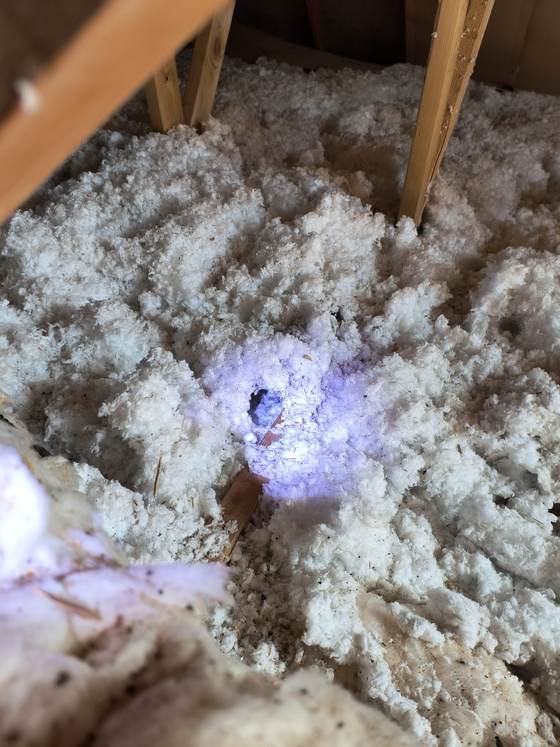
WSU’s vole publication is specific about Washington: two species cause most of the damage in this state, and the one west of the Cascade Mountains is the Townsend’s vole. The montane vole takes over east of the mountains. So on this side, in Whatcom and Skagit, Townsend’s vole is the default answer.
WSU lists its habitat as lawns, open grassland, gardens, farms, orchards, meadows, cropped areas and young forested plantations. That is a fair description of a great deal of this county, and it explains why this is a routine complaint here and a curiosity elsewhere.
The runways are the diagnosis
If you take one identification method from this page, take this one.
UC IPM calls the clearest evidence of voles the presence of well-traveled aboveground runways connecting burrow openings, usually hidden under a canopy of grass. WSU describes the same thing from the animal’s side: voles cut runways through grass, feeding on the vegetation as they move.
To find them, part the grass and look at the soil surface. What you are looking for is a network of narrow paths, an inch or two wide, worn down to bare or matted ground, running between small open holes. They are not tunnels and there are no mounds of pushed-up soil along them. They connect, they branch, and they usually follow cover — the base of a hedge, the edge of a bed, along a fence line, under a shrub skirt, beneath a tarp or a sheet of weed cloth.
Two corroborating signs are worth checking while you are down there. UC IPM names fresh clippings of green grass in the runways, cut and left rather than carried away, and greenish droppings about three-sixteenths of an inch long near the runs and burrows. Clippings plus droppings plus paths is a complete identification and it takes about a minute.
The other thing the runways tell you is scale. A few short runs at the edge of a bed is a different situation from a lawn with a visible network across it once the grass is parted, and that difference should govern how much anybody spends.
Vole, mole, or something else entirely
This is where most of the confusion in this county sits, and the two animals have almost nothing in common beyond living underground in a lawn.
Moles are not rodents and do not eat plants. Oregon State Extension is direct: moles tunnel while hunting prey — worms, grubs and insects — rather than feeding on vegetation. A mole in a lawn is not eating your lawn. It is eating what lives underneath it, and the damage it does is mechanical rather than dietary: raised ridges where a surface run has been pushed up, and mounds of excavated soil.
The mounds are the fastest check. Oregon State describes mole mounds as volcanic and rounded, thrown up from below with no visible entrance. Gopher mounds, for completeness, are flatter and fan-shaped with the hole off to one side. Voles produce no mounds of any kind. They produce surface paths and small open holes.
The damage is different in kind. Plants dying back, bark gone at the base of a shrub, bulbs disappearing, hostas grazed to the crown — that is a plant-eater and it points at voles. A lawn full of soil heaps with the plants otherwise healthy points at moles. The two can occur on the same property at the same time, and voles will happily use a mole run as a highway, which is how the two get blamed for each other.
Neither is our work. Moles are outside what this company does. Voles are outside what this company does. We are telling you the difference because you asked what you have, not because either answer leads to us.
Pocket gophers get raised occasionally and are a much less likely answer on the wet side of the Cascades. UC IPM’s distinction is still useful if the question comes up: vole girdling damage generally occurs above ground, while similar gopher damage generally occurs below it.
What the damage looks like
Turf and ground cover. Grazed patches, the runway network itself, and in a bad year a lawn that looks scored and thinned across a large area once the grass lifts in spring. UC IPM notes damage to turf and landscape plantings where the dense vegetation they live in gives them cover.
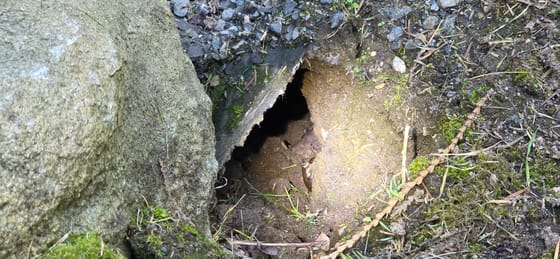
Bark at the base of woody plants. This is the one with real financial consequence. UC IPM describes gnaw marks about an eighth of an inch wide and three-eighths long, in irregular patches. WSU gives tooth scars generally a sixteenth of an inch wide, appearing in a crisscross pattern on the damaged plant. Either way, the texture is distinctive: irregular patches of crossed, short gouges rather than the clean chisel work of a rabbit or the ragged strip damage of a deer.
Bulbs, tubers and roots. Tulips that never come up. Crocus that vanished. Root damage on young trees below the soil line.
Nursery and orchard rows. Young stock is the most vulnerable thing there is — thin bark, small caliper, and usually planted into exactly the mulched, weed-clothed, ground-covered conditions that suit a vole.
Girdling, and why it all appears in one week
The mechanism behind the worst of it is worth understanding because it explains the timing, and the timing is what makes people think it happened overnight.
Girdling means gnawing all the way around a stem, trunk or root. UC IPM sets out the consequence: when voles gnaw completely around a trunk or roots, the flow of nutrients is interrupted and the plant can die. A tree girdled at the base in February can leaf out perfectly in April and then fail in July, which is why the diagnosis often arrives months after the damage.
The reason it concentrates in winter is cover. A vole is a small prey animal that will not spend long in the open, so bark feeding happens where something is hiding the animal: matted grass, heavy mulch, weed fabric, a shrub skirt, a board, and above all snow. UC IPM notes that snow cover extends damage a foot or more up the trunk, because the vole is working on top of the snowpack rather than at ground level.
In Whatcom County we do not get months of continuous snowpack, which caps the height of the damage relative to a colder region. What we do get instead is eight months of dense damp ground cover that never dries out or dies back, and that provides most of the same protection. A mild, wet, green winter is a good winter for a vole.
So the practical shape of it is: the animal works through the dark months under cover, the cover comes off in spring, and the damage arrives all at once as information.
The cycle, and why some years are much worse
Vole populations do not sit at a steady level and it is important to know that before spending money on the assumption that this is now permanent.
WSU records population explosions in Washington roughly every three to five years, potentially reaching more than a thousand voles per acre, followed by a crash. UC IPM describes the same cyclical pattern reaching peak numbers every three to six years before dropping back to low levels.
The arithmetic behind the peaks is startling. UC IPM gives females maturing in thirty-five to forty days and producing five to ten litters a year of three to six young, with individuals rarely surviving beyond twelve months. WSU’s illustration of the same thing is that a single female can theoretically produce over three thousand female descendants within about four and a half months.
Two conclusions follow, and they pull in opposite directions, which is why we give you both.
A bad year is usually a peak rather than a change to your property. If the whole neighborhood has vole damage this spring, you are living through a cycle and it will fall away regardless of what anybody does.
Waiting it out does not protect a young tree. A crash next year is no comfort to something girdled this year. The barrier work below is worth doing on anything you would be sorry to lose, independently of where the cycle is.
Why this county suits them
Nothing about vole pressure here is a reflection on how a property is kept. It is a straightforward consequence of the climate and of how western Washington landscaping is done.
No hard freeze. Populations are not reset by winter the way they are inland, so the animals come through in numbers.
Green cover year-round. Grass keeps growing through the mild season and ground cover plantings never die back, so the protective canopy the species depends on is available for twelve months rather than five.
Heavy mulching. Bark mulch laid deep is standard practice on landscaped lots here, and a deep mulch bed against a shrub is close to purpose-built vole habitat.
Weed cloth. UC IPM specifically names weed cloth alongside vegetation and mulch as protective ground cover that voles occupy. It is everywhere in local landscaping and it is doing exactly the wrong job.
Edges. Field margins, greenbelt boundaries, drainage ditches, creek corridors and the untended strip along a fence line are all reservoir habitat, and most residential lots in this county have at least one within a few yards.
What we do and do not do here
Stated plainly, because the point of this page is to be useful rather than to convert.
We do not treat voles. Not in a lawn, not in a bed, not in an orchard, not in a nursery. It is not structural pest work, it is not what our licensing is organized around, and a company that will treat anything on request is not doing you a favor.
We do not do mole work, for the same reason plus the fact that it is a different animal doing a different thing.
We do not offer wildlife or nuisance-animal services of any kind. Birds, bats, squirrels, raccoons and opossums are all somebody else’s specialty and several of them carry legal timing constraints that make them a job for an operator set up to handle it properly.
We will tell you what you have. If you describe the signs or send a photograph of the runways and the gnaw marks, that costs nothing and it is usually settled in a couple of minutes.
And we will tell you when it is actually a mouse or a rat, which happens often enough to be worth the call, because that is our work and the answer changes completely.
What actually works on voles
None of this is a treatment, which is the whole point. Both extension sources land in the same place.
Take away the cover, which is the single highest-value measure. UC IPM recommends removing weeds, heavy mulch and dense vegetative cover by mowing, herbicide or tilling. WSU’s version is to keep grass short and to hold mulch down to one to two inches rather than the four or five that gets laid on a typical bed. A vole crossing open ground is exposed to every predator on the property, and that is the mechanism doing the work.
Clear a circle at the base of anything young. UC IPM specifies keeping a four-foot-diameter circle around the base of a young tree free of vegetation. Mulch pulled back from the trunk rather than piled against it, which is better for the tree in several other ways as well.
Guard the trunks you care about. UC IPM describes cylinders of hardware cloth, sheet metal or heavy plastic around individual trees; WSU points to quarter-inch hardware cloth barriers. The mesh needs to be a quarter inch or smaller, and the base needs to be pushed into the soil rather than resting on it.
Fence a bed if it is worth fencing. UC IPM’s specification is wire fencing or aluminum flashing standing at least twelve inches above ground, quarter-inch mesh or smaller, with the bottom edge buried six to ten inches. That is a real piece of work and it is only worth it around something valuable.
Trap, in the runways. Both sources support it and both are realistic about the numbers. WSU describes ordinary mouse traps baited with apple or peanut butter, set at right angles across a runway. UC IPM’s guidance on quantity is the part people underestimate: a dozen traps for a small garden, fifty or more for a larger area, placed along the runs. Trapping a lawn with three traps is a gesture.
Let the predators work. Barn owls, hawks, herons on wet ground, and every other thing that eats small rodents are doing this for nothing. WSU is honest that cats kill voles but damage other wildlife while doing it, and that predation on its own will not resolve a peak year.
What does not work
Rodenticide, for a homeowner in this state. WSU states that no rodenticides are registered for home use against voles in Washington. UC IPM notes that zinc phosphide is the only toxicant usable against voles in residential settings in California, which is a different state with different registrations, and it is the kind of difference that catches people out when they read national advice. If somebody is offering to put bait down for voles on your lawn, ask what the product is and whether its label covers what they are proposing.
Repellents. WSU records their effectiveness as unproven, listing blood meal and castor oil products among what is sold. We would not spend money there.
Ultrasonic devices, vibrating stakes and windmills. No credible mechanism and no evidence.
Flooding a run or dropping something down a hole. Runways are a surface network with many openings and the animals simply leave and come back.
Treating the lawn with an insecticide. This is worth naming because it gets sold. Voles eat plants. Killing the grubs in a lawn does nothing to them whatever — and if grubs were the issue, the animal digging for them would be a mole rather than a vole.
The one case that is ours
There is a narrow exception and it is worth stating so nobody is caught by an absolute.
Voles very occasionally get into an outbuilding, a garage, a crawlspace or a greenhouse, particularly where a structure sits directly on grade with heavy vegetation right up against it. UC IPM’s own framing is that they usually do not enter buildings, and usually is not never.
If something is genuinely getting inside a structure, the sealing work is ordinary exclusion and repair and the standard is the same quarter-inch threshold that governs every rodent on this site. That part we do.
But the far more likely explanation for an animal inside a building is that it is not a vole. Check the tail and the ears before anything else. A long bare tail and prominent ears is a mouse, and that is a different page with a different answer.
Where to go instead
For the horticultural side of this — which is most of it — the useful contacts are the WSU Extension Master Gardener program for Whatcom County, which handles exactly this kind of question, and the extension publications listed below, which are written for a homeowner rather than for a commercial operator.
For a landscape at scale, an orchard or a nursery block, a landscape contractor or an agricultural adviser is better placed than a pest control company, because the fix is cultural: mowing regimes, mulch depth, weed control, clear circles and trunk guards.
And if what you actually have turns out to be something in the building rather than something in the grass, call us and we will pick it up from there.
Frequently asked questions
Is this a vole or a mole?
Different animals with different diets. Oregon State Extension puts it plainly: moles hunt worms, grubs and insects rather than eating plants, while voles graze grass and gnaw shrubs and stems near their holes and runways. Mole mounds are rounded and volcano-shaped; voles leave surface runs and small open holes.
Do voles get into houses?
Very rarely. UC IPM states that voles are poor climbers and usually do not enter homes or other buildings, inhabiting exterior areas instead. If something is moving inside a wall or a crawlspace, it is almost certainly a mouse or a rat rather than a vole.
Do you treat voles?
No. This is a lawn, garden and orchard problem rather than a structural pest one, and it sits outside what this company does. The measures that actually work are habitat management and physical barriers, and none of them is a pesticide application.
Why did all the damage appear at once in spring?
Because it happened out of sight. Voles feed at the base of trunks through winter beneath matted grass, heavy mulch and snow, and UC IPM notes that snow cover lets gnawing extend a foot or more up a trunk. Spring reveals the damage rather than causing it.
Why are there suddenly so many this year?
Vole numbers run in cycles rather than staying level. WSU records population explosions in Washington roughly every three to five years, potentially exceeding a thousand voles per acre, followed by a crash back to low numbers.
Can I put poison down for them?
Not as a homeowner in this state. WSU's vole publication states that no rodenticides are registered for home use against voles in Washington, which leaves habitat modification, barriers and trapping as the realistic options.
What actually reduces the damage?
Taking away the cover. WSU advises keeping grass short and mulch thin at one to two inches, with quarter-inch hardware cloth around plants worth protecting. UC IPM adds keeping a four-foot circle at the base of young trees clear of vegetation.
Sources
- WSU Extension — Vole Management in Home Backyards and Gardens (Home Garden Series) — read September 2, 2026
- UC IPM Pest Notes — Voles (Meadow Mice) — read September 2, 2026
- Oregon State University Extension — How to identify and manage moles, voles and gophers in Oregon gardens — read September 2, 2026
Rules change. This page is scheduled for review against its sources by September 1, 2027. If you are reading it after that date and something looks out of step with the current rule, the rule is right and we are wrong — please tell us.
Pest problem in Whatcom County?
Family-owned, no long-term contracts, and every treatment is backed by our 100% Service Guarantee.
Most calls in Whatcom County are out within 1–2 days, about 3 during the late-summer peak.
Last updated