
Brown Recluse Spiders in Washington State
No. The Washington State Department of Health states that brown recluse spiders do not live in Washington, and the Burke Museum's arachnology collection holds no Washington specimen among more than a hundred thousand. The nearest established population is most of a continent away, in the south-central United States.
Call 360-410-2199 Request a free inspection
What to do, in order
- Photograph the spider from above with something for scale before deciding anything — a coin works, a ruler is better.
- Count the eyes if the photograph is sharp enough: a recluse has six in three pairs, and almost everything here has eight.
- Check what the spider is doing. Recluses hide; the ones people find here are usually sitting in a web or running across a floor.
- Treat a skin wound as a skin wound. See a doctor about the wound itself rather than about the spider nobody saw.
- Keep the spider if you caught it. An actual specimen settles in seconds what a description argues about for weeks.
- Send us the photograph. Identification is free and we will tell you plainly when the answer is that it does not matter.
The short answer, and the reason it is worth stating plainly
There are no brown recluse spiders in Washington.
Not rare here. Not occasionally here. Not here. The Washington State Department of Health states that brown recluse spiders do not live in Washington, and the Burke Museum at the University of Washington — which holds the state’s arachnology reference collection, well over a hundred thousand Washington spiders — has never had a Washington brown recluse in it. The nearest established population is in the south-central United States, most of a continent from here.
We state it this flatly because the alternative has a cost. People in this county spend real money on treatments for a spider that does not exist here, and rather more importantly, people walk around with untreated skin infections because somebody told them it was a spider bite and spider bites take time to heal.
Where the brown recluse actually lives
The south-central states, and the Burke Museum’s distribution map stops well short of anywhere near us.
The museum’s position on reports from outside that range is blunt: of the hundreds of brown recluse bite reports made each year in the United States, at least 80% are false, and in the Pacific coast states it considers essentially 100% of them to be errors. It further estimates that around 95% of such cases are not spider bites of any kind.
That is a strong claim and it comes from the institution that identifies the specimens. When somebody sends a suspected recluse to an arachnologist in this state, it comes back as something else, every time.
What people actually have
Nearly always one of three things, and all three are harmless.
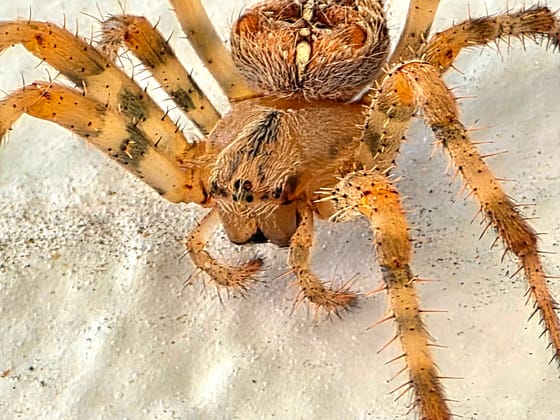
A giant house spider. Large, brown, fast, and the animal behind most alarmed phone calls in Whatcom County. WSU reports it outnumbers the hobo spider in the Puget Sound region and is far more frequently encountered.
A hobo spider. The one that inherited the recluse’s reputation in the Pacific Northwest, and which turned out not to deserve it either. That page goes through what the evidence actually showed.
A wolf spider. Hairy, striped, hunting on the ground, and the species most often compared to a recluse in national articles. It lacks the violin marking and has eight eyes rather than six.
The full list, in order of how likely each is in a house here, is in common spiders in Washington state.
How to tell, if you want to be sure
Three checks, in order of how much they are worth.
Count the eyes. A brown recluse has six eyes arranged in three pairs. Almost every spider in Washington has eight. On a sharp photograph this is visible, and it is the only one of these checks that is genuinely diagnostic.
Look at the build. A recluse is small — well under an inch of body — smooth, matte, uniformly tan, with long thin legs and no pattern on the abdomen. If your spider is big, hairy, banded, striped or stocky, it is not one.
Ignore the violin. The fiddle marking behind the head is the famous character and the one that causes the most trouble, because people find violins on spiders that have no markings at all, and because several harmless species have a darker patch in roughly that position.
If you have a wound
See a doctor about the wound, and do not let the spider become the story.
The Burke Museum lists what actually produces the lesions blamed on recluses: bacterial and fungal infections, lymphatic disorders, delayed hypersensitivity reactions, and bites from ticks and other blood-feeding arthropods. Several of those get materially worse during the weeks somebody spends waiting for a “spider bite” to resolve on its own.
Nothing here is medical advice, and we are not qualified to give any. What we can tell you is the entomology: if nobody saw a spider, the odds that a spider was involved are poor, and the odds that the spider was a brown recluse in Washington are effectively nil. That is worth saying to a clinician, and it is worth saying before a course of treatment is chosen rather than after.
If you did catch the spider, keep it. A specimen in a jar settles in seconds what a description argues about for weeks.
What we do about it
Nothing, because there is nothing to do, and we will say that on the phone rather than after a visit.
Where there is a real spider problem — heavy webbing in a garage, numbers in a crawlspace, a household where somebody is genuinely frightened — that is funnel weaver work and it is set out honestly on spider control, including what a treatment achieves and what it does not.
Where there is not, we would rather be the company that told you so. Send a photograph and we will identify it for nothing. The answer will almost always be that it is harmless, that it lives here, and that nobody needs to treat anything — and that is a better outcome for you than a quote.
Frequently asked questions
Are there brown recluse spiders in Washington state?
No. The Washington State Department of Health states that brown recluse spiders do not live in Washington. The Burke Museum, which holds the state's reference collection of well over a hundred thousand Washington spiders, has never had a Washington brown recluse in it. There is no established population anywhere in the state.
Could one have arrived in a shipment?
Occasionally, and it happens with a lot of species. A single spider traveling in freight or in somebody's belongings from the Midwest is not a population — it does not breed, it does not spread, and it does not change the answer for the house next door. Established is the word that matters.
My doctor said my wound was a brown recluse bite. Were they wrong?
Almost certainly about the spider, and quite possibly right about the wound needing treatment. The Burke Museum describes brown recluse bite as having become shorthand for an unexplained sore, and in Pacific coast states it considers essentially all such reports to be errors. The wound is still real and still worth treating.
Then what causes those wounds?
The Burke Museum lists bacterial and fungal infections, lymphatic disorders, delayed hypersensitivity reactions, and bites from ticks and other blood-feeding arthropods. Several of those get worse while somebody waits for a spider bite to heal, which is the practical reason this misidentification matters at all.
What is the spider I have then?
In this county, most likely a giant house spider or a hobo spider if it is large, fast and brown, or a cellar spider if it is long-legged and in a corner. All of them are harmless. Our guide to the spiders of Washington works through the realistic list in order of likelihood.
How do I tell a recluse from what we have here?
The eyes settle it: six in three pairs on a recluse, eight on nearly everything in Washington. The violin marking behind the head is the famous one and the least reliable, because people see violins on spiders that have no markings at all. Size helps too — a recluse is small.
Do you treat houses for brown recluse spiders?
No, and nobody honest in this state should. There is nothing here to treat. If you have a spider problem worth dealing with, it is a funnel weaver problem, and we would rather tell you that and quote the actual job than sell a treatment against a species that does not live here.
Spider Control in Whatcom County?
Family-owned, no long-term contracts, and every treatment is backed by our 100% Service Guarantee.
Most calls in Whatcom County are out within 1–2 days, about 3 during the late-summer peak.
Last updated