
Indianmeal Moth — Find the Package, Not the Room
Plodia interpunctella · Fabric and pantry pests
The Indianmeal moth is the pantry moth, and an infestation is a package rather than a building. Larvae spin silk webbing through stored food, then wander far from it to pupate, which is why cocoons appear at ceiling corners. Finding and discarding the source is nearly the whole job.
Call 360-410-2199 Request a free inspection
Rarely worth treating. Usually this is a sealing or cleaning job.
Indianmeal moth at a glance
| Size | A small moth with a wingspan of about half an inch |
|---|---|
| Wings | Two-toned: whitish gray on the inner portion, reddish brown with a coppery luster on the outer two-thirds |
| Larva | Pale caterpillar, whitish with a greenish, pinkish or yellow hue, around half an inch when grown |
| How to tell it from a clothes moth | Flies toward light and webs food; the clothes moth is plain gold or buff, shuns light and webs wool |
| Source | One infested package — often birdseed, dry pet food, dried decor or a forgotten bag of grain |
| Do we treat it | Rarely warranted — finding and discarding the source is nearly the whole job, and no spraying near food |
Signs you have them
- Silk webbing on the surface of grain, flour, cereal, seed or dried fruit, leaving it clumped or matted
- Small two-toned moths flying near a lamp, range hood or window in the evening
- Cocoons and pale caterpillars at the wall-ceiling junction or the top of a door frame, often far from food
- Webbing in the folds of a bag, or in a sack of birdseed or pet food in the garage
This is one package, not a house
An Indianmeal moth infestation is a container of food. It is almost never a building problem, it is almost never a hygiene problem, and it is almost never worth treating a room over.
That is the honest headline and it is worth stating before anything else, because the instinct when moths start crossing a kitchen in the evening is to think of the kitchen as infested. It is not. Somewhere in the house — and frequently not in the kitchen at all — there is a bag, a box or a sack with silk running through it, and clearing that one item does most of the work.
Kentucky’s extension guidance names the usual origin directly: partially used boxes or bags of product that have been forgotten at the backs of pantries and shelves. That is the shape of nearly every case.
Which is why the verdict at the top of this page reads as it does. This is a search and a cleaning job. We are happy to do the search, and where we do it the outcome is usually that a household throws out a sack of birdseed and puts the rest of the shelf into jars. That is a genuinely better result than a treatment, and it costs less.
The moth itself
Small, and unmistakable once you have looked at one properly.
UC IPM describes the forewings as reddish brown with a coppery luster on the outer two-thirds and whitish gray on the inner portion. Clemson gives the same two-toned pattern — reddish brown with a copper luster on the outer two-thirds, gray on the inner third — and a wingspan of about half an inch. Minnesota puts the wingspan at half to five eighths of an inch, with a pale gray or tan base to the front wing and the remainder reddish brown.
That sharp division across the wing is the identifying feature. Sitting still on a cupboard door the moth reads as two colors joined by a line, and no other small moth people meet indoors here looks like that.
The behavior matters as much as the color. These adults fly to light, which is exactly why they get noticed — a household sees them near a lamp, a range hood or a window in the evening and concludes the problem is everywhere in the house. The flying is real; the spreading is not. Adults disperse; the food source is still one container.
Adults are short-lived and their only job is reproduction. Clemson records females laying two hundred to three hundred eggs over one to eighteen days, so a single overlooked package produces a great many moths in a short time.
Webbing is the evidence
The insects are hard to see inside food. What they leave is not.
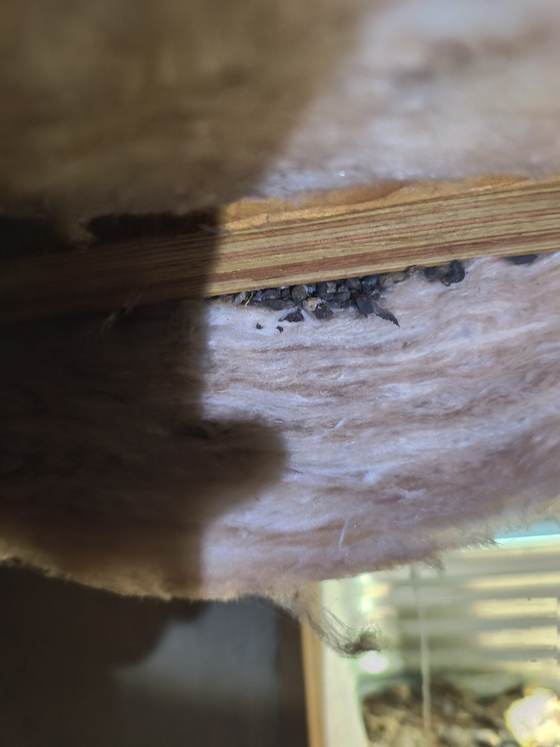
UC IPM says the larvae spin a web as they grow and leave behind silken threads. Minnesota describes silk webbing present on the surface of the product. Kentucky notes they produce silk webbing throughout the food source. Clemson adds that the larva weaves a tunnel-like case of frass and silk around itself as it feeds.
In practice that means infested grain, flour, cereal, seed or dried fruit looks slightly wrong before it looks obviously infested. Clumped. Stringy. Matted at the surface, or webbed into the folds of the bag. Tip a suspect bag into a pale bowl and the silk shows against the material immediately.
The larvae themselves are pale caterpillars. Minnesota calls them whitish worms with shades of yellow, pink, green or brown, growing to half an inch. Clemson gives a quarter to three quarters of an inch and notes the color varies with what they have been eating. UC IPM describes fully developed larvae at about half an inch, white with a greenish or pinkish hue.
Uninfested product has no webbing in it. That is the whole test, and it is far faster than looking for insects.
The wandering, and why people search the wrong place
This is the behavior that sends households in the wrong direction, and it is worth understanding because it saves an enormous amount of pointless searching.
When an Indianmeal moth larva finishes feeding, it leaves the food. UC IPM states that mature larvae can often be found in parts of the house far from the original food source because they move quite a distance to pupate. Minnesota says larvae often leave the food when mature and may move long distances before spinning a cocoon. Kentucky describes the caterpillar crawling away from the infested product to find a place to transform. Clemson notes it may travel a considerable distance away from its food source, and puts the pupal stage at fifteen to twenty days.
They crawl upward and outward. So the cocoons and the little pale caterpillars people find are on the junction of wall and ceiling, on the top edge of a door frame, along a picture rail, on the underside of a shelf lip, in a light fitting — routinely in a bedroom or a hallway with no food in it at all.
Two consequences follow, and both are useful.
Finding larvae far from food is normal. It does not mean the infestation has spread through the house. It means the larvae walked, which is what they do.
The location of the cocoons tells you almost nothing about the source. People strip and scrub the room where they found the cocoon and are baffled when it happens again. The source is wherever the silk-filled package is, which may be two rooms and one floor away.
Search for webbing in food. Do not search for caterpillars on ceilings, other than to confirm what you are dealing with.
Where the source actually hides
Kitchens get emptied first and the source is frequently not in the kitchen. In rough order of how often it turns out to be the answer:
Birdseed. This is the single most under-suspected reservoir on properties in this county, and it is usually a large sack in a garage or a shed that nobody has emptied to the bottom in a year. Kentucky and the Pacific Northwest handbook both name bird seed explicitly. If you feed birds, look here first, before you throw out a single thing from the cupboard.
Dry pet food. Same problem, same scale, same storage. Minnesota and the Pacific Northwest handbook both list pet food and treats.
Dried decorative material. Ornamental corn, seed pods, potpourri, dried flower arrangements, wreaths and craft supplies. Kentucky notes decorative ear corn as a common source for a related stored-product moth, and the principle carries. Nobody thinks of a dried arrangement as food and it is exactly that.
Spices, nuts and dried fruit. Whole spices, nutmeats, raisins, dates, dried apricot. UC IPM’s pantry pest list runs through nuts, dried fruit and confectionery, and these are the items households buy in bulk and then keep for years.
The bag at the back since last year. Flour, cornmeal, rice, oats, pancake mix, birdcage grit, bulk grain. Kentucky’s line about forgotten partially used packages describes this precisely.
Spilled material out of sight. Under a shelf liner, in the seam at the back of a cupboard, or in the shelf-support holes drilled into cabinet sides. A very small quantity of meal supports a population indefinitely.
Two further places worth checking in this county specifically: a chicken or livestock feed bin in an outbuilding, and a bag of grass seed or cover crop in a garage. Both are common on rural properties here and neither reads as food to the person who bought it.
It was probably in the package before you bought it
This is worth saying because people are embarrassed about these calls and they should not be.

Stored-product insects are introduced during processing, packing, warehousing, transport or retail storage, and the eggs are microscopic. A package can be sealed, undamaged and brand new and still carry the beginning of an infestation. Nothing about a household’s cleaning standards affects that. Minnesota’s explanation of how these insects get into packaging — chewing in, or crawling in through folds and seams — describes a route that is open at every point in the supply chain before you get there.
What household practice does change is what happens next: whether one introduced package stays one package, or seeds the whole shelf. That is a storage question, and it is answerable.
The season here
Development runs on temperature, and a heated Whatcom County kitchen is warm year-round, so this species never really stops.
UC IPM puts the complete egg-to-adult cycle at about six to eight weeks in warm weather, and Kentucky records a life cycle as short as twenty-five days. Clemson gives eggs hatching in seven to eight days and larvae feeding for six to eight weeks. Those are fast numbers compared with the fabric pests, and they are why a pantry situation escalates from a first moth to a room full of them in a couple of months.
The seasonal shape locally comes from storage rather than from weather.
Summer is the peak, because warmth accelerates everything and because it is when bulk buying and outdoor birdseed storage put the most material on properties.
Autumn brings the second wave, when feeders go back up, decorative dried material comes out and the garage fills. The Pacific Northwest handbook’s recommendation — not storing food longer than two months unless it is frozen — is aimed squarely at this.
Winter does not stop it indoors. An unheated garage in Ferndale slows a sack of seed down considerably, but a warm cupboard in the same house does not, and our mild winters never get cold enough to clear an outbuilding.
Late winter and spring is when households finally investigate, having watched moths cross the kitchen since the previous summer.
Around the county
Where the source turns out to be tracks the kind of property more than the town.
Rural and agricultural land — Lynden, Everson, Nooksack, Sumas. Livestock and poultry feed, seed stock, grain and bulk storage in outbuildings, all of it in quantities that make a domestic cupboard irrelevant to the search. On these properties the barn is the first place to look and the kitchen is the last.
Properties with feeders, which is most of the county. A sack of wild birdseed in a garage is the reservoir we find more often than any other single item, and it usually sits within a few feet of a door into the house.
Bellingham’s prewar neighborhoods — the Lettered Streets, Columbia, Sunnyland, York, South Hill. Deep original cabinets, shelf-support holes, gaps behind trim, and pantries with corners a modern kitchen does not have. The source is easy enough to find; the spilled material that keeps it going is harder.
Second homes and seasonal places around Lake Whatcom and out toward Blaine and Birch Bay, where a cupboard is stocked, left for months and opened again in spring. Time is the ingredient this insect needs and those kitchens supply it generously.
Anywhere with a craft or holiday storage box. Wreaths, dried arrangements and ornamental corn get put away in October and rediscovered in a cloud of moths.
Not the clothes moth, and not a weevil
Two separations worth making quickly.
Against the clothes moth, the tests are light and location. This species goes toward a lamp; the webbing clothes moth actively avoids light and hides when disturbed. This species is two-toned; that one is a plain gold or buff all over. This one webs food; that one webs wool. If there is silk in a cereal box, nothing about your wardrobe is at risk, and the reverse holds too.
Against beetles and weevils, the test is webbing again. Silk binding the contents together points to a moth. Fine sawdust-like debris in the bottom of a container, small round exit holes in individual grains or beans, and small brown beetles crawling at the top of a bag point at a beetle instead. The sawtoothed grain beetle is the flat one that turns up in flour and dried fruit, and the weevils that develop inside a grain are covered in our post on weevils in the pantry.
Both can be present at once in a cupboard that has been left alone long enough, and both are cleared the same way.
Clearing it out
The sequence matters, because doing it in the wrong order is how the “we threw everything away and it came back” case happens.
Find the source before you throw anything away. Check every container, including the ones that look fine, and check the four suspects — birdseed, pet food, dried decorative items, spilled material — before the kitchen shelves.
Take infested material out of the building, not into the kitchen bin.
Empty the cupboard and vacuum the structure. UC IPM’s advice is to use a crevice attachment in corners and cracks to remove eggs and pupae, then wash shelves with soap and water. The shelf-support holes drilled into cabinet sides are a standard harborage and are worth doing individually.
Treat what you are keeping. Minnesota gives a freezer at zero degrees Fahrenheit for at least four days, or an oven at one hundred thirty degrees for at least thirty minutes on shallow trays, and states those temperatures kill any eggs or insects present. Kentucky gives one hundred fifty-five degrees for about twenty minutes, or zero degrees for four days, specifically for decorative items and bird feed. The Pacific Northwest handbook gives three or four days in a freezer. Choose by what the item can survive: freezing suits food you will eat, heating suits seed and craft material.
Re-store in containers that seal. UC IPM specifies containers with tight-fitting lids rather than plastic bags, and says not to mix old food with new or refill an unwashed container. The Pacific Northwest handbook warns specifically against thin plastic bags of the supermarket produce variety. Glass, metal or rigid plastic with a gasket is the standard, and it is the single change that stops one introduced package from becoming a shelf-wide problem.
Freeze bulk purchases on arrival, as a habit rather than a response.
Then monitor. Pheromone traps catch adult males. UC IPM’s guidance is to place them where the infestation was, check weekly, and expect most traps to work for about three months. Falling catches over several weeks is a result; one empty trap is not.
Why nobody should spray your pantry
UC IPM is unambiguous, and we agree with it entirely: insecticides are not recommended for controlling pantry pests, and spraying pesticides on or near food may cause greater harm to a household than the pantry pests would.
That is a strong statement from a land-grant program and it deserves to be quoted rather than softened. The answer to an infested package is removal. The answer to a cupboard is a vacuum and a cloth. There is no product application that improves on either, and any proposal to fog or spray food storage is worth declining on the spot.
Where anything is applied at all in this kind of work, it is narrow crack-and- crevice application in cabinet structure, well away from where food sits — and even that is a supporting move after the source has gone, not a substitute for finding it.
When we are actually worth calling
The verdict on this page is rarely-warranted, and we mean it. Most households solve this themselves once they know where to look, and the pages you are reading exist partly so that they can.
There are cases where a visit earns its cost.
A source that will not be found. Two or three genuine rounds of searching, no webbing located, moths still flying. At that point a second pair of eyes and a methodical run through the outbuildings, the garage and the less obvious containers usually settles it in an hour.
A property with real storage. A farm building, a feed store, a large bird seed or grain reservoir, or a household with several outbuildings — where the number of candidate containers exceeds what one person will work through.
Commercial food handling. Restaurants, groceries, bakeries and food storage, where the same species arrives in deliveries and the answer is receiving inspection, stock rotation and monitoring rather than treatment. That is commercial work and it is a program rather than a visit.
Recurrence across seasons in a household that has genuinely done the storage work, which usually means a reservoir nobody has thought of yet.
What we will not do is book a treatment for a kitchen with moths in it. If the answer is the sack of seed in the garage, that is what you will be told, and the estimate that produced the answer is free.
Knowing when it is over
Because adults keep appearing for a while after the source has gone, households routinely conclude the clearance failed when it did not. A few markers help.
Expect a tail. Larvae already wandering in the structure when you emptied the cupboard will still pupate and emerge, and Clemson’s fifteen to twenty day pupal stage sets roughly how long that tail runs. Moths in week two are not proof of a missed source.
Watch the trap count rather than the sightings. A falling weekly catch over a month is the signal. A single moth seen in a hallway is noise.
No new webbing in anything you open. This is the strongest household test available, and it is worth deliberately opening and checking the containers you kept rather than waiting to find out by accident.
No fresh cocoons appearing at ceiling lines. Old ones stay stuck where they are, so scrape or vacuum the ones you find so that anything new is obviously new.
Judge it across a season. A pantry that is quiet in July and moth-filled again in September had a reservoir that was never located — most often outside the kitchen — and that is worth one more search rather than a treatment.
Where to start
Before you call, do three things.
Look for webbing and tell us where you found it, or that you have not found any. That is the fastest single piece of information.
Check the birdseed and the pet food before the cupboards, because that is where it most often is.
Leave the cocoons alone on the ceiling line — they confirm the identification and they cost nothing to leave for ten minutes.
Then, if you still want somebody to work through it with you, the service page is moth control, and the beetle side of the same cupboard is on beetle and pantry pest control.
Frequently asked questions
Why are there cocoons at my ceiling when the food is in a cupboard?
Because mature larvae walk. UC IPM notes that they can be found in parts of the house far from the original food source because they travel a considerable distance to pupate, and Minnesota's extension says the same. Cocoons on a ceiling line are normal behavior, not evidence that the infestation has spread.
We threw out the whole pantry and they came back — what did we miss?
Almost certainly one of four things: dry pet food, birdseed, a decorative item containing seed or dried botanicals, or spilled material under a shelf liner. Kentucky's guidance points at partially used boxes and bags forgotten at the backs of shelves, and those are exactly what survives a purge.
What does infested food actually look like?
Look for silk rather than insects. Minnesota describes silk webbing present on the surface of the product, and UC IPM says the larvae spin a web as they grow and leave behind silken threads. Grain or cereal that looks slightly clumped, stringy or matted together is the reliable sign.
Is this a moth that will eat my clothes?
No. It has no interest in wool, silk or fur, and it cannot digest keratin. Two questions separate the two problems: does the moth fly toward light, and is the webbing in food or on fabric. This species goes to light and lives in the kitchen; the clothes moth avoids light and lives in a dark closet.
What freezing time and temperature will clear an item I want to keep?
Minnesota gives a freezer at zero degrees Fahrenheit for at least four days, and Kentucky gives the same zero degrees for four days for birdseed and decorative items. The Pacific Northwest handbook's shorter figure is three or four days. Those temperatures kill the eggs, which is the stage nobody can see.
Can I heat something instead of freezing it?
Yes, for the right item. Minnesota gives an oven at one hundred thirty degrees Fahrenheit for at least thirty minutes on shallow trays, and Kentucky gives one hundred fifty-five degrees for about twenty minutes for decorative items and bird feed. Heat is better suited to bulk seed than to anything you plan to bake with.
Do pheromone traps get rid of them?
No, and it matters that nobody claims otherwise. They catch adult males and tell you whether the population is falling. UC IPM's advice is to place them where an infestation was and check them weekly, noting most traps stay effective for about three months. They measure the result; they do not produce it.
Does having pantry moths mean my kitchen is dirty?
It does not. These insects are routinely introduced already inside sealed packaging, before anything reached your house, and the most common reservoir on a property is a sack of birdseed in a garage. It is a storage and rotation issue rather than a cleanliness one, and people are needlessly embarrassed about it.
Sources
- UC IPM Pest Notes 7452 — Pantry Pests — read September 2, 2026
- University of Minnesota Extension — Pantry pests: Insects found in stored food — read September 2, 2026
- University of Kentucky Entomology ENTFACT-612 — Stored Product Pests in the Pantry — read September 2, 2026
- Clemson Cooperative Extension HGIC — Indian Meal Moth — read September 2, 2026
- Pacific Northwest Insect Management Handbook — Nuisance and household pests: Flour moth — read September 2, 2026
Rules change. This page is scheduled for review against its sources by September 1, 2027. If you are reading it after that date and something looks out of step with the current rule, the rule is right and we are wrong — please tell us.
Pest problem in Whatcom County?
Family-owned, no long-term contracts, and every treatment is backed by our 100% Service Guarantee.
Most calls in Whatcom County are out within 1–2 days, about 3 during the late-summer peak.
Last updated