Why Ants Invade Bellingham Homes Every Spring (And How to Stop Them)
Call 360-410-2199 Request a free inspection
Ants come inside in spring because warmer temperatures trigger colony expansion. Queen ants restart egg-laying, workers fan out to find food and moisture, and your home — with its warm walls, kitchen crumbs, and plumbing leaks — looks like a buffet. In the Pacific Northwest, this surge typically begins in late February and peaks between March and May. Your ant problem did not appear out of nowhere; it spent all winter building up just outside your walls, waiting for exactly this moment.
Why do ants come inside in spring?
Ants are cold-blooded insects, so their metabolism, egg-laying, and activity are all controlled by temperature. During winter, colonies do not die. They enter a dormant state: the queen stops laying, and workers cluster deep underground or inside wood, living off stored reserves. When soil temperatures rise into the 50s, the colony switches back on.
Here is what drives the spring invasion:
- The queen restarts egg-laying at full capacity
- Workers need protein and sugar to feed developing larvae, so demand spikes
- Mature colonies produce winged reproductives (alates) that swarm to start new colonies
- Workers expand foraging territory aggressively, covering far more ground than in summer
- Moisture-seeking behavior intensifies as scouts hunt for reliable water for the brood
Your home is often the most reliable source of warmth, moisture, and food for some distance around. When a scout finds food, she lays a pheromone trail back to the nest, and every worker that follows reinforces it. Within hours, you have a line. That is also why killing the ants you see rarely helps: a large odorous house ant colony can hold tens of thousands of workers and multiple queens, so the nest producing the 20 ants on your counter may contain thousands more.
Why are Bellingham springs especially ant-friendly?
The Pacific Northwest climate creates near-perfect conditions for spring ant activity:
- Mild, wet winters keep colonies alive and healthy, since deep freezes rarely kill them here
- Spring rain saturates the soil, driving ants upward and inward to find drier harborage
- Abundant organic matter like leaf litter, mulch, and landscaping provides nesting habitat right next to your foundation
- A slow, gradual warmup from February through April gives colonies weeks of prime foraging weather
- Older homes across Whatcom County often have the gaps, cracks, and moisture issues ants exploit
Which ants are invading Bellingham homes?
Identification matters because different species need different treatments. These are the ones we encounter most:

Odorous house ants
The tiny dark ants trailing across your kitchen counter, about 1/16 to 1/8 inch long, dark brown to black. Crushed, they smell like rotten coconut. They love sugary foods and moisture, nest in wall voids and behind baseboards, and are hard to control because of multiple queens and satellite colonies.
Pavement ants
Slightly larger and dark brown, with sandy nest mounds in driveway and sidewalk cracks. In spring they move indoors for protein and greasy foods. Their colonies respond moderately well to baiting.
Carpenter ants
The big ones — workers up to about 1/2 inch, with queens larger still — black or reddish-black. They do not eat wood but excavate it to build galleries, making them a structural risk in homes with moisture-damaged wood. Foragers are most active March through June and are sometimes confused with termite swarmers.
Field ants
Large ants often mistaken for carpenter ants. They build mounds in lawns and garden beds and forage indoors but rarely nest inside. Common on rural properties in Lynden and Ferndale.
A quick field rule: if a crushed ant smells like coconut or blue cheese, it is an odorous house ant. If it is the size of a sunflower seed and solid black, it is probably a carpenter ant.
How do ants get into your home?
Ants squeeze through gaps you can barely see. The most common entry points we find on Bellingham service visits:
- Foundation gaps and cracks, especially at corners and where the foundation meets landscaping
- Utility and pipe penetrations, since gas lines, conduits, cable lines, and hose bibs create gaps and often hold residual moisture
- Door and window frames with deteriorated weather stripping or shrunken caulk; even a 1/32-inch gap is enough
- Landscaping and mulch piled against the foundation, one of the single biggest risk factors
- Firewood and debris stacked against the house
- Attic and roof entry points at fascia boards, damaged soffit, and missing mortar around chimneys, which is why carpenter ants sometimes appear on upper floors
What works, and what doesn’t, for spring ant control?
Most homeowners reach for a can of spray first, and it usually makes things worse. Residual sprays kill foraging workers but not the queen, so the colony simply replaces them. Worse, odorous house ants often bud when stressed by pesticides, splitting into multiple satellite colonies and spreading the problem. Store-bought bait stations are frequently under-dosed or carry the wrong attractant for the species you actually have.
Effective control targets the queen and the colony. The professional approach involves several integrated steps:
- Identify the species, because protocols differ; getting this wrong wastes time and money
- Trace and map the colony by following trails to nest sites and checking moisture zones, attics, and crawl spaces
- Apply the right treatment, combining gel bait on active trails, granular outdoor bait, a residual perimeter barrier, and targeted spot treatments
- Seal entry points and remove harborage so new colonies cannot move in
- Follow up and monitor, coming back out and re-treating if activity continues
DIY prevention that actually helps
- Store all food, including pet food, in sealed containers
- Fix leaking faucets, pipes, and appliance connections
- Pull mulch and organic material at least 12 inches back from the foundation
- Store firewood off the ground and well away from the house
- Caulk cracks around windows, doors, and pipe penetrations with waterproof silicone
- Keep gutters clean and trim branches that touch the roofline
- Clean behind appliances and wipe counters daily during peak season, and caulk the gap between your countertop backsplash and the wall, a favorite kitchen travel corridor
When should you call a professional?
Not every ant requires a pro, but these are clear signals DIY has run its course:
- Treatments fail and ants return within a few days
- You see ants in multiple rooms or on multiple floors
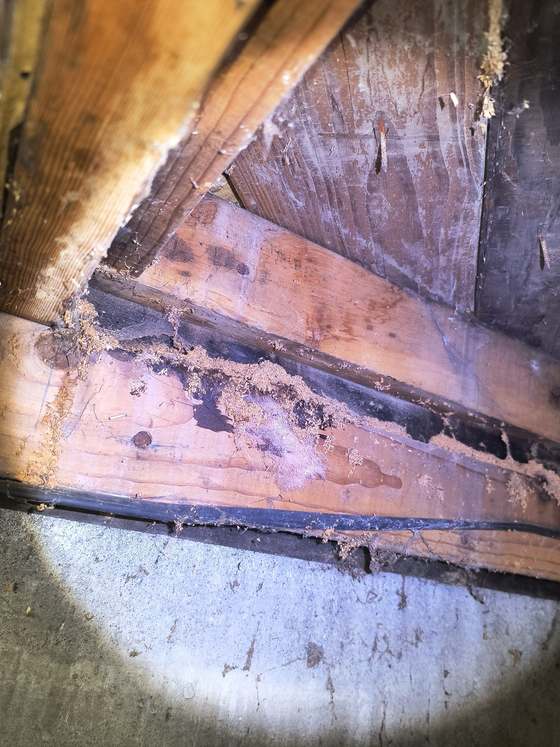
- You spot large black ants near wood structures, or sawdust-like shavings near baseboards
- The population keeps growing despite your efforts
- You find winged ants (swarmers) indoors
- The same problem returns for multiple spring seasons
Waiting tends to make ant problems harder to resolve. A colony that is modest in March can be several times the size by June, with satellite colonies through your walls. Early spring, when colonies are just ramping up, is actually the best time to treat.
Common questions about spring ant invasions in Bellingham
Why do I only get ants in spring and not other times of year?
Spring is peak invasion time because colonies transition from winter dormancy to full activity. Queens lay at maximum capacity and workers forage aggressively to feed larvae. By summer many colonies settle into stable territories, and in fall they store resources rather than expand. If you see ants in December or January, that suggests an indoor nest, which is a more serious situation than a seasonal invasion from outside.
Are the ants I see actually coming from inside my walls?
Possibly, but not necessarily. Most spring invasions start with outdoor nests and foragers entering through cracks. However, odorous house ants frequently establish satellite colonies in wall voids near moisture. If ants emerge from baseboards or around outlets, the nest is likely inside; if they trail in from under a door or window, it is more likely outside. Having someone come out and trace the trails settles it.
I’ve been spraying with store-bought insecticide for two weeks and it’s not working. Why?
Contact sprays kill the ants they touch but do nothing to the colony. Some species, particularly odorous house ants, respond to chemical stress by budding, splitting into multiple satellite colonies and actually increasing the number of trails you see. Stop spraying and switch to a slow-acting bait matched to your species, or call and have someone come out to identify what you have and treat it properly.
Is professional ant treatment safe for kids and pets?
Professional products are applied by trained technicians in targeted areas like ant trails, voids, and outdoor perimeters rather than broadcast across surfaces, and the baits we use are enclosed in stations. We always provide re-entry guidance. Controlled professional treatment involves far less product, in far fewer places, than the repeated heavy consumer spraying many homeowners resort to.
How long does professional ant treatment take to work?
It depends on species and approach. Contact treatments at entry points work within hours but only affect foragers. Colony-targeting baits take 5 to 14 days by design, since workers must carry the bait back to the queen before the colony declines. It is normal to still see ants for a few days afterward. Most homeowners see significant reduction within a week and a substantial drop within two to three weeks.
How do I tell winged ants from termite swarmers?
Ants have a pinched waist, elbowed antennae, and wings of unequal length. Termite swarmers have a uniform body width, straight antennae, and equal-length wings. Both swarm in spring, which is why they are confused. Finding winged ants indoors indicates an established colony nearby, and carpenter ant swarmers inside are worth having a professional come out and look at, because it usually means nesting somewhere in the framing.
Originally published on our previous website at
/why-ants-invade-homes-spring-bellingham/. Brought across August 31, 2026, with the text
left as it was written apart from corrections to anything that is no longer
accurate.
Related posts
- Why Do I Have Millipedes in My Home?
- Why Earwigs Are Invading Your Home (And What to Do About It)
- Why Wood-Boring Beetle Treatment Matters After Flooding, Before New Insulation Goes In
- Wood-Boring Beetles: A Silent Threat to Your Home
- Yellow Jackets: How Sasquatch Pest Control Can Help
- How Apartments and Rentals Should Handle Spring Pest Outbreaks in Bellingham
Pest problem in Whatcom County?
Family-owned, no long-term contracts, and every treatment is backed by our 100% Service Guarantee.
Most calls in Whatcom County are out within 1–2 days, about 3 during the late-summer peak.
Last updated