How to Identify Termites
Call 360-410-2199 Request a free inspection
Identifying termites in your home
Understanding the appearance and behavior of termites is useful for any homeowner in Bellingham, WA, and the surrounding area. Catching wood-destroying insects early is what keeps a small problem from becoming a structural one. Here is how to recognize what you are looking at.
Recognizing termite characteristics
Key features of termites:
- Size and shape: Termites range from about one-eighth of an inch to one inch long. They are often confused with ants but can be distinguished by their straight, beaded antennae and thicker waists.
- Color variations: Termites vary in color depending on the species and their role in the colony. Workers tend to be pale, soldiers have darker heads, and swarmers are darker, appearing brown or black.
Which termites actually live in western Washington?
Most termite information online is written for the South and does not describe what happens here. Whatcom County’s cool, wet climate produces a different picture from Texas or Florida.
Pacific dampwood termite. This is the termite of the Pacific Northwest and the one you are most likely to encounter around Bellingham. It is one of the largest termites in North America. As the name says, it needs wood with a high moisture content — framing wet from a leak, a rotting deck post, a sill plate sitting in a damp crawl space. It nests directly in the wet wood it eats and does not need contact with soil. In practice, a dampwood termite finding is a water finding: the insect follows the moisture.
Subterranean termites. The western subterranean termite is present in Washington but is genuinely uncommon in Whatcom County, and it is far more associated with the drier, warmer parts of the state east and south of here. It nests in soil and builds soil tunnels to reach wood. Do not treat the classic Southern advice about mud tubes and soil trenching as the starting point for a Bellingham home — that is not where our risk usually lies.
Drywood and Formosan termites. Both are frequently described in national articles. Neither is established in western Washington. Drywood termites are a warm, dry climate pest of the southern and coastal southwestern states, and Formosan termites are a Gulf Coast, Hawaii, and southern US problem. If an article tells you to watch for them in Bellingham, it was not written about Bellingham.
The wood destroyers that actually matter here
If you own a home in Whatcom County, the three things that damage structural wood in this climate, roughly in order of how often they turn up, are:
- Moisture-driven decay fungi — ordinary wood rot. Fungi need wood that is very wet to do real damage: well above the roughly 20 percent moisture content that is considered safe, and closer to the fiber saturation point around 30 percent before serious decay gets going. Persistently wet framing is the single most common cause of structural wood damage in this county.
- Carpenter ants — extremely common here. They do not eat wood; they excavate galleries in it to nest, and they strongly prefer wood that has already been softened by moisture. Their galleries are smooth and clean, and they push out coarse frass that looks like pencil shavings mixed with insect parts.
- Dampwood termites — less common than carpenter ants, and, like them, a downstream symptom of a water problem.
All three come back to the same root cause: water in the wood. That is why moisture control does more for a Bellingham home than anything aimed at the insects alone.
Mistaken identities: termites versus other pests
Termites versus ants. Termites have straight antennae and two pairs of wings of equal length, while ants have bent, elbowed antennae and forewings noticeably longer than the hindwings. Termites have a thick, uniform waist compared with the sharply pinched waist of an ant. This is the single most useful comparison to know, because in this county a swarm on a windowsill is far more likely to be carpenter ants than termites.
Termites versus carpenter bees. Carpenter bees are robust, with black and yellow coloration and a shiny, hairless abdomen. They are often mistaken for bumblebees and are substantially larger than termites. Like carpenter ants, carpenter bees do not eat wood — they bore into it to create nest galleries, which can look like insect damage of another kind.
Signs of wood-destroying insect activity
- Discarded wings. After swarming, termites shed their wings, which are often found near windowsills and doors. Equal-length wings point to termites; unequal ones point to ants.
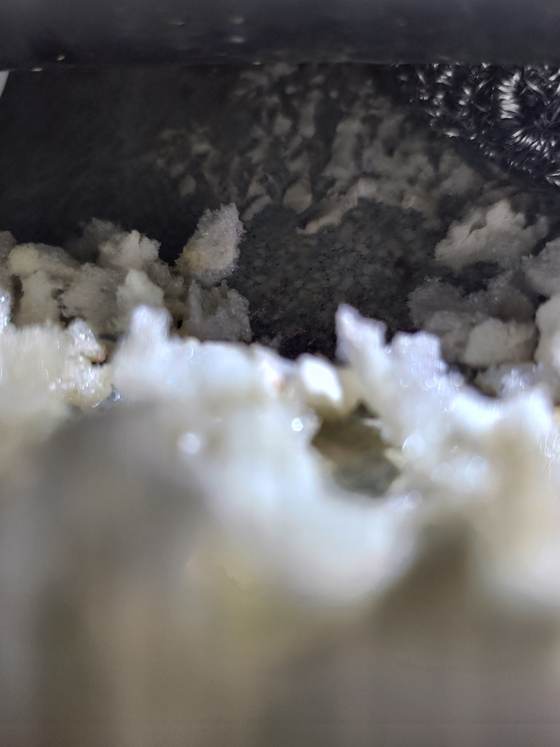
- Fecal pellets. Dampwood termites push small, hard pellets out of the wood, which accumulate below the infested area.
- Frass or coarse shavings. Carpenter ants push out sawdust-like debris mixed with insect fragments.
- Damaged wood. Wood that sounds hollow when tapped, feels soft under a screwdriver tip, or shows blistering paint over a damp area.
- Damp, rotting, or crumbling wood, particularly near leaks, gutters, crawl spaces, and anywhere wood touches soil.
What to do about it
If you are seeing any of the above, the useful next step is to find and fix the water. Repair leaking gutters, downspouts, and plumbing; get water moving away from the foundation; ventilate the crawl space and address standing water; break wood-to-soil contact at deck posts, stair stringers, and siding; and pull mulch and stored firewood back from the house.
Sasquatch Pest Control treats wood-destroying insects across Bellingham and Whatcom County. We will come out and take a look at the situation, talk you through what is going on and what treatment would involve, and give you a written record of any treatment we perform. No contracts, no scare tactics, and no hidden fees. Pricing depends on the property and the scope of the work, and we quote it after a visit.
Originally published on our previous website at
/how-to-identify-termites/. Brought across August 31, 2026, with the text
left as it was written apart from corrections to anything that is no longer
accurate.
Related posts
- Does Bellingham, WA Have a Termite Problem? What Homeowners Need to Know
- How to Know If You Have Bed Bugs in Bellingham (And What NOT to Do)
- Why Professional Pest Control is Essential for Identifying Rodent and Pest Activity in Your Home
- Keeping Your Home Pest-Free in Ferndale, WA: Top Tips
- Know Your Bees: Distinguishing Carpenter Bees from Bumblebees
- Ladybugs vs Asian Lady Beetles: Why They're Swarming Your Bellingham House
Pest problem in Whatcom County?
Family-owned, no long-term contracts, and every treatment is backed by our 100% Service Guarantee.
Most calls in Whatcom County are out within 1–2 days, about 3 during the late-summer peak.
Last updated