
The Complete Guide to Spider Control in Bellingham, WA
Call 360-410-2199 Request a free inspection
Bellingham and Whatcom County are home to dozens of spider species, and the vast majority are harmless and actually beneficial for controlling other insects. One — the western black widow — is genuinely medically significant, and it is uncommon on this side of the Cascades. The giant house spider is the one people actually meet, and it is startling rather than dangerous. A heavy indoor spider population usually signals an underlying insect problem feeding it, so effective spider control means addressing the spiders and their food supply together.
Spiders are one of the most consistent pest complaints in Bellingham, not because they are especially dangerous here, but because they are highly visible, they leave webs everywhere, and some are genuinely large and startling. If you have found a spider the size of a half-dollar in your bathroom at midnight, you already know why people call us. This guide covers the species you are most likely to see, which ones actually warrant concern, why spiders move indoors, and what real spider control looks like.
What spider species live in Bellingham and Whatcom County?
Most homeowners here encounter only a handful of species regularly.
Giant house spider (Eratigena duellica) — the big one
This is the spider most Bellingham residents call about. Females can reach a leg span of up to 4 inches and they move extremely fast in short bursts. They are brown to dark gray with a patterned abdomen, most visible in late summer and fall when males roam for mates, but active year-round indoors. Older references call this species Eratigena atrica, a name now treated as a doubtful catch-all rather than the correct one for our local spider.
- Habitat: Dark corners, basements, garages, closets, under furniture
- Behavior: Build funnel-shaped webs and wait at the narrow end for prey
- Danger level: None to minimal — venom is not medically significant in healthy adults
- Good news: They are effective predators of silverfish, earwigs, and other household pests
Hobo spider (Eratigena agrestis)
Closely related to the giant house spider and frequently confused with it. Medium-sized, brown, and also a funnel-web builder. Hobo spiders were once blamed for necrotic wounds, and that claim has not survived scrutiny — the studies behind it were later questioned and never replicated, the CDC removed the hobo spider from its list of venomous spiders, and the Washington State Department of Health states that hobo spiders are not considered dangerous as previously thought and that no evidence links their venom to skin necrosis. They tend to stay at ground level in garages, crawl spaces, and along basement walls.
They are also less common than the name suggests. WSU Extension reports that west of the Cascades the giant house spider outnumbers the hobo spider roughly three to one, and UC IPM records that the larger species has competitively displaced it across parts of the Pacific Northwest. Separating the two reliably means examining the reproductive structures under magnification — the chevron markings people go looking for are not used as a character by either WSU’s identification key or UC IPM’s pest note on the species.
Yellow sac spider (Cheiracanthium spp.)
Small, pale yellow to cream-colored, and they do not build traditional webs. Found on walls and ceilings, often in silk retreat tubes in corners. They are legitimate biters — one of the more common causes of spider bites in Washington — though their venom causes mild, localized pain and redness rather than serious symptoms.
Cellar spider / “daddy long legs” (Pholcus phalangioides)
The spindly-legged spiders that build messy, irregular webs in basement corners, garages, and crawl spaces. Completely harmless and actually beneficial — they prey on other spiders, including more problematic species. The myth that their venom is extremely potent is false.
Orb weaver spiders (family Araneidae)
The classic circular-web spiders, including the striking cross spider (Araneus diadematus) with its white cross marking. Primarily outdoor spiders that build large webs in gardens, on fences, and around exterior lights. They come inside accidentally or set up at entry points where flying insects gather.
Western black widow (Latrodectus hesperus)
The Washington State Department of Health describes the western black widow as common to eastern Washington, and that is the accurate shape of it: the range follows the drier, warmer country east and south of the Cascades, and Bellingham’s cool wet climate is close to the opposite of what the species wants. It is uncommon here rather than routine. Where one does turn up it is in a dry, sheltered spot — wood piles, under outdoor furniture, meter boxes, the undisturbed corners of garages and sheds. Females are glossy black with a red hourglass on the underside of the abdomen.
- Behavior: Slow-moving and not aggressive; bites usually happen when the spider is pressed against skin
- Danger level: This is the one local spider that is genuinely medically significant. A bite can cause severe pain, muscle cramping and other whole-body symptoms, and warrants prompt medical evaluation, particularly in children, older adults, and anyone with existing health conditions. Serious outcomes are rare and deaths are very rare, but a suspected bite should be looked at by a doctor rather than waited out.
The red hourglass sits on the underside, so you will not see it while the spider rests on its web above you. The spider is shiny black, globular, and about 1/2 inch in body length. If you find one you suspect is a black widow, do not handle it — call us and we will identify it.
Why do spiders come inside Bellingham homes?
Spiders do not seek out houses for their own sake — they follow their food. Understanding why they move indoors is the key to long-term control.
They’re following insect prey
Spiders are predators; they go where the food is. A home with active silverfish, earwigs, or flies attracts spiders to exploit that supply. A lot of spiders usually means a meaningful underlying insect population. Treating spiders without addressing their food source produces temporary results at best.
Exterior lighting concentrates flying insects
Standard white or warm-spectrum exterior lights draw flying insects in large numbers, and those insects draw spiders. That is why entry-adjacent lights are often the most heavily webbed areas of a home. Switching to yellow LED or sodium vapor bulbs reduces insect attraction considerably and, with it, web building.
Harborage and shelter
Spiders need shelter for retreats and egg sacs. Cluttered basements, stored cardboard, wood piles in garages, and dense landscaping against the exterior all provide harborage. Reducing clutter and vegetation contact reduces available habitat.
Mating season, not the cold
Sightings peak from late August through October, and the reason is not temperature. Spiders here overwinter outdoors perfectly well and are not moving in to get warm. What happens in those weeks is that mature males stop maintaining a web and start walking to find females, so animals that were sedentary and hidden become mobile and obvious. The Burke Museum, which holds the state reference collection for regional arachnology, adds a second reading worth knowing: house spiders are largely an indoor-adapted lineage, and generally fewer than five percent of the spiders seen indoors have ever been outdoors at all. Some of the September traffic walked under a door and some of it hatched in the building — either way the population was there beforehand, and the season ends on its own.
Moisture still matters, indirectly and year-round. Damp crawl spaces, basements and plumbing leaks drive the insect prey that spiders eat, and the spider count follows the insects.
What actually works for spider control in Bellingham?
- Reduce the food supply. A perimeter insect-barrier treatment that suppresses earwigs, silverfish, and flies cuts the spider food supply and reduces spider numbers, even without targeting spiders directly.
- Exterior web removal and perimeter treatment. Physically removing exterior webs plus a residual treatment at the foundation, entry points, and soffits disrupts harborage and creates a treated barrier. This is the most effective exterior approach.
- Interior treatment of problem areas. Applications in crawl spaces, basements, garage corners, and behind appliances target established populations, while targeted web removal pulls out egg sacs.
- Exclusion and harborage reduction. Sealing entry points, fixing screens, replacing worn door sweeps, and clearing exterior clutter limits access and keeps spiders from re-establishing.
- Lighting adjustment. Switching exterior entry lights to yellow LED reduces the insect concentration that draws spiders — an easy, chemical-free win.
The most common mistake is spraying surfaces where spiders walk with consumer insecticides. Spiders’ long legs hold their bodies off the surface, so they do not pick up contact residuals the way crawling insects do. Professional treatments use products chosen for effectiveness against spiders specifically.
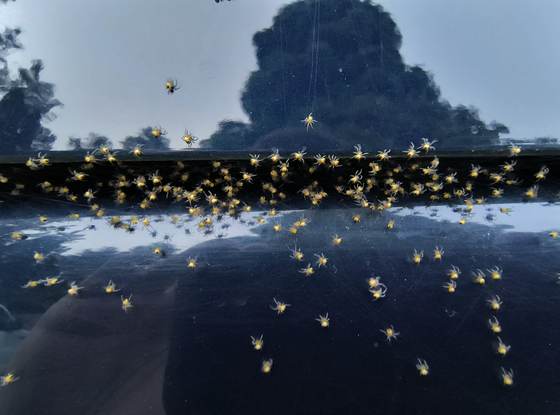
DIY spider prevention steps for Bellingham homeowners
- Sweep down exterior webs regularly — repeated removal discourages permanent establishment
- Switch exterior lights to yellow LED or sodium vapor
- Seal entry points: fix torn screens, replace worn door sweeps, caulk utility gaps
- Reduce clutter in basements, garages, and crawl spaces
- Move firewood storage away from the home — wood stacks are ideal black widow and giant house spider habitat
- Clear landscaping from direct foundation contact
- Vacuum egg sacs from corners, under furniture, and in closets
- Keep garage doors closed when not in use — garages are the primary interior harborage zone
Common questions about spiders in Bellingham, WA
Are there dangerous spiders in Bellingham, WA?
The one medically significant spider in the state is the western black widow, and the Department of Health describes it as common to eastern Washington rather than here — the range follows the drier country east and south of the Cascades, which makes it uncommon in Whatcom County and confined to dry sheltered spots like wood piles and undisturbed garage corners when it does occur. Giant house and hobo spiders, whatever their size suggests, are not medically significant. Yellow sac spiders can cause mild local reactions. If you find a small, shiny black spider with a globular abdomen in a dry sheltered location, treat it as a possible black widow and do not handle it.
Why do I see more spiders in fall in Bellingham?
Because it is mating season. Mature males leave their retreats and walk to find females, which turns hidden animals into visible ones over a few weeks. It is not the cold — spiders here winter outdoors without difficulty and are not seeking warmth. The ones crossing your floor in September and October have been in or around the building all summer, and by the Burke Museum’s account a large share of the house spiders you see indoors have never been outdoors at all. Treatment done in late summer, before the peak, is better timed than treatment done during it.
Are the giant spiders I see in my house really harmless?
Yes — the large brown spiders most homeowners encounter are giant house spiders, and they are not medically significant in healthy adults. They can bite if forcibly handled, but the venom does not cause serious symptoms. That said, “harmless” and “welcome” are different things; if large spiders in your living space are an ongoing quality-of-life issue, professional control is a legitimate and effective solution.
I found a black spider with a red marking. Is it a black widow?
Possibly, though the odds are against it here — the western black widow is a Washington species that the Department of Health calls common to eastern Washington, and it is uncommon west of the Cascades. The defining features are a small shiny black body, a globular abdomen, and a red hourglass on the underside. The false black widow, which is genuinely common in local garages and basements, is purple-brown rather than jet black and has no hourglass at all. Do not handle either; call us and we will identify it at no charge. If someone has been bitten by a suspected black widow, seek medical evaluation promptly, as symptoms can be delayed.
Why do I have so many spiders in my basement?
Basements offer stable temperature and humidity, low light, abundant harborage, and proximity to the insects spiders eat — earwigs, silverfish, isopods, and fungus gnats are all common basement prey. Addressing moisture, reducing clutter, and applying a professional perimeter treatment to the basement interior typically reduces spider numbers significantly.
Do ultrasonic spider repellers work?
No — there is no credible evidence that ultrasonic repellers meaningfully affect spider populations. Independent studies have found no significant reduction in pest activity. Physical exclusion, prey reduction, targeted treatment, and web removal are what actually work.
How long does professional spider treatment take to work?
Initial results appear within days as spiders cross treated surfaces. Reduced interior web-building and sightings are usually apparent within one to two weeks. Professional residual treatments typically hold up for 30 to 90 days depending on conditions, and if activity returns before then, call us and we will come back out.
Originally published on our previous website at
/spider-control-bellingham-wa/. Brought across August 31, 2026, with the text
left as it was written apart from corrections to anything that is no longer
accurate.
Related posts
- The Complete Spring Pest Prevention Checklist for Bellingham and Whatcom County Homeowners
- Stinging and Flying Insect Control in Whatcom and Skagit County
- Why Stink Bugs Invade Bellingham Homes Every Fall (And How to Keep Them Out)
- Does Bellingham, WA Have a Termite Problem? What Homeowners Need to Know
- Termite and Wood-Destroying Pest Control in Bellingham, WA
- The Blaine Peace Arch: A Symbol of Unity
Pest problem in Whatcom County?
Family-owned, no long-term contracts, and every treatment is backed by our 100% Service Guarantee.
Most calls in Whatcom County are out within 1–2 days, about 3 during the late-summer peak.
Last updated