Understanding Wasps vs. Yellowjackets
Call 360-410-2199 Request a free inspection
As we embrace the warmer months in Bellingham, Washington, not only do we start spending more time outdoors, but we also see an increase in stinging insects like wasps and yellowjackets. Both creatures emerge in the spring and remain active throughout the summer, thriving on the abundance of food and opportunities to reproduce. This can unfortunately lead to more human and insect interactions. But with so many types looking similar, how do you identify the ones to keep an eye on?
The Difference Between Wasps and Yellowjackets
Many of our customers ask, “Are wasps and yellowjackets the same thing?” The answer is nuanced. While all yellowjackets are wasps, not all wasps are yellowjackets. Wasps represent a large category of insects within the Hymenoptera order, which also includes ants and bees. Yellowjackets are a type of wasp known for their distinct black and yellow markings and smaller size compared to other wasps like the paper wasp.
Understanding these differences is crucial, especially when it comes to handling them around your home. Yellowjackets are particularly notorious for their aggressive nature and attraction to human food, which often brings them uncomfortably close to our living spaces.
Identifying Wasps, Yellowjackets, and Hornets
Distinguishing between these insects can be challenging, especially when they’re buzzing around. Generally, wasps have slender bodies with a narrow waist and are less hairy than bees. Yellowjackets, identifiable by their black antennae and yellow legs, are smaller and more aggressive than other wasps. They also tend to keep their legs tucked in during flight, unlike the dangling legs of a paper wasp.
European paper wasps, often mistaken for yellowjackets due to their similar appearance, are established here, are less aggressive, and generally only sting when provoked. The large hornet you are actually likely to meet in Whatcom County is the bald-faced hornet, which is not a true hornet at all but an oversized relative of the yellowjacket. It builds the gray, football-shaped paper nest you see hanging in a tree or under an eave, and it defends that nest vigorously.
Dealing with Nests: Prevention and Safe Removal
Encountering a nest can be alarming. Nests located above ground are likely home to non-yellowjacket wasps, like the paper wasp, while those underground or in hidden spots are typically yellowjackets’ domains. If you find a nest on your property, it’s essential to handle it with care.
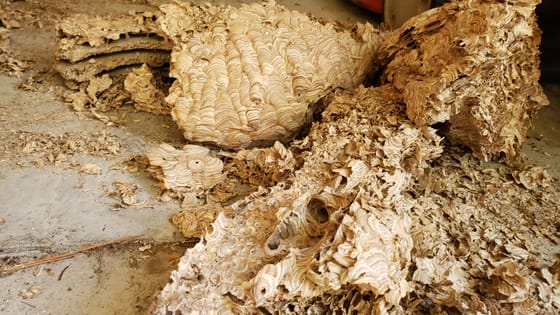
At Sasquatch Pest Control, we advise against tackling these situations on your own due to the potential danger. Our trained professionals are equipped with the expertise and tools to safely remove nests, minimizing the risk to you and your family. We understand the nuances of wasp and yellowjacket behavior, enabling us to provide effective solutions tailored to your situation.
Preventative Tips
To reduce the likelihood of wasps or yellowjackets setting up shop near your home, here are a few tips:
- Remove potential food sources from your property.
- Seal up cracks and crevices to deny entry into your home.
- Ensure garbage cans and compost piles are well-sealed.
- Regularly dispose of trash to avoid attracting these pests.
Your Safety is Our Priority
Discovering a wasp or yellowjacket nest near your home can be a stressful experience. At Sasquatch Pest Control, your safety is our priority. “No matter your pest problems, we Squatch your back!” Call us at the first sign of trouble, and let our experts handle the situation safely and efficiently.
Originally published on our previous website at
/understanding-wasps-vs-yellowjackets/. Brought across August 31, 2026, with the text
left as it was written apart from corrections to anything that is no longer
accurate.
Related posts
- Stinging and Flying Insect Control in Whatcom and Skagit County
- Dealing With Wasp Stings: What to Do First
- When Do Wasps Build Nests in Bellingham, WA? (And How to Spot One Early)
- Unwanted Buzzing: How to Locate the Best Beehive Exterminator Near You
- Weevils: The Tiny Troublemakers Hiding in Your Pantry
- What Is Integrated Pest Management (IPM) — And Why Sasquatch Uses It
Pest problem in Whatcom County?
Family-owned, no long-term contracts, and every treatment is backed by our 100% Service Guarantee.
Most calls in Whatcom County are out within 1–2 days, about 3 during the late-summer peak.
Last updated