Mud Dauber Wasps in Washington State
Call 360-410-2199 Request a free inspection
Mud daubers undergo complete metamorphosis, transitioning through four stages: egg, larva, pupa, and adult. In the spring, adult females emerge to construct their signature nests, which consist of mud tubes built in sheltered locations like under eaves, porches, garages, and sheds.
Each tube houses several paralyzed spiders — prey that the female mud dauber captures and stores as food for her larvae. She deposits an egg on the first spider in the nest, seals it with mud, and leaves the larvae to hatch and feed. After about three weeks, the larvae pupate, forming cocoons where they overwinter until they emerge as adults the following spring to start the cycle again.
Why Mud Daubers Are Beneficial
Unlike many other wasp species, mud daubers are solitary and do not live in colonies. There is no worker force, no queen to defend, and nothing that behaves like a yellowjacket nest. More importantly, they don’t defend their nests or exhibit aggressive behavior. A female will keep working while you stand and watch her, and stings are rare enough that most people who have mud daubers on the house never realize it. This makes them much less of a concern for homeowners compared to social wasps like yellow jackets or hornets.
Mud daubers provide natural pest control by preying on spiders. A single female packs dozens of them into her nest over a season, and orb weavers and other common yard spiders make up most of the haul. In warmer regions they are also known for hunting black widows, though that spider is not something Whatcom County homeowners generally run into. Adult mud daubers feed themselves on flower nectar and honeydew, so they do a modest amount of incidental pollinating along the way.
Identifying Mud Dauber Nests
Mud dauber nests are easy to identify by their shape. The species you are most likely to find in Washington is the black-and-yellow mud dauber, which builds a cluster of short mud tubes about an inch long, laid side by side and often plastered over into a single lump of dried mud. If you find a mud dauber nest with round holes in it, it likely means the nest is old and inactive, as these wasps chew their way out when they leave.
Should You Remove a Mud Dauber Nest?
Honestly, in most cases there is no reason to. The wasp is harmless, the nest is not going to grow into a colony, and the tubes are a cosmetic problem rather than a pest problem. If the look of them bothers you, an old nest can be knocked off with a putty knife and washed down with a hose — that is a five-minute job with a bucket of soapy water, not something that needs treating.
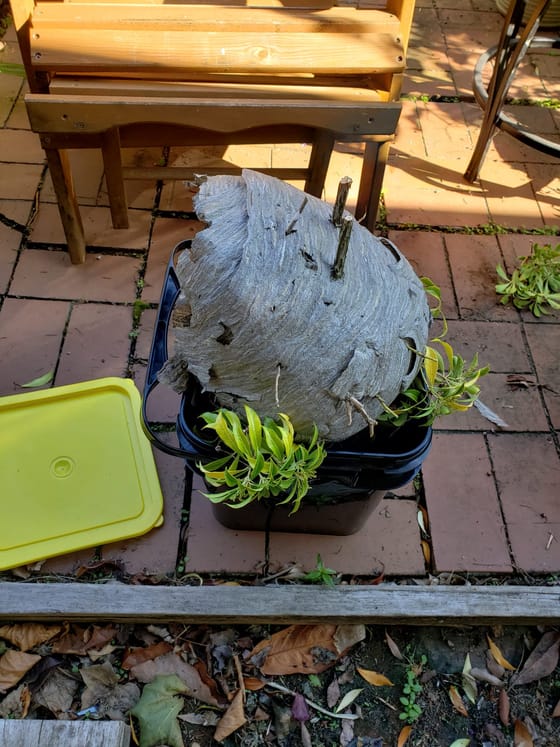
Two things are worth knowing before you scrape. First, wait until the nest is finished. Round exit holes mean the young have already left. Second, abandoned mud dauber cells are sometimes taken over by other wasps and bees, so if you see steady traffic at a nest you thought was empty, leave it alone and identify what is actually using it before you touch it.
The best way to discourage mud daubers from building near your home in the first place is to seal cracks and openings that give them shelter. This not only deters them but also helps prevent other pests from getting inside.
Need Help with a Wasp Problem?
At Sasquatch Pest Control, we prioritize safe and effective pest management, and part of that is telling you when a wasp does not need treating. Mud daubers usually don’t. If what you actually have is yellow jackets in the ground, a paper wasp nest over a doorway, or a bald-faced hornet nest in a tree, those are a different matter and we are glad to help. If you’re not sure which one you’re looking at, send us a photo or have us come out and take a look.
Originally published on our previous website at
/mud-dauber-wasps-in-washington-state-natures-non-aggressive-pollinators/. Brought across August 31, 2026, with the text
left as it was written apart from corrections to anything that is no longer
accurate.
Related posts
- What Does Pest Control Cost in Bellingham, WA? (An Honest Pricing Guide)
- Safeguarding Your Home: Our Services in Blaine, WA
- Pest Control for Ferndale Homes and Yards
- The Homeowner's Complete Guide to Pest Prevention in the Pacific Northwest
- Pest Trends in Whatcom County: Year in Review and What's Coming Next
- The Importance of Preventative Pest Control Services
Pest problem in Whatcom County?
Family-owned, no long-term contracts, and every treatment is backed by our 100% Service Guarantee.
Most calls in Whatcom County are out within 1–2 days, about 3 during the late-summer peak.
Last updated